Gua Sha: tools, strokes, skin, and hygiene
Study body Gua Sha as a traditional external method and learn to distinguish a skin response from injury.
Traditional framework
Traditionally it is associated with moving Qi and Blood at the surface. Traditional explanations and observable physiological responses should be presented separately.
History and language
What Gua Sha means and how it was transmitted.
Gua Sha literally means “scraping the sha”: deliberately producing a controlled skin response that tradition read as a pathogenic factor being brought to the surface. It began as a household technique — something a grandmother did with the edge of a spoon or a coin — linked to febrile illness and heat exhaustion, and only later entered the professional repertoire.
In classical texts the term sha names both the skin response and a whole group of acute conditions: the 1675 treatise “Sha Zhang Yu Heng” is devoted entirely to them. That double meaning explains much of the modern confusion, because “bringing out the sha” meant at once a maneuver and a theory of disease. The technique is not exclusive to China: Southeast Asia has its own versions with the same gesture and different cultural frames — which has created a real problem in host countries, where the marks have sometimes been mistaken for signs of abuse in pediatric emergency departments. Being able to explain what a Gua Sha mark is belongs to knowing the technique.
- Popular use linked it to fever, sunstroke, and heat exhaustion, with different household variants in each region.
- Sha names both the dotted skin response and a family of acute conditions described in texts such as the 1675 treatise devoted to them.
- Household and professional variants are not equivalent, either in pressure or in selection criteria.
- Southeast Asian sister techniques — cạo gió in Vietnam, kerokan in Indonesia — share the gesture and differ in cultural framing.
- Modern content should avoid vague formulations such as “removing toxins,” which describe nothing verifiable.
痧 · Shā The dotted (petechial) skin response that appears with scraping; in classical texts it also names a whole family of acute conditions.
Tools
Stone, ceramic, metal, and other materials.
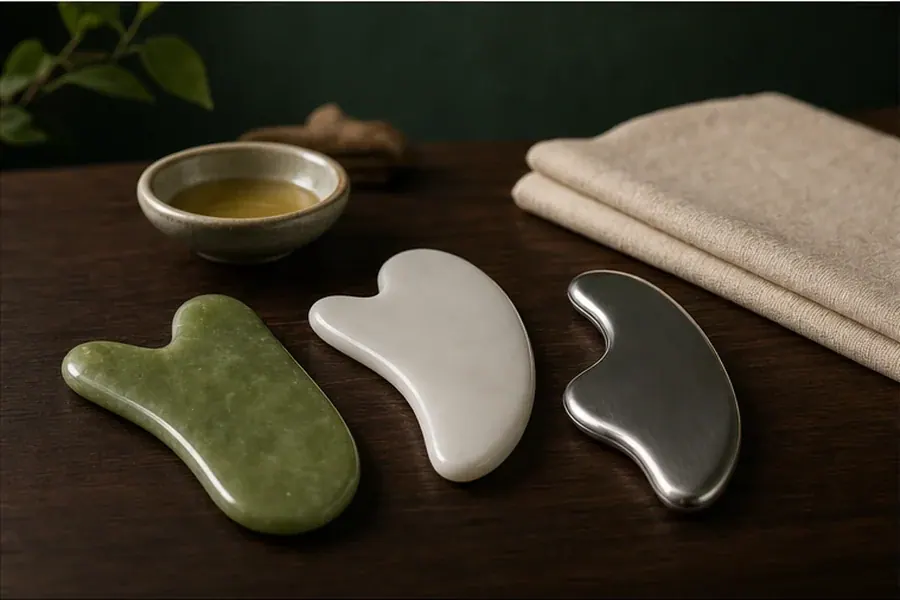
Any smooth edge can scrape; what distinguishes a tool is its geometry, its grip, and whether it can be cleaned. Buffalo horn, jade, or steel add no therapeutic properties through the material they are made of: they contribute weight, contact temperature, shape, and durability — which are already four relevant technical variables.
Shape matters more than material. A long straight edge covers broad areas such as the back; a curved edge fits the shoulder or the neck; U-shaped notches are used over elongated reliefs; rounded ends serve localized work. Edge thickness decides how pressure is distributed: a very thin edge concentrates and can injure, an overly thick one barely transmits. Traditional household use relied on porcelain spoons, coins, and jar lids, and that does not make them equivalent tools: what we require today — an intact edge, a disinfectable material, a reproducible shape — almost none of them meet.
- The working edge should be smooth, intact, and of intermediate thickness: very thin edges concentrate too much, very thick ones do not transmit.
- Shape is chosen by area: long and straight for the back, curved for shoulder and neck, rounded ends for localized work.
- The material’s weight and temperature change the sensation — a cold stone feels different from light plastic — but not the therapeutic effect.
- Material does determine something critical: whether it can be disinfected. Porous or cracked ones are ruled out for shared use.
- Tools are stored clean, dry, and protected from impacts: a fall can chip a stone edge in ways invisible to the eye.
Working edge The part of the tool that contacts the skin. It must be smooth, intact, of adequate thickness, and suited to the area being worked.
Preparing the skin and the session
Inspection, lubrication, and prior agreement.
Preparation decides the quality of everything that follows: inspected skin, sufficient lubrication, and a clear agreement about sensations and about the marks that will remain. The angle is studied from day one, because it is what separates scraping from scratching: the tool works tilted against the skin, never driven in perpendicular.
The usual reference is an angle between 15° and 45°. The flatter the tool, the more edge surface makes contact and the more the pressure spreads; the closer to vertical, the more it concentrates along a narrow line and the higher the risk of abrading. The lubricant is not an accessory: it is what lets the edge glide instead of drag, and there must be enough for the whole path — a neutral vegetable oil or a dedicated balm works, checking first for nut or ingredient allergies. It is removed afterwards, since it ends up mixed with shed skin cells.
- Skin is inspected first: wounds, eczema, recent sunburn, prominent moles, or irritation exclude that area.
- The reference angle is 15° to 45°: flatter spreads the pressure, more vertical concentrates it in a narrow line and raises the risk.
- Lubrication must last the whole path; if the tool starts to drag mid-stroke, lubricant is missing.
- Check for lubricant allergies before applying, especially with nut-based oils.
- The expected sensation is explained, the person is warned that visible marks will last several days, and a way to report discomfort is agreed.
Working angle The reference tilt of the tool against the skin, roughly between 15° and 45°. It determines whether pressure spreads or concentrates.
Body Gua Sha
Broad controlled strokes over soft tissue.
Body Gua Sha is organized in stroke paths: series of unidirectional, ordered, coherent passes over soft tissue, typically described downward and from the center outward. That system is not cosmetic: it lets you compare areas, dose deliberately, and avoid returning again and again to the same skin without noticing.
The classic study areas are the paraspinal musculature — on both sides of the spine, never over the processes — the trapezius, the scapular region, and the back of the arms and legs. Each pass runs some five to ten centimeters and the series overlap slightly, the way you would paint a surface, so no strips are left untreated and no lines are repeated excessively. The free hand has its own job: it stabilizes and gently tensions the skin ahead of the stroke, which makes the glide more even and reduces dragging.
- Direction stays constant within a series: you work one way and return to the start without contact.
- Reference passes run five to ten centimeters, and series overlap slightly to cover the area evenly.
- The free hand tensions and stabilizes the skin ahead of the tool: better glide, less drag.
- Do not scrape over bony prominences, the spine itself, broken skin, or areas with obvious varicose veins.
- On the neck, work the posterior and lateral muscular area, avoiding the front because of its vascular structures.
Stroke path A defined track of passes in a single direction over a specific area, with slight overlap between series.
Pressure, rhythm, and the limit
How much is enough and how to know when to stop.
The dose in Gua Sha is pressure multiplied by number of passes, and its limit is set by the skin itself: once the expected response appears, that area is done. The goal is never the darkest mark but a sufficient stimulus with the least possible damage — and understanding that difference is what separates technique from mistreating skin.
One clinical observation is worth holding from the start: sha appears quickly where it is going to appear. If an area does not respond after a correct series of passes, insisting will not make it respond — it will only irritate it — because the response depends on local capillary fragility and tissue state, not on persistence. So the progression is always the same: start at minimum pressure, complete a first series, assess, and decide. As a study reference, series are limited — on the order of ten to twenty passes per line — but that is guidance: the skin is in charge.
- Pressure increases progressively, always starting from the minimum and assessing the response after the first series.
- Each line receives a limited number of passes; exceeding it does not produce more sha, it produces more damage.
- Once the expected skin response appears, that area is left alone and you move to the next.
- If an area does not respond after a correct series, do not insist: the absence of sha is information too.
- Rhythm stays steady and free of jerks; abrupt pressure changes are what cause abrasions.
- Chasing a darker mark adds no value whatsoever and multiplies injury risk.
Scraping dose The combination of pressure, number of passes, and observed skin response. The skin sets the limit — not the clock, and not a fixed number.
Facial is not body Gua Sha
Different aims, pressure, and expectations.
Facial Gua Sha shares the name and the tool with body practice, but it is a different discipline: very light pressure, no sha sought at any point, with cosmetic and wellbeing aims. Confusing the two planes is the most widespread mistake outside professional settings, and the one that injures most people learning from videos.
All facial technique operates below the threshold that produces petechiae, which is why its key parameter is “sub-petechial pressure.” Strokes are described from the center of the face outward and upward, following the jawline, always supported on bone or muscle, avoiding the eyeball and working with particular gentleness over the thin skin of the lower lid. Facial skin also has its own pathology: inflammatory acne, rosacea, dermatitis, or recent dermatological procedures contraindicate the technique or require prior assessment, because dragging can spread lesions or worsen redness.
- Facial pressure always stays below the petechial threshold: if a mark appears, there was an excess.
- Strokes run from the center outward and upward, supported on bone or muscle.
- The eyeball is avoided entirely and the thin periocular skin is worked with maximum gentleness.
- Inflammatory acne, flaring rosacea, dermatitis, or recent dermatological procedures contraindicate or postpone the technique.
- Facial tools are usually dedicated and cleaned as rigorously as body ones, or more: facial skin is more reactive.
- No structural or medical changes are promised; the frame is cosmetic and wellbeing-oriented.
Sub-petechial pressure Working below the threshold that produces sha. It is the range in which all facial technique operates, without exception.
Skin response and injury
Observe, stop, and document.
Reading the skin is the central competence of this technique: distinguishing the expected petechial response from injury — abrasion, blistering, wounds, sharp pain, loss of sensation. The expected response does not hurt sharply and fades within days; injury demands stopping, assessing, and reviewing which parameter went too far.
Physically, sha is petechiae: pinpoint micro-extravasations appearing in clusters, which the skin normally reabsorbs over some two to five days, changing color like any bruise. Anything outside that picture deserves attention: a linear abrasion indicates a defective edge or missing lubricant; an area still tender to touch days later suggests excessive pressure; and extensive purpura disproportionate to the stimulus can be the first sign of unrecognized capillary fragility or a clotting problem — in which case the right move is referral, not a technique adjustment.
- The expected response is clustered petechiae, without sharp pain, reabsorbing over some two to five days.
- Sharp pain, bleeding, blistering, linear abrasion, or numbness are not goals: they signal excess or faulty technique.
- Extensive purpura disproportionate to the stimulus may indicate unrecognized capillary fragility or a clotting disorder: refer.
- Medication shifts the threshold: anticoagulants, antiplatelets, and long-term corticosteroids make it appear sooner and stronger.
- Documenting the response at the end allows comparison with what the person sees over the following days.
- Any lesion that persists or worsens requires medical assessment.
Petechiae Pinpoint micro-extravasations of blood in the skin: the physical substrate of what tradition calls “sha.”
Hygiene and contraindications
The tool directly contacts skin.
The tool touches skin that may carry invisible micro-lesions — indeed, the technique produces them — so reprocessing between people is not optional: mechanical cleaning first, then disinfection, both appropriate to the material. On top of that sit the general contraindications of friction techniques: damaged skin, vascular disorders, and any state that weakens tissue.
Order matters: first remove the lubricant and residue with soap and water, because no disinfectant works well on a greasy surface, and only then disinfect. That detail explains why wiping an oiled tool with an alcohol swab achieves nothing. As for contraindications, the criterion is again the mechanism: avoid it when the skin is not intact, when clotting is altered, when there is vascular pathology in the area — marked varicose veins, suspected thrombosis — and when a clinical situation calls for prior assessment, such as fever of unknown origin. In pregnancy the abdomen and lumbosacral region are excluded.
- Reprocessing has two phases: mechanical removal of lubricant and residue, then disinfection; skipping the first nullifies the second.
- Tools are not shared without full reprocessing, not even within a family.
- Avoid infection, wounds, burns, recent sunburn, flaring eczema, and areas with relevant vascular changes.
- Anticoagulation, antiplatelet therapy, thrombocytopenia, and fragile skin demand specific criteria and often abstention.
- In pregnancy the abdomen and lumbosacral region are excluded; with fever of unknown origin, postpone and refer.
- Porous or cracked materials are unfit for shared use even when they look clean.
Reprocessing A documented sequence of mechanical cleaning plus disinfection of the tool between uses and between people.
What the evidence says
Small studies have documented a transient increase in microcirculation in the treated area, which explains the visible response but does not by itself demonstrate clinical benefit. The available trials on neck or back pain are few, small, and impossible to blind — the mark identifies the group — so conclusions remain provisional. No evidence supports the idea that Gua Sha “removes toxins”: that formulation does not describe anything measurable.
Safety
Excessive pressure, damaged tools, or poor hygiene can injure skin. Facial Gua Sha should not be confused with body practice.
Test what you've learned
Tap each question to see the correct answer and its explanation.
1. What is an essential difference between facial and body Gua Sha?
- Facial practice uses much more pressure
- Facial practice should not seek strong marks
- Body practice never uses a tool
- There is no difference
Facial application is lighter and should not seek an intense skin response.
2. What signals that an area should be left alone?
- Thirty minutes have passed
- The expected skin response has appeared
- The mark is as dark as possible
- The practitioner is tired
The skin response marks the limit: continuing only adds injury risk, not benefit.
3. What is “sha” physically?
- Sweat retained in the skin
- Micro-extravasations of blood (petechiae)
- An allergic reaction to the lubricant
- Pigment released by the tool
The dotted response to scraping corresponds to petechiae: small capillary extravasations in the skin.
4. Why must tools not be shared without reprocessing?
- They lose potency
- Direct skin contact can transmit microorganisms
- They become blunt
- Their color changes
The tool touches skin directly; without cleaning and disinfection it can carry infection.
Health notice. Educational and study content. It describes concepts of Traditional Chinese Medicine and does not replace diagnosis or treatment by a healthcare professional. Needling, medicinal herbs and invasive techniques must be applied by trained professionals. Safety guide.