Moxibustion: mugwort, heat, methods, and burn prevention
Understand traditional moxa forms and the safety requirements related to heat, smoke, and skin.
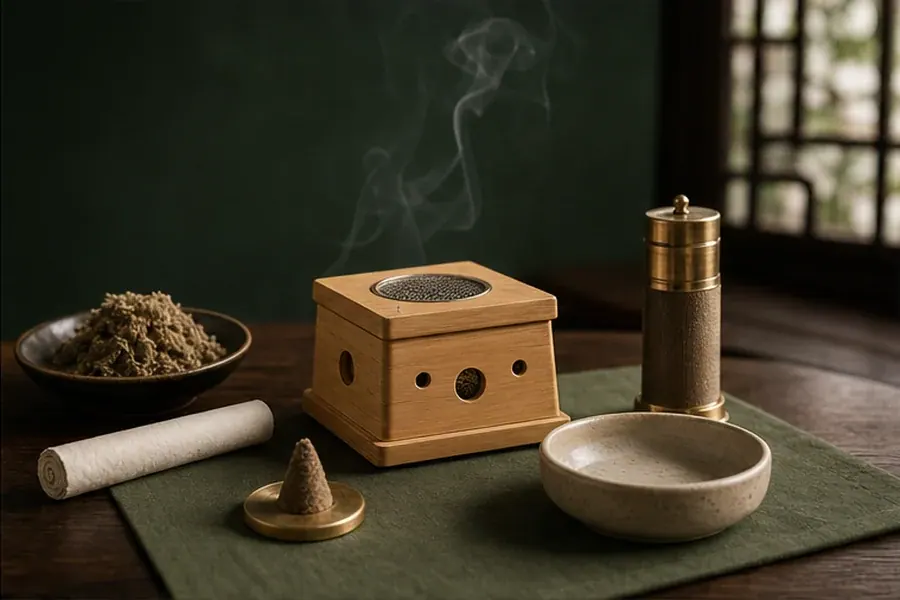
Traditional framework
Moxibustion is traditionally described as a method to warm, move, and support Yang. This terminology belongs to the TCM framework.
From mugwort to moxa
Processing, aging, and presentation.
Moxa is mugwort (Artemisia argyi) dried, aged, and sifted into a plant wool that burns slowly and steadily. That process is not decorative: it separates the fibers from the veins and dust, and what remains is a material that holds an even ember instead of bursting into flame. The entire technique depends on that property.
The degree of refinement is expressed as a ratio — 5:1, 10:1, 30:1 — indicating how many kilos of leaf were needed to obtain one of wool. Coarse wools, with more fiber, burn somewhat faster and smokier, and suit large cones and boxes; highly refined wools, almost golden and soft, burn more slowly and at a lower peak temperature, and tradition reserves them for delicate techniques and small cones. Aging — often three years or more — reduces the volatile oils and makes combustion more predictable, which is why classical texts insist on old moxa.
- The raw material is mugwort leaf harvested, dried, pounded, and repeatedly sifted until the fiber is separated from the rest of the plant matter.
- The refinement ratio (5:1, 30:1…) predicts behavior: the more refined, the slower the burn, the lower the peak temperature, the less smoke — and the higher the price.
- Aged moxa burns more evenly because it has lost part of its volatile oils: it is more predictable and therefore safer.
- Storage shapes the result as much as quality: dry, ventilated, and away from moisture, which makes it mold and turns it irritating.
- Provenance should be documentable; mugwort is not the only species sold as “moxa,” and substitution changes how it burns.
艾絨 · Ài Róng “Mugwort wool”: the sifted, aged fiber that is the base material of all moxibustion, in any of its formats.
Forms and supports
Sticks, cones, boxes, and indirect media.
The same material yields very different formats: the stick concentrates heat on a movable point handled at a distance, the cone builds it progressively to a peak and then declines, and the box spreads it over a broad area for longer. Studying the formats means studying how heat is distributed in space and time, and how much room for control each one leaves you.
Indirect methods place something between the ember and the skin, and that “something” has its own name in the tradition. In 隔姜灸 (ge jiang jiu) the cone rests on a perforated slice of ginger; in 隔蒜灸 on garlic; in 隔盐灸 the cone sits on salt filling the navel — a classic application over point CV8, which is never needled. The interposed medium does two things: it cushions the thermal peak and adds the aroma of the material. “Smokeless” formats of pressed charcoal cut particles but leave the thermal risk untouched: they are still an ember at hundreds of degrees.
- Moxa stick: the most controllable format for learning, because distance is adjusted continuously and it can be withdrawn instantly.
- Cone on an interposed medium: heat rises progressively to a peak and then falls; it must be removed before that peak if the person signals.
- Moxa box: spreads heat over a broad area for longer, at the cost of hiding the skin underneath the box.
- Adhesive moxa on a base: convenient, but stuck to the skin it offers no way to move away from the heat — the format with the least room to react.
- “Smokeless” means fewer particles, not less heat: ember temperature and the risk of burn or fire are equivalent.
壯 · Zhuàng The traditional dosing unit: each moxa cone burned over a point counts as one zhuàng. Classical texts prescribe “seven zhuàng,” “three zhuàng,” and so on.
Indirect moxa
Principles of distance, observation, and communication.
In indirect moxa the heat source never touches the skin: the stick is suspended at a distance, or a medium such as ginger or salt is interposed. The technique consists of sustaining pleasant, steady warmth for minutes, adjusting the distance to the area, the moment, and what the person reports. It sounds simple and is not: holding a stable stimulus demands continuous attention.
Tradition distinguishes three ways of handling the suspended stick, each producing a different sensation. In static moxa a fixed distance is held — on the order of two to three centimeters, always adjusted by perception — over one point. In “sparrow pecking” (雀啄灸, què zhuó jiǔ) the stick moves rhythmically closer and away, which raises perceived stimulus without raising the skin’s average temperature. In circling moxa (回旋灸, huí xuán jiǔ) the stick traces circles over a wider area, spreading the heat. Choosing between them is choosing how to distribute the stimulus, not how much to heat.
- Skin stays visible and is checked continuously: this is the only format where you can see in real time what is happening.
- The reference is pleasant, diffuse, sustained warmth; heat that “bites” or stings means moving away immediately.
- Distance is adjusted constantly because the ember advances and the stick shortens: a fixed hand position does not mean fixed heat.
- Accumulated ash insulates and deceives: remove it regularly into a safe container, or the real heat changes without your noticing.
- Heat sensitivity varies by person and area: the same distance burns on the inner arm and is barely felt on the back.
- A burning source is never left unattended, not even for a moment.
懸灸 · Xuán Jiǔ “Suspended moxa”: the stick is held at a distance from the skin, with height and movement regulating the intensity.
Areas, positioning, and dosage
Moxa “dosage” combines distance, time, and perception.
Thermal dosage is not a number: it emerges from distance, time, and reported perception. That is why moxibustion demands continuous dialogue — the warmth the person describes is the primary measuring instrument and the visible skin is the second. When either is missing, the technique loses its control system.
The expected response is mild, diffuse redness around the area, with a pleasant warmth that lingers afterwards. What is not expected: stinging or “biting” heat, pain, pallor at the center of the area, or any abrupt change in sensation. Positioning is part of the dose: if the person has to hold an uncomfortable posture they will move, and movement with an ember centimeters away is exactly the scenario that burns skin and clothing. So you choose a posture that can be held comfortably for the whole intended time.
- The three parameters interact: moving the stick closer forces you to shorten the time, and extending the time forces you to move it away.
- The posture is chosen so the person never needs to move: any movement with the ember nearby is a direct risk.
- Regions are not equivalent: thin skin — inner arm, abdomen, face — tolerates far less than the back or the glutes.
- The expected response is mild, diffuse redness; the goal is never an intense mark or a blister.
- With reduced heat perception — diabetic neuropathy, neurological injury, sedation, extremes of age — the safety margin disappears and abstention is usually indicated.
- Ask actively and periodically; waiting for the person to speak up is not enough, because many endure out of politeness.
Thermal dosage The combination of distance, duration, and reported perception. It is adjusted during the application according to the response, not fixed in advance.
Professional methods
Direct moxa and needle moxa.
Direct moxa places the cone on the skin itself, and needle moxa adds combustion to the handle of an already inserted needle. Both demand regulated training — ash control, removal within seconds, clear selection criteria — and are studied here to be recognized and understood, not reproduced.
Tradition distinguishes two forms of direct moxa: non-scarring (无瘢痕灸), where the cone is removed as soon as the person feels intense heat, and scarring (瘢痕灸), where it is allowed to burn down and produce a lesion that heals over weeks. The latter was historically considered a method of deep strengthening and is today exceptional and ethically contested in almost every context. Needle moxa, Wēn Zhēn Jiǔ, carries one very specific risk: incandescent ash can detach and fall onto the skin, so it requires a protective base beneath the needle and constant supervision.
- They are presented for study: recognizing the technique, understanding its risk, and knowing it exists — with no protocol applicable at home.
- Non-scarring direct moxa depends entirely on the moment of removal: a few seconds too long turns a stimulus into a burn.
- Scarring moxa deliberately produces a lesion with risk of infection and permanent scarring: it is exceptional and its ethical justification is disputed.
- Needle moxa requires protection beneath the needle against falling ash and a firmly stable needle.
- Both demand prior anatomical command and a clear, immediate way to interrupt the application.
- Regulation varies by territory and determines who may perform them and in what setting.
溫針灸 · Wēn Zhēn Jiǔ “Warm needle”: moxa burning on the handle of an inserted acupuncture needle, conducting heat along the metal toward the tissue.
Smoke, ventilation, and fire
Environmental safety is part of the method.
Combustion produces smoke, fine particles, and incandescent material, so environmental safety is not an add-on: it is part of the technique. Ventilation, fireproof containers, and verified extinguishing weigh as much as distance or time, and they are what separates trained practice from a house fire.
Moxa smoke contains fine particles and irritant compounds, and in an enclosed space it reaches concentrations that bother anyone and are clearly problematic for people with asthma, COPD, or respiratory hypersensitivity. Ventilating is not opening a window at the end: it is maintaining air renewal throughout the session. The other risk is fire, and it comes from a deceptive property of the material: a moxa stick can stay incandescent inside long after the surface looks out, so tossing it in a bin or storing it “because it stopped smoking” is exactly how incidents happen.
- Ventilate throughout the session, not just at the end, and ask beforehand about asthma, COPD, or respiratory sensitivity.
- Whoever applies moxa daily accumulates far more exposure than whoever receives it: ventilation protects the practitioner too.
- Ash is collected in a metal or ceramic container, never paper or plastic, and kept away from textiles.
- Extinguishing is verified actively: smother the stick in a closed container or sand and confirm no internal ember remains.
- Blowing on the ember does not put it out: it revives it and scatters incandescent particles.
- Check the rules of the space: many rented premises and buildings prohibit indoor combustion, and smoke detectors trigger easily.
Verified extinguishing Actively confirming that no internal combustion remains before storing or discarding the material — not merely the absence of visible smoke.
Skin and contraindications
Burn prevention and responsible selection.
All of moxibustion’s skin safety comes down to burn prevention: selecting well — intact skin, preserved sensation, ability to communicate — observing constantly, and stopping at any signal. An accidental blister is handled as what it is, a burn, and becomes a lesson by reviewing which parameter failed.
It helps to have the scale clear. Mild redness fading within hours is the expected response. A superficial burn leaves skin red and painful without a blister. When a clear-fluid blister appears, damage has reached the dermis: it is a partial-thickness burn and is managed as such — not popped, covered with a clean dressing, and monitored. If the blister is extensive, sits on a functional area such as hands or joints, or shows signs of infection, medical assessment applies. The highest-risk groups are always the same: those who cannot perceive heat well or cannot report it.
- Avoid damaged, recently scarred, or irradiated skin, areas with altered sensation, and sites with superficial implants or hardware.
- Stop at burning, pain, central pallor, or any unexpected skin change, without waiting to “finish the series.”
- A blister is not popped: cover it with a clean dressing and review it; popping opens a door for infection.
- A burn is an injury, never an expected therapeutic outcome, and must be recorded and communicated as such.
- Medical assessment applies to extensive blisters, those on hands, face, or joints, and any sign of infection.
- In diabetes with neuropathy, spinal cord injury, sedation, dementia, or extremes of age, heat perception is unreliable and abstention is usually indicated.
Partial-thickness burn A thermal injury reaching the dermis, showing as a clear-fluid blister. Protect it without popping and assess if it progresses or becomes infected.
Records and follow-up
What to note and re-check after every study session.
Follow-up separates trained practice from improvisation: check the skin when finishing and again at 24–48 hours, record parameters and reaction, and store the material dry and away from ignition sources. Delayed reactions exist, and they are only detected if someone actively looks for them.
Heat has one feature suction does not share: part of the damage shows up late. An area that was merely red at the end can develop a blister hours later, when nobody is looking at it. That is why the 24–48 hour check is not a formality, and why it is worth telling the person what to look for and whom to contact. In the record, the parameters that genuinely help are the ones that let you repeat or correct the session: format, area, approximate distance, duration, and observed response.
- Record moxa format, area, approximate distance, duration, and the response observed at the end.
- Check the skin when finishing and agree a review at 24–48 hours, because thermal reactions can appear late.
- Explain what is expected (redness fading within hours) and what is not (blister, increasing pain, persistent local heat).
- Store material cool, dry, in a closed container, away from textiles, paper, and any ignition source.
- Damp or moldy moxa is discarded: it burns unevenly and its smoke is more irritating.
- Increasing pain, blisters, discharge, or fever require medical assessment.
Delayed reaction A skin change appearing hours after the application, once the session is over. It is the reason for the 24–48 hour check.
What the evidence says
The most studied application is moxibustion at point BL67 for breech presentation: trials and reviews exist, but with heterogeneous results and highly variable methodological quality, so there is no consensus. For other indications the evidence is limited and studies are hard to compare, because “moxibustion” covers very different techniques — direct, indirect, on the needle — with doses that are almost never described reproducibly. What is best documented are the risks: burns, fires, and respiratory irritation from smoke.
Safety
Combustion can cause burns, fire, and respiratory irritation. Direct methods and needle moxa require professional training.
Test what you've learned
Tap each question to see the correct answer and its explanation.
1. What does “smokeless” moxa mean?
- It produces no heat
- It needs no supervision
- It reduces smoke but retains thermal risks
- It can be used anywhere
Lower smoke emissions do not remove heat, burn, or fire risks.
2. What is the correct response to an accidental blister?
- Pop it to relieve pressure
- Treat it as a burn and protect the area
- Apply more heat to “complete” the stimulus
- Ignore it if painless
A blister is a thermal injury: protect it without popping and seek assessment if it progresses.
3. Which combination defines “dosage” in indirect moxa?
- Application time alone
- Distance, duration, and reported heat perception
- The size of the moxa stick
- The color of the smoke
Dosage is not a fixed number: it combines distance, time, and the sensation the person reports.
4. What is a zhuàng (壯)?
- A type of mugwort
- The traditional unit: one cone burned over a point
- A forbidden area
- The bamboo support for moxa
Classical texts dosed moxibustion by counting zhuàng: cones burned per point.
Health notice. Educational and study content. It describes concepts of Traditional Chinese Medicine and does not replace diagnosis or treatment by a healthcare professional. Needling, medicinal herbs and invasive techniques must be applied by trained professionals. Safety guide.