Tuina: manual methods, ergonomics, regions, and professional limits
A structured introduction to Chinese manual therapy, its technical vocabulary, and safe method selection.
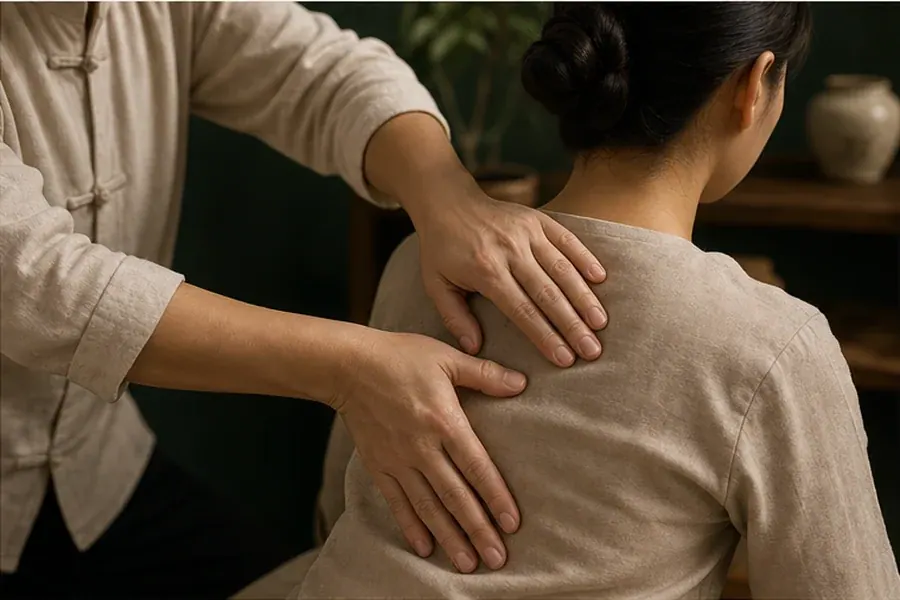
Traditional framework
Tuina combines manual methods, mobilization, and traditional channel and tissue frameworks. It should not be reduced to a universal symptom routine.
Tuina and An Mo
History, terms, and scope.
Tuina — push (tuī) and grasp (ná) — is Chinese medicine’s manual therapy system: dozens of codified methods, each with its name, its gesture, and its context of use. Its technical vocabulary is the doorway into the discipline, because the names describe concrete, reproducible actions rather than recipes for symptoms.
The oldest name is An Mo (按摩), “press and rub,” which already appears in the classics alongside daoyin practices. “Tuina” takes over much later, in Ming-dynasty texts, and interestingly it does so through the pediatric branch: treatises on children’s tui na from around 1600 popularize the term. Today the discipline is organized into schools with their own identity — the “one-finger meditation push” (Yi Zhi Chan), the rolling school (Gun Fa), the pediatric, and the orthopedic — each with characteristic methods and specific training. Knowing which family a method belongs to tells you more about how to perform it than any isolated description.
- Tuina groups families of manual methods and joint mobilizations, not a fixed sequence.
- An Mo is the historical name; “Tuina” spreads in the Ming dynasty out of the pediatric literature.
- The schools — Yi Zhi Chan, Gun Fa, pediatric, orthopedic — have their own repertoires and criteria.
- Names describe actions: whoever understands the gesture can recognize the method even when the context changes.
- Training combines observation, palpation, ergonomics, and safety; none of the four is optional.
法 · Fǎ “Method”: the suffix that turns a gesture into a codified maneuver — Àn Fǎ, Gǔn Fǎ, Róu Fǎ, Zhèn Fǎ…
Body mechanics
Protecting hands, shoulders, and back.
A practitioner’s hands are their working tool across dozens of sessions a week: body mechanics exists to protect them, and it is the content you appreciate most years later. Force arises from the feet and from body weight transmitted through a stable posture; the fingers direct and modulate the contact — they do not generate the force.
The force chain runs from the floor to the point of contact: feet planted and apart, knees slightly bent, trunk stable, shoulder relaxed, and an elbow that transmits rather than pushes. When that chain works, the practitioner can lean their weight in and increase pressure without gripping harder, which is exactly what preserves the small joints. Table height is part of the system: too high forces you to work with raised shoulders, too low strains the back. And there is a simple control test: if you cannot stop the maneuver at any moment without losing balance, you are using your weight badly.
- Force originates in the base of support and travels through the trunk: the fingers modulate contact, they do not create it.
- Table height shapes the whole mechanic: it is adjusted to the person working, not the person receiving.
- Rhythm and continuity matter as much as pressure: an irregular maneuver forces the tissue to keep readjusting.
- The practitioner’s breathing sustains rhythm and prevents tension accumulating in shoulders and neck.
- Contact surfaces are alternated — thumb, fingers, knuckles, thenar eminence, forearm — to spread the load across the day.
- Control test: the maneuver must be stoppable at any instant without losing balance.
Force chain The path support → trunk → arm → contact that replaces raw finger force and protects the small joints of the hand.
Structure of a study session
From initial assessment to gradual closure.
A study session has architecture: initial assessment, opening with general methods, specific work, continuous re-evaluation, and gradual closure. That structure teaches the hardest part of manual therapy, which is not performing a method but deciding which one, in what order, and when to stop.
The general→specific→general progression has both a physiological and a safety logic. The physiological: tissue tolerates specific work far better when it arrives warmed up and the person has already adjusted their tone to your contact. The safety one: general methods are your first real examination — while applying them you are palpating temperature, tone, tender areas, and reactions, information the prior conversation does not give you. Going straight to the painful spot is therefore not only more aggressive; it deprives you of the data you should have used to decide what to do.
- Every session starts with assessment: relevant history, observation, mobility, and gentle palpation.
- The general opening doubles as examination: it reports tone, temperature, and reactive areas.
- Specific work comes afterwards and is dosed by what the opening revealed, not by a pre-written script.
- Re-evaluate after each block: if something does not improve or worsens, change strategy rather than adding intensity.
- Continuous communication adjusts pressure and rhythm without interrupting the work.
- Closure is gradual, with lighter methods, and ends with a brief record of what was observed.
Re-evaluation Checking the tissue’s and the person’s response after each block of methods, before deciding the next one.
Pressing and kneading
An Fa and Rou Fa as study families.
An Fa (pressing) and Rou Fa (kneading) are the basic families of sustained contact: the first applies graded, held, perpendicular pressure; the second adds a circular movement that mobilizes tissue without lifting off the skin. Together they teach the essential competence of the whole discipline, which is grading.
The difference between Rou Fa and other circular methods lies in depth of action, and it is a distinction worth having crystal clear. In Rou Fa the hand and the skin move together over the deep tissue: there is no sliding between hand and skin, but displacement of the whole over the underlying planes. In Mo Fa (摩法), by contrast, the hand brushes the surface in circles without dragging the tissue: a far more superficial, sedating method, common on the abdomen. If your hand slides across the skin when you meant to do Rou Fa, you are not doing Rou Fa badly — you are doing a different maneuver.
- An Fa applies perpendicular, progressive, sustained pressure with gradual entry and exit — never abruptly.
- Rou Fa combines fixed contact and circular movement: hand and skin travel together over the deep tissue.
- Mo Fa is its superficial relative: gentle circles brushing the skin without dragging tissue, more sedating.
- The contact surface is chosen by area: thumb for focal work, thenar eminence or palm for broad areas, forearm for large masses.
- Pressure is held long enough for the tissue to respond: withdrawing as soon as resistance appears prevents any change.
- Unexplained acute pain is not worked on: first you need to know what is causing it.
按法 · Àn Fǎ / 揉法 Róu Fǎ Graded, perpendicular, sustained pressing / circular kneading moving hand and skin together, without sliding over the surface.
Rolling and rubbing
Gun Fa, Mo Fa, and related variations.
Gun Fa, rolling with the back and ulnar edge of the hand, is Tuina’s signature maneuver: it spreads considerable pressure over a broad area with a continuous, sustained rhythm. Its technical difficulty is real and acknowledged — traditionally it is trained for months on a rice bag before being applied to a person — and that requirement says a great deal about the discipline.
The gesture combines wrist flexion-extension with forearm rotation, so the contact rolls between the back of the hand and its ulnar edge without losing support. The classical cadence reference is around 120 to 160 cycles per minute, but what defines good execution is not speed: it is continuity, with pressure neither vanishing between cycles nor thudding on arrival. Alongside Gun Fa sit the friction methods: Ca Fa (擦法), a fast linear rubbing that generates surface heat and requires lubricant to avoid abrading, and Mo Fa, superficial circular friction. In all of them the rule is the same: the contact surface stays constant.
- Gun Fa combines wrist flexion-extension with forearm rotation: the contact rolls without lifting off the tissue.
- The reference cadence runs from 120 to 160 cycles per minute, but continuity matters more than speed.
- The wrist must stay loose: rolling with a rigid wrist turns the method into a series of blows.
- Ca Fa produces heat through fast linear friction and needs ample lubricant; it is not repeated over already reddened skin.
- Each method changes with the region: what works on the lumbar mass does not transfer unchanged to a shoulder.
滾法 · Gǔn Fǎ Rhythmic rolling with the back and ulnar edge of the hand, with a classical cadence reference between 120 and 160 cycles per minute.
Percussion and vibration
Pai Fa, Ji Fa, and Zhen Fa as rhythmic families.
The rhythmic methods — cupped-palm percussion, ulnar-edge tapping, and vibration — work through frequency more than pressure. They are studied last in the repertoire because they demand everything learned before: a stable rhythm, gesture control, a loose wrist, and very careful area selection.
Pāi Fǎ strikes with a cupped palm, and that hollow is not a cosmetic detail: the air cushion softens the contact and turns the blow into a wave that diffuses, rather than a point impact. Jī Fǎ taps with the ulnar edge or a relaxed fist and is more penetrating, so it is reserved for large muscle masses. Zhèn Fǎ, vibration, is the hardest of the three: it transmits a fine, sustained oscillation generated by forearm co-contraction, with no visible hand displacement, and it is the one that tires the practitioner fastest. The forbidden areas are common to all three: head, spine, kidney region, and any bony prominence.
- Pāi Fǎ uses the cupped palm: the air cushion diffuses the impact and prevents a direct blow to the tissue.
- Jī Fǎ, with the ulnar edge or a relaxed fist, is more penetrating and is limited to large muscle masses.
- Zhèn Fǎ transmits fine vibration from the forearm with no visible displacement: it demands control and tires quickly.
- Never percuss over the head, spine, kidney region, scapula, or bony prominences.
- Intensity stays low and rhythm constant: the training goal is frequency, never impact.
- The sound reports on execution: a hollow pop means a properly cupped palm; a dull slap means a flat one.
拍法 · Pāi Fǎ / 振法 Zhèn Fǎ Cupped-palm percussion / fine sustained vibration transmitted from the forearm with no visible hand displacement.
Mobilizations
Range, control, and end feel.
Mobilizations take joints through their available range: guided rotations (Yáo Fǎ), gentle traction (Bá Shēn Fǎ), and stretches. The rule is absolute and admits no nuance: work stays within the pain-free range, respects the end feel, and never chases a click. High-velocity techniques are outside this introduction.
The most useful information in a mobilization is not how far the joint moves but how the movement ends. A springy end feel, giving slightly and rebounding, suggests soft-tissue resistance and usually allows progressive work. A hard end feel, stopping dead, indicates bone contact or a structural block, and forcing there achieves nothing. A painful end feel, arriving before mechanical resistance, signals guarding or irritation: an indication to stop and assess, not to insist. Learning to tell those three endings apart is what turns mobilization into an assessment tool as well as a treatment.
- Yáo Fǎ mobilizes in guided rotation; Bá Shēn Fǎ applies sustained axial traction, always progressive.
- End feel tells you more than amplitude: springy allows work, hard does not, painful means stop.
- A painful range is never forced, and a joint click is never a therapeutic target.
- Prior mobility and the person’s neurological response determine what can be done and how far.
- High-velocity, low-amplitude techniques require specific regulated training and are outside this introduction.
- On the cervical spine, high-velocity mobilization carries documented vascular risks and is never improvised.
搖法 · Yáo Fǎ Guided rotational mobilization of a joint within its available range, at a slow rhythm with progressive amplitude.
Warning signs
When not to continue a method.
Red flags are manual work’s traffic light: findings that require stopping the technique and referring for clinical assessment. They are not rare exceptions appearing once a year but the first check of every session, and the difference between recognizing them and missing them is the only barrier separating safe practice from serious harm.
The list worth internalizing is short and concrete. Recent trauma with suspected fracture. Progressive neurological deficit: loss of strength, altered sensation, or reflexes. Signs of cauda equina compression — urinary retention or incontinence, saddle anesthesia, bilateral leg weakness — which constitute an immediate medical emergency. Night pain that does not ease with position change, unexplained weight loss, or fever. And, before any cervical work, symptoms of vertebrobasilar origin: dizziness, double vision, difficulty speaking or swallowing, unsteadiness. None of these findings is “adapted” by reducing pressure: they are referred.
- Recent trauma, visible deformity, loss of strength, or sensory loss require assessment before any technique.
- Suspected cauda equina compression — urinary retention, saddle anesthesia, bilateral weakness — is an immediate medical emergency.
- Night pain unchanged by position, unexplained weight loss, or fever call for referral, not manual treatment.
- Dizziness, diplopia, dysarthria, or unsteadiness during or after cervical work mean stopping immediately.
- Chest pain, breathlessness, or systemic symptoms are never addressed with a manual routine.
- Educational content does not replace clinical examination nor authorize you to rule a diagnosis out.
Red flag A finding that requires interrupting and referring for clinical assessment; it is not a reason to adapt the technique but a reason not to apply it.
Regions and precautions
Neck, abdomen, and joints need specific knowledge.
Each region sets its own conditions: the neck lives alongside superficial vascular and neurological structures, the abdomen holds viscera and situations such as pregnancy, and every joint has its own mechanics. Adapting method, position, pressure, and duration to the region — and to the age — is what turns a repertoire of maneuvers into safe practice.
In the neck, the anterior triangle is excluded from pressure work: the carotid, the jugular, and nerve structures that do not tolerate compression run there, so you work the posterior and lateral musculature. On the abdomen, avoid sustained deep pressure over the midline — where the abdominal aorta is palpable, especially in thin or older people — and exclude it entirely during pregnancy. Joints require knowing their physiological range before mobilizing. And the extremes of age change the whole frame: in older people skin is more fragile, bone may be osteoporotic, and tissue tolerates less; in children, pediatric Tuina is its own specialty with methods and points — linear and areal, not only punctual — that do not exist in the adult repertoire.
- Neck: work the posterior and lateral musculature; the anterior triangle is excluded because of its vascular and nerve structures.
- Abdomen: avoid sustained deep pressure over the midline and exclude it entirely during pregnancy.
- Joints: mobilize within the known physiological range, never exploring by trial and error.
- Osteoporosis and bone fragility contraindicate percussion and sharply limit sustained pressure.
- Anticoagulation requires reduced intensity because of hematoma risk, and a decision on whether to apply the technique at all.
- In pediatric and older ages, intensity and duration are systematically reduced.
小兒推拿 · Xiǎo Ér Tuī Ná Pediatric Tuina: a specialty with its own repertoire, including linear and areal points that do not exist in the adult system.
What the evidence says
Trials of Tuina in neck and low back pain suggest possible short-term relief, but methodological quality varies and comparison between studies is very hard: each protocol combines different methods for different durations, so “Tuina” does not name a single intervention. As with all manual therapy, it is difficult to separate the effect of the technique from the effect of touch, attention, and expectation. Serious adverse events are rare and are associated mainly with high-velocity cervical manipulation, which lies outside this introduction.
Safety
Manipulation in trauma, neurological deficit, vascular disease, or severe pain requires assessment and professional training.
Test what you've learned
Tap each question to see the correct answer and its explanation.
1. Which principle best protects a Tuina student?
- Use all force through the thumbs
- Force range to gain mobility
- Use stable posture and grade pressure
- Repeat the same sequence for everyone
Body mechanics, grading, and communication are foundations of controlled practice.
2. Which family of methods does Gun Fa belong to?
- Sustained static pressure
- Rolling over broad areas
- Fine sustained vibration
- High-velocity stretching
Gun Fa is the rolling method, traditionally trained on a rice bag before being applied to people.
3. In Rou Fa (kneading), how do hand and skin relate?
- The hand slides over lubricated skin
- Hand and skin move together over the deep tissue
- The hand taps the skin rhythmically
- The hand only brushes the surface
In kneading the contact neither lifts nor slides: hand and skin turn together, mobilizing the tissue beneath.
4. Which situation means a method must NOT continue?
- Pleasant local warmth
- Loss of strength or sensation
- Progressive muscle relaxation
- Calm breathing
Neurological deficits are warning signs: stop the method and refer for clinical assessment.
Health notice. Educational and study content. It describes concepts of Traditional Chinese Medicine and does not replace diagnosis or treatment by a healthcare professional. Needling, medicinal herbs and invasive techniques must be applied by trained professionals. Safety guide.