Abdominal cartography
Introduction to the abdomen as a correspondence zone in contemporary systems, distinct from classical Ren Mai and Kidney meridians.
History
Modern abdominal acupuncture is especially associated with Bo Zhiyun’s system, alongside other umbilical and traditional readings.
The map model
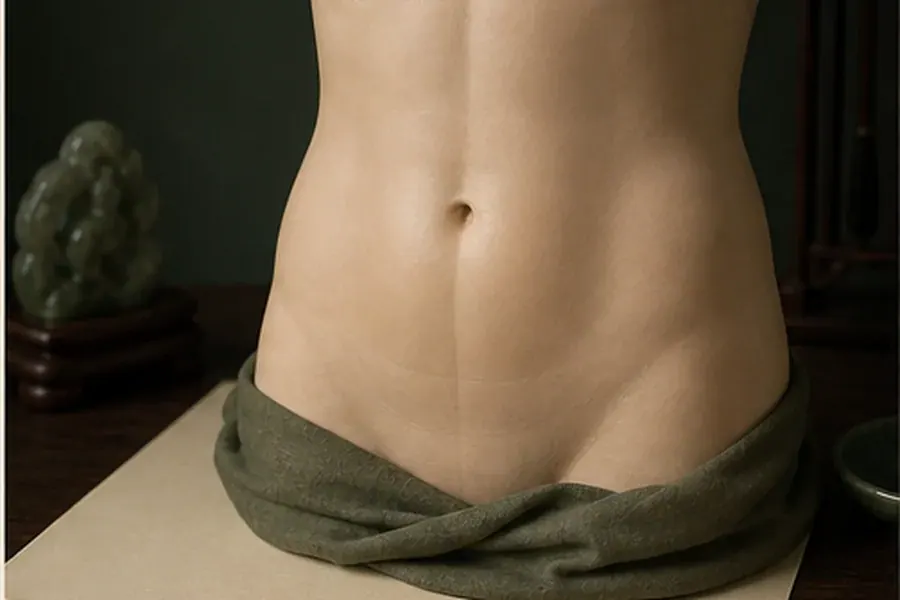
It uses the navel, midline, and proportional distances to construct a sacred-turtle and other correspondences. It is not an internal anatomy map.
Regions of the map
Visible center of the abdomen.
Geometric origin of several maps.
Do not interpret shape or color as diagnosis.
Surface line between sternum and pubis.
Ren Mai reference and correspondence axes.
Separate classical and modern nomenclature.
Area between costal margin and navel.
Upper projections in some models.
Symptoms in this area are not interpreted through the map.
Area between navel and pubis.
Lower fields and nearby classical points.
Pregnancy completely changes safety scope.
Areas on both sides of the midline.
Limb correspondences in certain maps.
Use proportional measures from the original standard.
What the evidence says
Clinical studies are limited and protocol-dependent. Correspondence models do not replace medical abdominal examination.
Safety
Never self-needle the abdomen. Severe pain, rigidity, bleeding, pregnancy, or acute symptoms require medical evaluation, not a microsystem map.
Health notice. Educational and study content. It describes concepts of Traditional Chinese Medicine and does not replace diagnosis or treatment by a healthcare professional. Needling, medicinal herbs and invasive techniques must be applied by trained professionals. Safety guide.