Scalp cartographies
An educational overview of major scalp lines and why standards should not be mixed without identifying their origin.
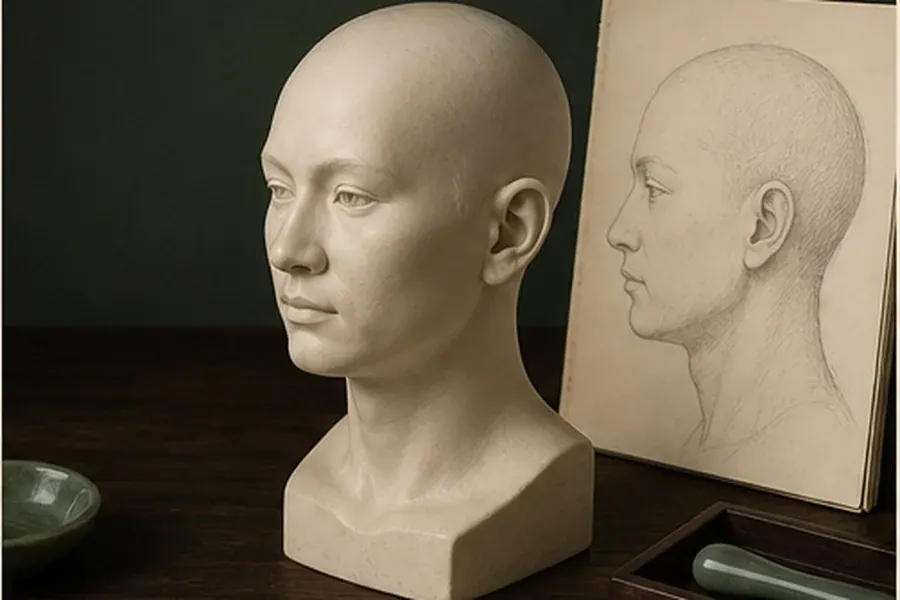
History
Modern scalp acupuncture took shape in China during the twentieth century and includes Jiao, Zhu, Lin, standardized lines, and other systems.
The map model
Maps use lines between cranial landmarks and functional projections. The same label may follow different paths across schools.
Regions of the map
Reference between glabella, vertex, and occipital protuberance.
Axis used to construct standardized lines.
Locate palpable bony landmarks first.
Area anterior to the approximate coronal suture.
Frontal lines with variable functional nomenclature.
Do not assume direct equivalence with a cerebral lobe.
Area around the highest point of the skull.
Intersection of midline and parietal lines.
Head position changes how the vertex is perceived.
Lateral area above the zygomatic arch.
Lateral systems and oblique lines by school.
Distinguish anatomical landmarks from functional names.
Posterior area around the occipital protuberance.
Posterior lines and balance references in some systems.
Always record the atlas and standard you use.
What the evidence says
Evidence must be reviewed by condition and alongside conventional rehabilitation. Mechanisms and protocols are not unified.
Safety
This is a professional invasive technique. The scalp is highly vascular and requires anatomy, asepsis, bleeding assessment, and emergency readiness.
Health notice. Educational and study content. It describes concepts of Traditional Chinese Medicine and does not replace diagnosis or treatment by a healthcare professional. Needling, medicinal herbs and invasive techniques must be applied by trained professionals. Safety guide.