The Five Elements
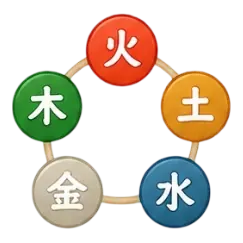
Wood, Fire, Earth, Metal and Water - the five fundamental processes of nature.
Introduction
Wu Xing (五行), literally "five movements" or "five phases", describes five archetypes of energy found throughout nature in continuous cycles of generation and control. Unlike the Western view of elements as static substances, in the Chinese worldview they are dynamic, relational processes. Wu Xing is first mentioned in the Book of Documents (Shang Shu, 11th century BCE) and reached its fullest medical development in the Huangdi Neijing (2nd century BCE).
Each phase corresponds to a broad set of associations: two organs (Zang and Fu), an emotion, a season, a flavour, a colour, a sound, a compass direction, an hour of the day, a body tissue and much else. This web of correspondences lets the Chinese physician identify imbalance patterns that span the patient's body, mind and environment at once. For instance, a patient with chronic anger, tight sinews, irritated eyes and irregular digestion in spring — every one of those signs points to the same phase: Wood/Liver.
The five phases relate through two fundamental cycles that keep the balance: the Generating cycle (Sheng, 生), where each phase nourishes and promotes the next (Wood → Fire → Earth → Metal → Water → Wood), and the Controlling cycle (Ke, 克), where each phase regulates and limits another, forming a five-pointed star (Wood controls Earth, Earth controls Water, Water controls Fire, Fire controls Metal, Metal controls Wood).
When the physiological cycles distort, two further pathological cycles appear: the Overwhelming cycle (Cheng, 乘), when a phase "crushes" the one it normally controls, through its own excess or the other's weakness — for example Wood/Liver in excess crushing Earth/Spleen, producing the typical combination of irritability plus digestive upset we see under stress; and the Insulting or Rebellion cycle (Wu, 侮), where the controlled phase grows so strong that it "insults" or turns on the one that normally limits it — for example a very strengthened Earth/Spleen starting to invade Wood/Liver. These two pathological cycles are crucial diagnostic tools in Chinese practice.
Key principles
- Generating cycle (Sheng): each phase nourishes the next like a mother her child. Wood (timber) feeds Fire; Fire produces ash that fertilises Earth; Earth concentrates and generates Metal (minerals); molten Metal produces Water; Water waters and nourishes Wood. In the body: the Liver (Wood) nourishes the Heart (Fire), the Heart nourishes the Spleen (Earth), and so on.
- Controlling cycle (Ke): each phase regulates and limits another, preventing excess. Wood penetrates Earth (roots hold the soil); Earth absorbs Water (dykes hold back floods); Water extinguishes Fire; Fire melts Metal; Metal cuts Wood. Without this controlling cycle any phase could become hyperdominant and pathological.
- Holistic correspondences: each phase shows up at every level of a person. The Wood phase corresponds to the Liver and Gallbladder (organs), the sinews (tissue), the eyes (sense), anger and frustration (emotion), sour (flavour), green (colour) and spring (season). These links are first-order diagnostic and therapeutic tools.
- Pathology between phases: when the controlling cycle reverses or becomes excessive, complex patterns appear. "Wood insults Earth" happens when a hyperactive Liver invades the Spleen/Stomach, producing irritability combined with disturbed digestion — a very common picture under modern stress. "Metal fails to control Wood" appears when a weakened Lung cannot regulate the Liver.
- Therapeutic application: in acupuncture, the phase points of each channel let you regulate relationships between organs. The Fire point of the Liver channel (LV-2) drains excess Heat from the Liver; the Mother point of the Lung channel (LU-9, Earth point) tonifies a deficient Lung by exploiting the Earth → Metal generating relationship.
Examples
- Wood 木 — Liver and Gallbladder: Wood energy is rising, expansive and creative like a shoot in spring. The Liver ensures the free flow of Qi throughout the body. Its imbalance produces anger, frustration, temporal headaches, muscular tension, premenstrual syndrome and irritated eyes. Treatment includes acupuncture at LV-3 (Tai Chong), vigorous physical movement and moderately sour foods such as lemon and plum.
- Fire 火 — Heart and Small Intestine: Fire energy is Yang at its peak: warm, expansive and bright like summer. The Heart houses the Shen (mind-spirit) and governs circulation. Its imbalance produces anxiety, palpitations, insomnia with vivid dreams, facial flushing and mental scattering. The point HT-7 (Shen Men, "spirit gate") calms the heart and anchors the Shen. The bitter flavour of coffee is cardiac-stimulating — useful in small doses, harmful in excess.
- Earth 土 — Spleen and Stomach: Earth energy is centring, nourishing and stabilising. The Spleen turns food into Qi and Blood, and the Stomach receives it and sends it down. Its imbalance produces excessive worry, fatigue, loose stools, circular thinking and difficulty assimilating — both food and emotional experience. Natural sweetness (carrot, pumpkin, sweet potato) moderately tonifies Earth; refined sugar damages it.
- Metal 金 — Lung and Large Intestine: Metal energy is descending, purifying and precise like autumn. The Lung distributes defensive Qi and regulates body water; the Large Intestine releases what is no longer needed. Its imbalance produces sadness, unprocessed grief, chronic cough, dry skin, constipation and difficulty letting go. Deep breathing practice, working through grief, and moderate pungent flavour (ginger, radish) strengthen Metal.
- Water 水 — Kidney and Bladder: Water energy is deep, cold and conserving like winter. The Kidney stores the Essence (Jing), governs development and reproduction, and is the root of Yin and Yang for the whole body. Its imbalance produces existential fear, low back pain, tinnitus, weak knees, hair loss and either copious or scanty urine. Cold is the Kidney's great enemy; protecting the lower back, sleeping enough and eating black foods (black sesame seeds, black beans) tonify it.
Practical applications
- Elemental self-diagnosis: identify which emotion predominates in your life right now. Irritability and frustration? → Wood/Liver. Anxiety and agitation? → Fire/Heart. Worry and circular thinking? → Earth/Spleen. Sadness and grief? → Metal/Lung. Fear and insecurity? → Water/Kidney. Each one tells you which phase needs attention.
- Eating by flavour: use flavours medicinally in small amounts. Sour (lemon, vinegar) moderately strengthens the Liver and astringes Qi. Bitter (green tea, milk thistle) drains cardiac Fire. Natural sweet (oats, sweet potato) tonifies the Spleen. Pungent (ginger, onion) disperses and moves Lung Qi. Salty (seaweed, miso) tonifies the Kidney. In excess, each damages its own organ.
- Seasonal syncing: adapt your lifestyle to each season. In spring (Wood): rise early, exercise outdoors, plan new projects. In summer (Fire): social activity, later bedtimes. In autumn (Metal): earlier to bed and earlier up, simplify life, cultivate gratitude. In winter (Water): conserve energy, sleep more, turn inward.
- The generating cycle as a therapeutic resource: if the Kidney (Water) is weak and the Liver (Wood) is suffering, instead of treating the Liver directly you can tonify the Kidney (the "mother") so it nourishes its "child" better. In acupuncture this is called "tonifying the mother"; in diet, adding foods that strengthen the Kidney (walnuts, black beans, black seeds) will indirectly benefit the Liver.
- Phase points in self-massage: massage the Yuan-source point of each phase daily. ST-42 (Chong Yang) for Earth; LU-9 (Tai Yuan) for Metal; KD-3 (Tai Xi) for Water; LV-3 (Tai Chong) for Wood; HT-7 (Shen Men) for Fire. Two minutes on each with firm circular pressure before sleep regulates the elemental balance.
Related concepts
Health notice. Educational and study content. It describes concepts of Traditional Chinese Medicine and does not replace diagnosis or treatment by a healthcare professional. Needling, medicinal herbs and invasive techniques must be applied by trained professionals. Safety guide.