Zang-Fu Organs
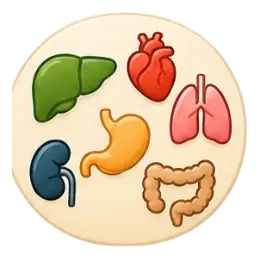
The 12 organs organized in Yin (Zang) and Yang (Fu) pairs.
Introduction
In TCM the organs (Zang-Fu, 臟腑) are integrated functional systems that go well beyond their physical anatomy. Each organ has specific physiological, psychological, emotional and spiritual functions, and relates to a coherent set of tissues, senses, emotions, colours, flavours, seasons and acupuncture points through the Five Phases system.
The six Yin organs (Zang, 臟) are solid and store vital substances without excreting them: Heart (Xin), Lung (Fei), Spleen (Pi), Liver (Gan), Kidney (Shen) and Pericardium (Xin Bao). To these is often added the Sanjiao (Triple Burner), a functional organ with no clear anatomical counterpart. The six Yang organs (Fu, 腑) are hollow and transform and transport: Small Intestine (Xiao Chang), Large Intestine (Da Chang), Stomach (Wei), Gallbladder (Dan), Bladder (Pang Guang) and Sanjiao (San Jiao).
Each Yin–Yang pair is linked by channels and forms one functional unit: Heart and Small Intestine, Lung and Large Intestine, Spleen and Stomach, Liver and Gallbladder, Kidney and Bladder, Pericardium and Sanjiao.
Key principles
- The Heart (Xin, 心): the "Emperor" of the organism. It governs Blood and the blood vessels, and is the seat of the Shen (mind-spirit-consciousness). The state of the Heart shows in the face (complexion colour and the brightness of the eyes). The emotions that disturb it are excessive joy and panic. Heart problems: insomnia, anxiety, palpitations, disturbing dreams, mental scattering and a red tongue tip. Key point: HT-7 (Shen Men).
- The Liver (Gan, 肝): the "General" of the army. It stores Blood and ensures the free flow of Qi throughout the body (the Shu Xie function, "to soothe and release"). It controls the sinews, ligaments and nails; it opens into the eyes. Anger, frustration and resentment are the emotions that damage it, and also the ones it produces when out of balance. The Liver is the organ most often affected in modern pathology by stress and suppressed emotion. Key point: LV-3 (Tai Chong).
- The Spleen (Pi, 脾): the "Minister of Transformation". It turns food into usable Qi and Blood, raises the pure Qi to the chest and holds the organs in place. It governs the muscles and limbs, and opens into the mouth (taste indicates the state of the Spleen). Excessive worry and circular thinking damage it. Spleen weakness — the root cause of many modern digestive problems — produces fatigue, loose stools, oedema, muscle wasting and prolapse. Key points: ST-36 (Zu San Li) + SP-3 (Tai Bai).
- The Lung (Fei, 肺): the "Prime Minister". It governs Qi and breathing, distributes fluids and Wei Qi over the body surface, and sends Qi down to the Kidney. It controls the skin and body hair; it opens into the nose. Sadness and unprocessed grief weaken the Lung. Signs of a weak Lung: chronic cough, low voice, spontaneous sweating, dry skin, frequent colds and extreme sensitivity to wind. Key points: LU-7 (Lie Que) + LU-9 (Tai Yuan).
- The Kidney (Shen, 腎): the "Root of Life". It stores Jing (Essence), is the source of Yin and Yang for the whole body, governs water (fluid distribution) and the reception of Qi (the Lung sends Qi down and the Kidney "anchors" it). It controls the bones, marrow and hair; it opens into the ears. Fear is its associated emotion. Signs of deficiency: low back pain, tinnitus, hair loss, weak knees, frequent night urination and reduced libido. Key points: KD-3 (Tai Xi) + KD-1 (Yong Quan).
- The Pericardium (Xin Bao, 心包) and the Sanjiao (San Jiao, 三焦): the sixth Yin–Yang pair. The Pericardium is the "protective wrapping of the Heart" — a shield against pathogens and emotional assaults that could otherwise strike the Heart, its "Sovereign", directly. Clinically the Pericardium shares many functions with the Heart (it rules circulation and the Shen) and its points are fundamental for anxiety, palpitations and nausea: PC-6 (Nei Guan, "inner gate") is one of the most powerful points in all of acupuncture. The Sanjiao (Triple Burner) is the only Fu organ with no single anatomical counterpart: it represents the system that communicates and distributes Qi and fluids between the three "burners" of the trunk. The Upper Burner (above the diaphragm: Heart and Lung) governs breathing and circulation — compared to a "mist" that sprays. The Middle Burner (diaphragm to navel: Spleen and Stomach) governs digestion — compared to a "bubbling cauldron" that transforms. The Lower Burner (below the navel: Kidney, Intestines, Bladder) governs excretion and reproduction — compared to a "drainage ditch" that filters. The Sanjiao regulates water metabolism throughout the body; its obstruction produces oedema, difficult urination and distension. Key Pericardium point: PC-6 (Nei Guan). Key Sanjiao point: SJ-5 (Wai Guan, "outer gate") — the partner of PC-6 and the main Yang point of defence and communication.
Examples
- The Heart and the Shen (mind-spirit): The Shen of the Heart covers what we call mind, consciousness, memory and emotional intelligence. When the Shen is well anchored by Heart Blood, a person has mental clarity, restorative sleep, the capacity to connect emotionally and proportionate responses. When there is Heart Blood deficiency or Heart Heat, the Shen becomes "disturbed": insomnia, anxiety, crying for no apparent reason, mental hyperactivity at night or, in severe cases, delirium and psychosis.
- The Liver and emotional Qi flow: The Liver ensures the free flow of Qi in every dimension: physical (smooth movement of fluids, regular digestion) and emotional (the capacity to process and release feeling). In TCM, emotions are not "stored" in the Liver as in Western psychoanalysis; rather, stagnant Liver Qi prevents free emotional circulation, creating repression. Regular physical exercise (especially running and moderate-impact sport) is the best mover of Liver Qi.
- The Spleen and emotional "earth": The Spleen does not only digest food — it digests experience. Excessive worry, circular thinking (modern "rumination") and the inability to "digest" difficult experience weaken the Spleen as much as a poor diet does. People with a weak Spleen tend towards hypochondria, worry and difficulty finding their "centre". Meditating, establishing stable routines and practising gratitude also tonify the Spleen.
- The Kidney and the life–death axis: The Kidney houses the "Ming Men" (Gate of Destiny or Fire of Life), the deepest Yang in the body, which warms every vital process. Without the Ming Men no organ can function. Existential fear of emptiness, of death, or of total loss of control exhausts Kidney Yang. That is why people with chronic fear feel cold (especially in the lower back and knees), urinate frequently and carry a deep sense of ontological insecurity.
Practical applications
- Basic organ self-assessment: check these indicators regularly. Are your eyes bright or dull? → Liver. Is your complexion vivid or drab? → Heart and Spleen. Is your skin hydrated or dry/eczematous? → Lung. Are your nails strong or brittle/without lunulae? → Liver and Blood. Do your ears ring or is your hearing fading? → Kidney. These "organ mirrors" let you monitor your internal state with no technology at all.
- Organ-specific foods by colour (Five Phases): red/bitter → tonifies the Heart (cooked tomato, blueberries); green/sour → tonifies the Liver (sprouts, lemon); yellow/sweet → tonifies the Spleen (carrot, pumpkin); white/pungent → tonifies the Lung (turnip, ginger); black/salty → tonifies the Kidney (seaweed, black sesame). Including something of each colour in the daily diet is the simplest practical application of the Five Phases.
- Emotions and organs — a self-regulation protocol: when you notice one emotion predominating, identify the related organ and act. Anger/Liver → physical activity + side stretches + mint or chamomile tea. Anxiety/Heart → 4-7-8 breathing + self-massage of HT-7 + hawthorn infusion. Sadness/Lung → deep breathing + gentle exercise + time in nature.
- Massaging the Mu and Shu points of each organ: the Mu ("alarm") points on the front of the trunk and the Shu ("associated") points on the back are the alarm and nourishment points of each organ. Massaging the corresponding area gently is both diagnostic (if it hurts, that organ may be out of balance) and therapeutic. BL-23 (Shen Shu) for the Kidney, BL-18 (Gan Shu) for the Liver, BL-20 (Pi Shu) for the Spleen, BL-13 (Fei Shu) for the Lung.
- The "Great Point" of the Stomach, ST-36: four fingers below the kneecap and one finger lateral to the tibial crest. The ancients called it "Zu San Li" (three miles on foot) because it tonifies Spleen-Stomach Qi so deeply that it lets an exhausted person walk three miles more. Moxibustion with a mugwort stick over ST-36 for 5–10 minutes daily is one of the most recommended disease-prevention practices in the Chinese classics.
Related concepts
Health notice. Educational and study content. It describes concepts of Traditional Chinese Medicine and does not replace diagnosis or treatment by a healthcare professional. Needling, medicinal herbs and invasive techniques must be applied by trained professionals. Safety guide.