Huáng Dì Nèi Jīng: Yellow Emperor’s Inner Classic
Foundational corpus for medical cosmology, physiology, diagnosis, prevention, channels, and acupuncture practice.
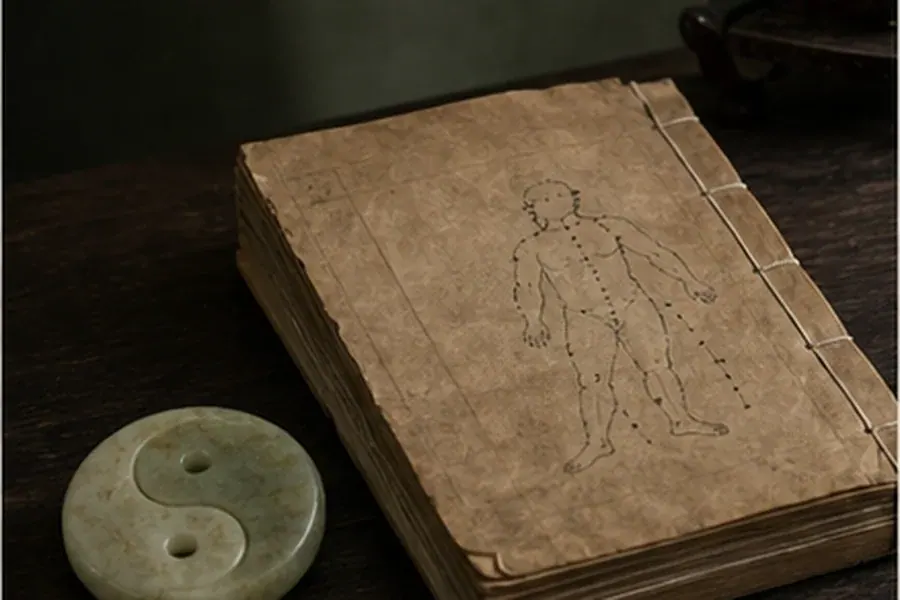
About the work
- Chinese title
- 黄帝内经
- Pinyin
- Huáng Dì Nèi Jīng
- Period
- Compilation: Warring States–Han
- Category
- Foundations
- Authorship
- It is not the work of one author or one date. Its textual layers were compiled, edited, and commented on over centuries.
- Structure
- It is mainly studied through the Su Wen, focused on foundational questions, and the Ling Shu, especially relevant to channels and acupuncture.
Legacy
Almost everything taught today as the “basic theory” of Chinese medicine — Yin-Yang applied to the body, Five Phase correspondences, Zang-Fu, Qi and Shen, the idea of treating before illness declares itself — traces back to this corpus, directly or indirectly. Not because it is a manual, but because it fixed the vocabulary the tradition used to argue with itself for twenty centuries.
- Yin–Yang, Five Phases, and correspondences.
- Zang-Fu, Qi, Blood, Jing, and Shen.
- Channels, points, needles, and preventive reasoning.
A book nobody wrote
Why the Neijing is a layered library rather than one author’s work.
The title ascribes the text to the Yellow Emperor, a mythical figure set in a remote past. That ascription is not a signature: in early China, linking a body of knowledge to an ancestral sage was a way of granting it authority, not of documenting its origin. What we call the Neijing is in fact a compilation of materials from different schools, probably written between the Warring States and the Han, gathered and reorganized by later editors.
The practical consequence is that the corpus contradicts itself. Different chapters propose different numbers of channels, different hierarchies among organs, and pulse models that do not fit together. Classical commentators spent centuries harmonizing those tensions; modern philological scholarship instead reads them as traces of the schools the compiler chose to gather under a single cover.
- Attribution to the Yellow Emperor is a device of authority, not authorship.
- The text gathers layers from several centuries and distinct traditions.
- Internal contradictions are a historical datum, not a copying error.
- The Mawangdui manuscripts, sealed in 168 BCE, describe vessels without points: the Neijing system is later and more elaborate.
Ascribed work A text attributed to a prestigious figure of the past to lend it authority. Recognizing the device prevents reading the Neijing as one master’s testimony.
Su Wen and Ling Shu: two books, one title
What each half contains and why their transmission histories differ.
The received Neijing consists of two collections of eighty-one chapters each. The Su Wen, “Basic Questions”, deals with cosmology, physiology, etiology, diagnosis, and therapeutic principles. The Ling Shu, “Spiritual Pivot”, is the reference text for channels, points, needle types, and needling technique. Anyone studying acupuncture spends more time in the Ling Shu; anyone studying theory or internal medicine, in the Su Wen.
Their trajectories diverge. The Su Wen was re-edited in 762 by Wang Bing, who rearranged the material, added commentary, and filled lost chapters with the seven treatises on the five circuits and six qi, whose belonging to the original text is still debated. The Ling Shu came close to being lost in China and was recovered in 1093, when the Goryeo court sent a copy to the Song.
- Su Wen: basic questions, cosmology, diagnosis, and prevention.
- Ling Shu: channels, points, needles, and technique; the basis of acupuncture.
- Wang Bing re-edited the Su Wen in 762 and his intervention remains visible.
- The Ling Shu we read returned to China from Korea in 1093.
Ling Shu 灵枢 “Spiritual Pivot”. It also circulated as the Zhen Jing, “Needle Classic”, a title that better describes its content: it is the corpus’s technical manual.
Yin-Yang and Five Phases as method
How the corpus turns two cosmological schemes into tools for clinical reasoning.
The Neijing does not define Yin and Yang as substances but as a relation: any pair of phenomena can be described by which expands and which gathers, which warms and which cools, which manifests and which sustains. The same holds for the Five Phases, which are not material elements but five modes of transformation — wood, fire, earth, metal, water — with generating and controlling cycles that let seasons, flavors, emotions, organs, and signs be ordered together.
The decisive intellectual move is correspondence: if the liver is linked to wood, and wood to spring, sour flavor, and anger, then a picture of seasonal irritability acquires a place within the system. This reasoning is powerful for organizing observations and generating hypotheses, and that is exactly where the modern reader must stop: correspondence explains the model’s internal coherence, it does not demonstrate a verifiable causal relation.
- Yin and Yang are relational terms: nothing is Yin absolutely, only Yin relative to something.
- The Five Phases are modes of transformation, not material elements.
- Generating and controlling cycles order seasons, organs, flavors, and emotions.
- Correspondence gives the system coherence; it is not causal evidence.
Wu Xing 五行 Literally “five goings” or “five movements”. The rendering “five elements” misleads: the term names processes, not materials.
Zang-Fu, Qi, Blood, Jing, and Shen
The corpus’s physiology, and why its “organs” are not anatomical ones.
The Neijing describes five Zang — storing organs — and six Fu — transit organs — each defined by what it does within the system rather than by its shape. The corpus’s liver governs free flow and houses the Hun; the spleen transforms and transports what is ingested; the kidney guards the Jing, the inherited reserve governing growth, maturity, and decline. Across that base circulate Qi, understood as capacity for action and transformation, and Blood, its nourishing and material counterpart.
The technical term ordering this physiology is Zang Xiang: “organ manifestation”. The tradition assumes the interior cannot be observed directly and is known only through external signs — complexion, voice, pulse, tongue, mood. That is why the corpus devotes so much space to observation and so little to dissection: not anatomical neglect, but an epistemological decision about how the body’s interior is reached.
- Five Zang store; six Fu receive, transform, and discharge.
- Organs are defined by their function in the system, not by anatomy.
- Jing is the reserve marking growth and ageing; Shen, conscious activity and its expression.
- Zang Xiang: the interior is inferred from its external manifestations.
Zang Xiang 藏象 The doctrine correlating internal organs with their visible manifestations. It grounds why the tradition diagnoses by reading the surface.
Channels, needles, and the arrival of Qi
The Ling Shu’s technical contribution and how it judged a needling.
The Ling Shu systematizes twelve regular channels tied to the Zang-Fu, describes their courses, interior-exterior pairings, and treatment points, and lists nine needle types with distinct shapes and indications: some for shallow insertion, some for pressure, some for incision. It also introduces the categories later acupuncture would develop, such as the antique Shu points and the Yuan-source points.
Its criterion of efficacy is strikingly concrete: technique is judged by the arrival of Qi, De Qi, a sensation recognizable to both operator and recipient. The text insists equally on restraint — what not to needle, in which states not to treat, when to stop — and those cautions are the part of the chapter that ages best.
- Twelve regular channels with courses, pairings, and associated points.
- Nine needle types with differentiated functions.
- De Qi as the classical sign that the manoeuvre has taken effect.
- Explicit warnings on depth, regions, and states in which not to treat.
De Qi 得气 “Obtaining the Qi”. A local sensation of heaviness, distension, or radiation that the tradition takes as the sign that needling has reached its aim.
Reading it today without betraying it
Editions, translations, and the limits of what the text can say about your health.
For a reader in English or Spanish, the sensible route is an annotated translation that declares its base text and discusses variants. The annotated Su Wen translation by Paul U. Unschuld and Hermann Tessenow (2011) and Unschuld’s Ling Shu (2016) are standard references precisely because they show the critical apparatus rather than hiding it. Popular versions without apparatus can serve as a first approach, but they let you verify nothing.
It also helps to separate three layers that are routinely conflated: the ancient text, the traditional commentary interpreting it, and the modern teaching synthesis that reorganizes both into a curriculum. Many claims circulating as “the Neijing says” in fact come from the third layer. And none of the three authorizes self-treatment: persistent, severe, or sudden symptoms require current medical evaluation.
- Choose translations that declare base edition and variants.
- Separate text, traditional commentary, and modern teaching synthesis.
- Always record collection, chapter, and translation when citing.
- Historical study does not qualify anyone to diagnose or treat.
Critical apparatus The notes documenting manuscript variants, translation decisions, and commentary. It is what allows a citation to be checked rather than believed.
Annotated passages
法于阴阳,和于术数,食饮有节,起居有常,不妄作劳。Fǎ yú yīn yáng, hé yú shù shù, shí yǐn yǒu jié, qǐ jū yǒu cháng, bù wàng zuò láo.
They took Yin and Yang as their model, accorded with the arts of calculation, ate and drank with measure, rose and rested with regularity, and did not exhaust themselves without reason.
The opening chapter begins not with diseases but with a regimen of living. It is the oldest and most quoted formulation of the corpus’s preventive ideal: regularity as the ground of health. Note that it describes a way of life, not an individualized prescription.
圣人不治已病治未病,不治已乱治未乱。Shèng rén bù zhì yǐ bìng zhì wèi bìng, bù zhì yǐ luàn zhì wèi luàn.
The sage does not treat illness already declared but what is not yet illness; he does not order disorder already come but what has not yet occurred.
The motto of prevention in Chinese medicine, and probably the most reproduced line of the Neijing. The parallel with governing a state is deliberate: body and realm are regulated by the same logic of anticipation. Prevention here means sustaining regularity, not running screenings.
阴阳者,天地之道也,万物之纲纪。Yīn yáng zhě, tiān dì zhī dào yě, wàn wù zhī gāng jì.
Yin and Yang are the way of heaven and earth, the mesh and guiding thread of the ten thousand beings.
A statement of method more than of content: the Yin-Yang pair is presented as the ordering principle of everything observable, from weather to the body. The chapter then unfolds the correspondences that structure much of later theory.
刺之要,气至而有效。Cì zhī yào, qì zhì ér yǒu xiào.
The essential of needling: when the Qi arrives, there is effect.
The Ling Shu’s first chapter sets the technical criterion of classical acupuncture. It measures neither depth nor duration: it measures a response. Hence the centrality of De Qi in later teaching, and also the difficulty of translating that criterion into a modern clinical trial.
How to study it
- Start with guided thematic chapters rather than linear reading.
- Compare translation, commentary, and Chinese text where possible.
- Record chapter number and cited edition.
Glossary
- 气QiQì
- The capacity for movement and transformation the tradition attributes to every vital process. “Energy” translates it poorly: the term covers subtle substance, function, and activity at once.
- 精Jing (essence)Jīng
- A dense, finite reserve, partly inherited, which in the model governs growth, reproduction, and ageing. The corpus places it in the custody of the kidney.
- 神Shen (spirit)Shén
- Conscious activity and its visible radiance: brightness of gaze, coherence of speech, presence. Classical diagnosis assesses it before any other sign.
- 藏象Zang XiangZàng xiàng
- The doctrine that internal organs are known through their external manifestations. The epistemological ground of diagnosis by observation.
- 治未病Treating the not-yet-illZhì wèi bìng
- The preventive principle of Su Wen 2: act on a tendency before it consolidates into illness. It is an ideal of regimen, not a protocol.
- 经脉ChannelsJīng mài
- Courses along which, in the model, Qi and Blood circulate, linking organs and surface. In the Ling Shu they are twelve regular channels with branches and interior-exterior pairings.
Test what you've learned
Tap each question to see the correct answer and its explanation.
1. What does attributing the Neijing to the Yellow Emperor actually indicate?
- That a historical emperor dictated the text to his physicians
- That knowledge is linked to an ancestral sage to grant it authority
- That the text was written within a single generation
- That the work comes from one lineage of transmission
Tying a body of knowledge to a mythical figure was a common device of legitimation. The corpus gathers materials from different schools and centuries.
2. Which of the two collections is the main reference for channels and needling technique?
- The Su Wen
- The Ling Shu
- Wang Bing’s seven treatises
- Both equally
The Ling Shu, also transmitted as the Zhen Jing or “Needle Classic”, is the corpus’s technical text. The Su Wen focuses on cosmology, diagnosis, and principles.
3. Why is “five elements” a problematic rendering of Wu Xing?
- Because there are actually six
- Because it names processes of transformation, not materials
- Because the term postdates the Neijing
- Because it applies only to the seasons
Xing means going or movement. The five phases name modes of transformation with generating and controlling cycles, not substances.
4. According to Ling Shu 1, how is it recognized that needling has taken effect?
- By the depth reached in millimetres
- By how long the needle is retained
- By the arrival of the Qi
- By the number of points treated
“When the Qi arrives, there is effect.” The classical criterion is a perceived response, not a physical measure — which explains both its centrality and its awkward fit with modern research.
5. What minimum details must a rigorous Neijing citation carry?
- Only the title of the work
- Collection, chapter number, and edition or translation
- The name of the commentator
- The year of the Han dynasty
Su Wen and Ling Shu number chapters separately, and translations differ. Without those three items the citation cannot be verified.
Health notice. Educational and study content. It describes concepts of Traditional Chinese Medicine and does not replace diagnosis or treatment by a healthcare professional. Needling, medicinal herbs and invasive techniques must be applied by trained professionals. Safety guide.