Acupuncture: Measuring the body
The cun belongs to the patient, not to you. 6 activities, about 13 minutes.
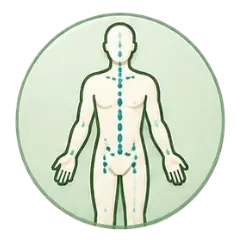
A proportional measure
寸 cùn
The cun does not measure centimetres: it measures proportions of the body being treated. That is why the same point falls in different places on a tall adult and on a child, and why measuring with your own fingers is the most repeated mistake of the early years.
- 1 cun
- the width of the patient's thumb
- 1.5 cun
- index and middle finger together
- 3 cun
- the four fingers together
- Golden rule
- always the patient's hand
Common mistake: Using your own fingers on a patient of very different build. The point shifts by several centimetres.
Bone first, count second
Points are not found by eye: you find a bone landmark that does not move and count from there. Reversing the order — counting first and confirming later — is what produces locations that shift from session to session.
- The wrist crease
- origin for most of the forearm
- Lower border of the kneecap
- reference for the leg
- Navel and pubis
- divide the abdomen into 5 cun
- Spinous processes
- number the back
Common mistake: Locating with the patient in one posture and needling in another. The landmark has moved with them.
To locate the point 3 cun below the kneecap and one finger-breadth lateral to the tibial crest, what do you do first?
Which segment does each proportional measure belong to?
- Elbow crease to wrist crease: 12 cun
- Navel to the upper border of the pubis: 5 cun
- Knee crease to the outer ankle: 16 cun
- Armpit to elbow crease: 9 cun
- Lower border of the kneecap to the inner ankle: 15 cun
- Between the two nipples: 8 cun
Order the steps for locating a point.
- Put the patient in the posture you will needle in
- Identify the bone landmark
- Measure the proportion with the patient's hand
- Palpate for the dip or the change in texture
- Confirm with the patient's reaction to pressure
Why is the proportional system especially useful in children?

Level complete!
Look back a second: you did not know this a while ago.
Did you enjoy it? In the app you save your progress, review what you forget and unlock the 723 exercises.
Study content. The exercises describe concepts of Traditional Chinese Medicine; they are not medical advice.