Diagnosis: Pulse
Four axes, not a list of names. 15 activities, about 14 minutes.
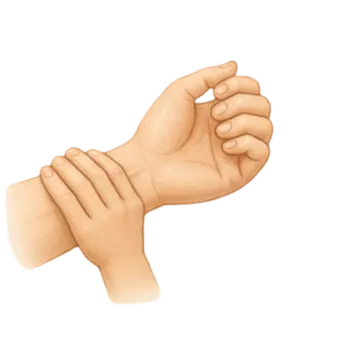
Axes first, name afterwards
A pulse is not recognised by its name: you place it on four axes and the name follows. Starting from the names is what makes the pulse feel impossible to learn.
- Depth
- superficial ↔ deep
- Speed
- slow ↔ rapid
- Strength
- forceful ↔ weak
- Contour
- thin ↔ broad
Common mistake: Trying to memorise twenty-eight pulses before you can place one on the axes.
A thin, rapid pulse with no force. What does it describe?
Three positions and three depths
Each wrist is read in three positions — near the wrist, middle, toward the elbow — and at three depths in each. You do not have to feel everything on day one: first compare whether one position stands out from the others.
- Distal position, left wrist
- Heart
- Middle position, left wrist
- Liver
- Distal position, right wrist
- Lung
- Middle position, right wrist
- Spleen and Stomach
Common mistake: Hunting for a pulse name at each position before you can compare positions with each other.
Match each position with the organ read there.
Sort each finding onto the pulse axis it describes.
- You have to press hard to find it
- Over ninety beats per minute
- It collapses as soon as you press
- It feels like a very narrow thread
- You feel it the moment you touch
- Under sixty beats per minute
A clearly superficial pulse in someone with fever and aversion to cold since yesterday. What does it say?
A pulse that rolls under the finger, rounded and fluid, in someone with a thick greasy coating. What does it indicate?
A taut, long pulse with the feel of a guitar string. What does it point to first?
Order the steps of taking a pulse.
- Let the patient settle for a few minutes
- Place the three fingers on the three positions
- Assess the overall pulse at the three depths
- Compare position by position and wrist to wrist
- Name what you found
Sort each pulse by the picture it suggests.
- Thin and weak in every position
- Rapid, full and forceful
- Taut as a string, especially on the left
- Deep and collapsing under pressure
- Broad and overflowing past the finger
- Rough, dragging irregularly
A rapid pulse in someone who just ran up four flights of stairs. Do you record it as heat?
A pulse found only under pressure, slow and without force. Build the reading.
All positions normal except the left middle, clearly taut. What do you conclude?
A pale, swollen tongue with a rapid, forceful pulse. What do you do with the contradiction?
Match each pulse with the axes that define it.

Level complete!
Your clinical eye just gained precision.
Did you enjoy it? In the app you save your progress, review what you forget and unlock the 723 exercises.
Study content. The exercises describe concepts of Traditional Chinese Medicine; they are not medical advice.