Meridians: Pathway and symptom
Where it runs, it hurts. 20 activities, about 13 minutes.
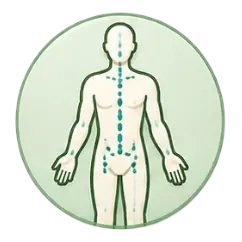
The pathway explains the local symptoms
The Heart channel runs along the inner arm to the little finger. That is why discomfort on that edge of the forearm reads as Heart and not Lung, which runs along the thumb side.
- Little-finger edge of the forearm
- Heart
- Thumb edge of the forearm
- Lung
Where does each channel run on the arm?
- Lung
- Heart
- Large Intestine
- Small Intestine
- Pericardium
- San Jiao
Match the complaint to the channel whose pathway it follows.
Treating from a distance
A channel can be worked anywhere along its pathway, not only where it hurts. Its strongest points lie below the elbow and the knee.
- Local point
- over the painful area: relieves
- Distal point
- far away, on the same channel: moves the whole channel
- Nape of the neck
- crossed by the Bladder, which runs down to the foot
A headache at the back of the head (occipital headache) has lasted weeks. Where is its channel's most useful point usually found?
The three leg yang channels split the body between them
Front, side and back. That division is what turns «my leg hurts» or «my head hurts» into a specific channel with no further tests.
- Front
- Stomach
- Side
- Gallbladder
- Back of the body
- Bladder
Common mistake: Locating pain by the nearest bone instead of by which face of the limb it sits on.
On the head, the same split
The leg yang channels start on the head and split it the same way: front, side and back. The Liver, a yin channel, reaches the top through an internal branch.
- Forehead
- Stomach
- Temples
- Gallbladder
- Nape
- Bladder
- Crown (vertex)
- Liver
Sort each headache by the channel running through that area.
- Pain across the forehead and brows
- Pain at one temple
- Pain in the nape running into the neck
- Pain at the top of the head
- Pain behind one eye toward the temple
- Pressure over the frontal sinuses
Pain running down the lateral thigh and leg to the outer ankle. Which channel do you work?
The leg yin channels rise on the inside
Spleen, Liver and Kidney leave the foot and rise along the inner leg to the trunk. Just above the inner ankle all three cross.
- Inner edge of the foot
- Spleen
- Inner side of the ankle
- Kidney
- Top of the foot, between the first and second toes
- Liver
Match each area of the leg with its channel.
The arm yang channels share out the shoulder
All three rise along the outer arm and reach the shoulder on different faces. Lifting the arm forward loads the front; moving it away from the body, the middle; reaching behind the back, the rear.
- Front of the shoulder
- Large Intestine
- Middle of the shoulder (deltoid)
- San Jiao
- Back of the shoulder and shoulder blade
- Small Intestine
Sort each shoulder pain by the channel involved.
- Hurts when raising the arm forward
- Hurts when taking the arm out to the side
- Hurts when reaching a hand behind the back
- Tender spot at the front of the shoulder
- Tender spot in the middle of the deltoid
- Tender spot along the posterior scapular border
Pain along the thumb edge, no cough, no breathlessness, nothing respiratory. Is the organ affected?
How does a channel reach its organ if its visible pathway runs along the arm?
Temple pain running down the side of the body to the hip. Build the reading.
You palpate a very tender spot that matches no named point on the channel. What do you do with it?
Knee pain covering both the front and the side. How do you approach it?
Each organ shows at an opening
Chinese medicine links each solid organ to an opening in the head, where it shows when it struggles. The Heart shows at the tongue.
- Liver
- eyes
- Kidney
- ears
- Lung
- nose
- Spleen
- mouth and lips
Match each organ with the orifice where it shows.

Level complete!
You can now read this pathway like a map.
Did you enjoy it? In the app you save your progress, review what you forget and unlock the 770 exercises.
Study content. The exercises describe concepts of Traditional Chinese Medicine; they are not medical advice.