Five-element diagnosis
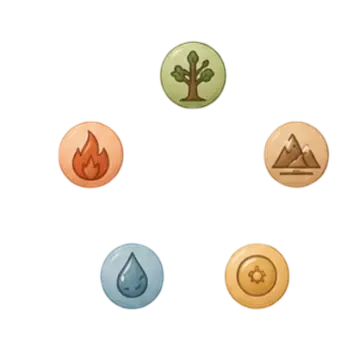
A map of five groups of correspondences — Wood, Fire, Earth, Metal and Water — used to explain why a problem that starts in one organ ends up showing in another.
What this method answers
- Why does sustained stress end up settling in the digestion rather than somewhere else?
- When two organs give signs at once, which one started it and which is only feeling it?
- Which organ is worth supporting when the failing one does not respond on its own?
How to study it
- Learn the two cycles first — generation and control — with the five names in order. Without them the correspondence tables have nothing to hold on to.
- Memorise only three correspondences per element: yin organ, emotion and tissue. Look the rest up when you need it.
- Practise one symptom at a time: name its element, then say what it nourishes, what it restrains and what restrains it.
- Finish with the worked case and the quiz; check that each answer cites a sign, not just a correspondence.
Five elements, no substances
Wǔ Xíng does not describe what the body is made of, but how its parts affect one another.
Xíng (行) means “march”, “phase in motion”, not “matter”. Wood, Fire, Earth, Metal and Water are five positions inside a network of relationships. When Chinese medicine says the Liver belongs to Wood, it does not claim the Liver is made of wood: it claims the Liver behaves like something that expands, pushes and needs freedom of movement. The clinical interest lies in the network: once you know which element nourishes which and which restrains which, you can explain why a problem jumps from one organ to another.
Think of five flatmates. None of them “is” water or “is” fire: what defines them is who pays whose rent and who turns down whose volume. If one leaves or goes off the rails, the whole household rearranges itself. That is what the five elements are: not five things, but five posts in a shared arrangement. Which is why the useful question is never “which element is this?” but “what is it hooked onto?”.
- Read “element” as “phase”: it describes a moment of movement, not a material.
- Each element has a yin organ and a yang organ; the yin one usually carries the reasoning.
- Before you attach a label, ask yourself which relationship you are asserting.
- If an explanation using elements mentions no relationship at all, it is not Wǔ Xíng reasoning.
Wǔ Xíng 五行 (Five Phases) The five phases — Wood, Fire, Earth, Metal and Water — understood as positions inside a network of relationships, not as substances the body is made of.
Correspondences: clues, not proof
Season, emotion, taste, tissue and sense organ point you where to look; they do not close the diagnosis.
Each element drags a list of correspondences behind it. Wood goes with spring, wind, anger, the sinews, the eyes and the sour taste; Earth with late summer, dampness, worry, the muscles, the mouth and the sweet taste. These lists were built by noticing which things tended to appear together. They tell you where to look first. They do not let you treat as proven what you have not yet seen.
A correspondence works like a smell of burning in a house: it tells you which room to enter first, not what is burning. If you walk into the kitchen and nothing is on the stove, the smell is still data, but the hypothesis falls. The same goes for “the patient is irritable, therefore Wood”: irritability sends you to the Liver, and there you have to find something else — tightness under the ribs, a wiry pulse, red tongue edges — or drop the hypothesis.
- Keep three anchors per element: yin organ, emotion and tissue. Look the rest up in the table.
- Ask in which season it worsens: one of the easiest correspondences to verify and one of the most useful.
- When a patient names an emotion, go looking next for a physical sign of the same element.
- Check whether the taste they crave or avoid matches the suspected element; if it does not, say so out loud.
Correspondence A group of phenomena — season, climate, emotion, tissue, sense organ, taste — that tradition assigns to one element because they were observed to appear together.
Generation cycle 相生: who feeds whom
Wood → Fire → Earth → Metal → Water → Wood: each element is mother of the next and child of the previous one.
The order is held by an image: wood feeds fire, the ash of fire enriches earth, earth condenses metal, metal collects water, water waters wood. The generating element is called the mother, the generated one the child. Clinically this explains a very specific kind of problem: an organ is not failing on its own, it is failing because the one that should feed it has been empty for a while.
Water watering wood is the most used image and the most useful. A tree turning yellow may have nothing wrong with its leaves: it may be dry at the root. In this framework, dry eyes and cramps (Wood) appearing alongside low back pain and ringing in the ears (Water) read like this: the tree is short of water. Insisting on the leaves alone leaves the problem where it was.
- Say the sequence out loud until it comes without thinking: Wood, Fire, Earth, Metal, Water.
- Facing a weak organ, look at its mother before concluding the fault is its own.
- Deficiency travels mainly along the generation cycle; excess travels along the control cycle.
- Check whether the mother’s symptoms came earlier in time than the child’s: that is what confirms the direction.
相生 xiāng shēng (mutual generation) The mother-child relationship by which each element nourishes the next in the Wood-Fire-Earth-Metal-Water sequence.
Control cycle 相克: the brake that keeps order
Wood → Earth → Water → Fire → Metal → Wood: each element restrains another, and that restraint is health, not aggression.
Roots hold the soil, soil contains water, water puts out fire, fire melts metal, metal cuts wood. Each element restrains the one two places ahead in the generation cycle. Without that brake the system would have no limit: fire would grow until it consumed everything. Normal control produces no symptoms; it is exactly what keeps any of the five from running away.
A thermostat is not the boiler’s enemy. It shuts it off at twenty-one degrees precisely so the house stays warm. Studying the control cycle, the vocabulary works against you — “control”, “dominate”, “overcome” sound like a fight — but what is described is a system of mutual limits. Pathology does not appear when there is control: it appears when that control overshoots or goes slack.
- Draw the five-pointed star inside the circle: the circle is generation, the star is control.
- Check that you can say, for each element, whom it restrains and who restrains it.
- Normal control gives no symptoms: do not go hunting for Ke signs in a healthy person.
- If an element grows unchecked, look first at whoever should have restrained it, not at the one growing.
相克 xiāng kè (mutual control) The relationship by which each element limits another and keeps the whole within bounds. It is physiological: without it there would be no balance.
When the brake overshoots: 相乘 and 相侮
Cheng is control pushed too hard; Wu is the restrained one turning back on its restrainer.
Cheng (相乘, overacting) follows the same direction as the control cycle but with too much force: either the restrainer is in excess, or the restrained one is so weak that any brake crushes it. Wu (相侮, counter-domination) runs the other way: the element that should have been restrained has grown so strong — or its controller so weak — that it pushes back. Direction is what tells them apart: Cheng goes with the arrow, Wu against it.
The everyday example is Wood invading Earth. Weeks of tension and anger keep the Liver (Wood) clenched; the Liver squeezes the Spleen and Stomach (Earth) harder than it should, and digestion falls apart: bloating after meals, stools loose one day and absent the next, appetite that comes and goes. The person does not consult about irritability, they consult about their belly. And the belly does not settle while Wood keeps squeezing.
- To tell Cheng from Wu, ask one thing only: does the pressure run with the control cycle or against it?
- Cheng has two possible causes: restrainer in excess, or restrained in deficiency. Find out which before deciding anything.
- In Wu, always look for weakness in the controller: Metal that no longer cuts lets Wood push it back.
- Put the symptoms in time order: whatever appeared first usually points to the element that started it.
相乘 xiāng chéng and 相侮 xiāng wǔ Overacting and counter-domination: excessive control along the cycle, and reversed control against it.
Choosing where to act: tonify the mother, drain the child
With two elements disturbed, the classical rule says look at the direction of the cycle before the loudness of the symptoms.
The rule reads: “in deficiency, tonify the mother; in excess, drain the child” (虚则补其母,实则泻其子). An empty Lung (Metal) leans on the Spleen (Earth), its mother. A full Liver (Wood) discharges through the Heart (Fire), its child. When two elements are disturbed, the one you address is not the noisiest but the one at the head of the chain. This describes how Chinese medicine reasons; it is not a treatment instruction.
An open tap and a wet floor are the same problem seen in two places. You can mop the floor all afternoon — and the patient will be grateful for twenty minutes — or you can close the tap. Classical practice does both: with “Wood invades Earth”, the principle is to disperse the Liver and support the Spleen at once, because a floor that has been wet for months is damaged too.
- Put the two disturbed elements in time order: whichever appeared first leads.
- With clear excess in one and deficiency in the other, you address the excess and support the emptiness.
- If the mother is sound and the child is still empty, the problem belongs to the child: stop pushing the mother.
- Check that the relationship you propose exists in some cycle. If you involve Wood and Metal, it is control or counter-domination, never generation.
虚则补其母 xū zé bǔ qí mǔ “In deficiency, tonify the mother”: the rule that derives where to act from the element’s position in the generation cycle, not from how loud its symptoms are.
Solved case: Three months of tense work and a digestion coming apart
Woman, 38. She comes for abdominal bloating after meals that started about three months ago. It coincided with a change of post: long days and frequent arguments with her manager. She eats at odd hours. She says her belly “goes hard” especially on bad days at the office.
Observations
- Abdominal distension after meals, with belching and frequent sighing.
- Alternating stools: two days loose, then a couple of days without going.
- A sense of tightness under the ribs, on both sides.
- Irritability and light sleep; she wakes between two and four in the morning.
- Tongue with slightly red edges and a thin white coating (the layer covering the tongue).
- Wiry pulse — taut like an instrument string — more marked on the left wrist.
Reasoning
- The symptoms that bring her in point to Earth (Spleen and Stomach): bloating after meals and irregular stools.
- But Earth alone does not explain the tightness under the ribs or the wiry pulse: that belongs to Wood (Liver and Gallbladder).
- Time order decides: work tension and irritability came first; the bloating followed. Wood started it.
- The pressure runs with the control cycle (Wood → Earth), so this is overacting (Cheng), not counter-domination (Wu).
- The thin coating and the absence of marked fatigue say Earth is not yet fully empty: it is being squeezed, not exhausted.
- The emotional correspondence supports the hypothesis but does not carry it alone: what confirms it are the rib tightness, the wiry pulse and the red tongue edges.
Glossary
- 五行Five Elements (Five Phases)wǔ xíng
- A relational model that sorts organs, seasons, emotions and tissues into five groups — Wood, Fire, Earth, Metal and Water — joined by two cycles: generation and control.
- 相生Mutual generationxiāng shēng
- Each element nourishes the next: Wood → Fire → Earth → Metal → Water → Wood. The nourisher is called the mother, the nourished one the child.
- 相克Mutual controlxiāng kè
- Each element limits another: Wood → Earth → Water → Fire → Metal → Wood. It is a normal relationship: without it the system would have no limits.
- 相乘Overactingxiāng chéng
- Excessive control in the same direction as the control cycle, because the restrainer is in excess or the restrained one is too weak. Example: Wood invading Earth.
- 相侮Counter-dominationxiāng wǔ
- Reversed control: the element that should be restrained pushes back at its controller, because it is in excess or the controller is too weak. Example: Wood insulting Metal.
Test what you've learned
Tap each question to see the correct answer and its explanation.
1. A healthy person has no digestive symptoms and their Liver normally moderates the Spleen. What is that relationship called?
- Control cycle (相克 xiāng kè): the normal relationship
- Overacting (相乘 xiāng chéng), because Wood acts on Earth
- Counter-domination (相侮 xiāng wǔ), because it runs against the generation cycle
- Generation cycle (相生 xiāng shēng), because Wood comes before Earth
Control is the physiological relationship: it keeps each element within bounds and produces no symptoms. Overacting is tempting because the direction is the same (Wood → Earth); what would define it is excessive force with damage to Earth, and here there is no damage.
2. A patient arrives irritable after a hard week. There are no other signs: normal tongue, normal pulse, digestion and sleep unchanged. What do you conclude?
- There is a Wood pattern, because anger corresponds to the Liver
- Irritability is a Wood clue that no sign backs up yet
- There is counter-domination of Metal over Wood
- There is Water deficiency, because Water is the mother of Wood
A correspondence guides the search, it does not close it. The first option is the commonest mistake with the five elements: the emotion fits, the pattern is taken as settled, and nothing else gets looked for. With no Liver sign at all, the hypothesis stays open.
3. Chronic cough and a weak voice (Metal) in someone who also has loose stools, poor appetite and years of tiredness (Earth). Which relationship best explains the picture?
- Earth, mother of Metal, has been empty for a long time and does not feed it
- Metal overacts on Wood
- Metal, mother of Earth, does not feed it
- Fire is not controlling Metal
In the generation cycle Earth generates Metal, and here the Earth symptoms came first and have lasted years. The third option reverses the direction: the classic slip when reciting the cycle from memory without fixing who is mother to whom.
4. A very weak Metal (Lung) stops restraining Wood, and signs of overflowing Wood appear. What is that situation called?
- Overacting (相乘 xiāng chéng)
- Counter-domination (相侮 xiāng wǔ)
- Generation cycle (相生 xiāng shēng)
- A reversed mother-child relationship
The normal control arrow runs Metal → Wood. Here the push runs Wood → Metal, against the arrow: that is counter-domination. It gets confused with overacting because in both cases an element is pushing too hard; what decides is not the force but the direction.
5. Faced with a clear deficiency of one element, what does the classical rule say?
- Drain the child, since that unloads the affected element
- Tonify the mother, since she is the one who feeds it in the generation cycle
- Tonify the element that controls it, to strengthen the brake
- Drain the mother, so she releases what she is holding
“In deficiency, tonify the mother; in excess, drain the child.” The first option is the other half of the rule applied to the wrong case: draining unloads an excess, it does not fill an emptiness.
Health notice. Educational and study content. It describes concepts of Traditional Chinese Medicine and does not replace diagnosis or treatment by a healthcare professional. Needling, medicinal herbs and invasive techniques must be applied by trained professionals. Safety guide.