Meridian diagnosis
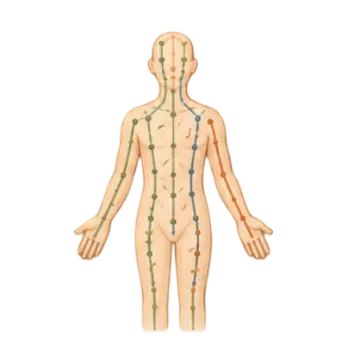
Meridian diagnosis uses the map of the body’s channels: when a symptom follows a line, that line tells you which channel to look at.
What this method answers
- Why does this pain run from the neck to the little finger and nowhere else?
- Is the problem in the pathway crossing the area, or in the organ that channel belongs to?
- What does it mean to wake up at the same hour every night?
How to study it
- Learn six pathways first, not twelve: the three Yin and three Yang channels of the arm. The leg repeats the same logic.
- For every complaint you meet, trace the line with your finger before naming any channel.
- Compare pathway symptoms and organ symptoms within the same meridian until you can tell which one leads.
- Leave the organ clock and the eight extraordinary vessels for last: they are nuances, not the entry door.
Why the map matters
If the symptom follows a line on the body, the line is the finding.
The other methods ask what kind of imbalance is present. This one asks where. Chinese medicine describes twelve main channels (经络, jīng luò), fixed routes along which Qi and Blood are said to circulate, each crossing a specific strip of the body. When a complaint draws a stripe rather than a blot, the map cuts twelve possibilities down to one or two.
Think of a city metro. If three people report delays at three different stations and all three stations sit on the same line, you do not chase three faults: you check the line. The body reads the same way. A sore shoulder, a pulling elbow and a numb thumb can be three stops on one route — and then they are not three problems but one.
- First decide whether the symptom has the shape of a line or of a blot. Only the line comes in through this door.
- Ask where it starts and where it ends, not only where it hurts most.
- Check whether several loose complaints fall along one and the same route.
- Learn the six arm pathways first: the leg repeats the same organisation.
Channel or meridian (经络, jīng luò) A route described by the Chinese tradition along which Qi and Blood circulate, with a fixed surface trajectory and an internal connection to an organ.
Reading the pathway
The outer edge of the arm and the inner edge are two different maps.
The three Yang channels of the arm run up the outer face: one along the thumb side (Large Intestine), one down the middle (San Jiao 三焦) and one along the little-finger side (Small Intestine). The three Yin channels run down the inner face in the same order: thumb (Lung), middle (Pericardium), little finger (Heart). A pain running down the outside to the index finger is not the same problem as one running down the inside to the little finger, even though the patient says the same thing: "my arm hurts".
Ask them to point with a fingertip, not with an open hand. The open hand covers three channels at once and gives the same answer for three different pictures; the fingertip draws just one. It is the difference between "I live around here" and giving the street name: only the second lets you go and look.
- Ask them to trace the complaint with a fingertip, from where it starts to where it dies out.
- Note whether the line is continuous or skips regions.
- Check which face of the limb it uses: the outer face is usually Yang, the inner face usually Yin.
- Ask which movement wakes it up and which one settles it.
- Palpate along the route looking for points that are tender under pressure (阿是穴, ā shì xué).
Following the channel (循经, xún jīng) A symptom distributing itself along the course of a channel, instead of staying at one spot or scattering without order.
Channel symptom, organ symptom
The same meridian can give shoulder pain or a cough; only one of the two is leading.
Every channel has an external part — the trajectory you can trace on the surface — and an internal one that connects to an organ. The Lung channel accounts for both a pain in the front of the shoulder and a dry cough. Telling which one dominates changes the whole reasoning: a pathway problem is local, follows a line and reacts to movement, cold or pressure; an organ problem brings companions that have nothing to do with the area, such as shortness of breath, sweating, or disturbed digestion or sleep.
Picture the wire running from the fuse box to a lamp. If a stretch of wire is pinched, that lamp flickers and nothing else. If the fault is in the box, the lamp flickers, the oven trips and the fridge will not start. Before deciding where to look, count how many things fail at once: one thing points at the wire, several point at the box.
- Ask what else has changed since it started: sleep, appetite, breath, mood, digestion.
- A single symptom, tied to movement and drawn along a line, points to the pathway.
- Several scattered symptoms that share one organ point to the organ.
- Cross-check with tongue and pulse: a pathway problem barely alters them; an organ problem almost always leaves a mark.
- Both can coexist; then you attend first to whichever limits daily life the most.
Channel symptom (经证, jīng zhèng) A picture confined to the surface course of a channel, without the general symptoms that would give away the corresponding organ.
The organ clock
Waking at the same hour every night is a hint, never a proof.
The 子午流注 (zǐ wǔ liú zhù) divides the day into twelve two-hour slots and assigns each to a channel, starting with the Lung channel between 3 and 5 in the morning. Within this framework, a symptom that appears or worsens always inside the same slot points to the channel of that slot. It is a hint you write down and cross-check with the rest of the picture, not a conclusion that can stand on its own.
It is like noticing that the noise in the building always comes at three. It tells you where to start looking, not what has broken. Waking at three in the morning falls inside the Liver channel slot and may simply be a late dinner, the neighbour’s night shift, or the phone on the bedside table. The hour opens the list of suspects; the rest of the picture is what closes it.
- Ask for the actual hour, not "at night".
- Check whether it repeats for several days or happened only once.
- Rule out the everyday first: late dinner, caffeine, alcohol, noise, shift work, screens.
- Use the slot to rank hypotheses, never to close them.
- If the hour contradicts everything else, everything else wins.
Organ clock (子午流注, zǐ wǔ liú zhù) Traditional cycle assigning each channel a two-hour slot of the day, in which its Qi is said to reach its highest point.
The eight extraordinary vessels
Eight reserve routes you turn to when the picture does not fit inside a single channel.
Besides the twelve main channels, the tradition describes eight extraordinary vessels (奇经八脉, qí jīng bā mài). They belong to no organ and have no time slot of their own: they are described as reservoirs that regulate and store what circulates in the twelve. The four that come up most are Du Mai (督脉), along the midline of the back; Ren Mai (任脉), along the midline of the front; Chong Mai (冲脉), called the sea of Blood; and Dai Mai (带脉), the only horizontal one, girdling the waist like a belt.
Think of the twelve channels as rivers and the eight vessels as reservoirs. On a normal day the water runs in the rivers and nobody looks at the reservoirs. When it rains too much, or the riverbed dries up suddenly, the reservoir is what absorbs the swing. That is why these eight are consulted in long-standing, cyclical or midline pictures, and not for a shoulder you pulled yesterday.
- Suspect them when the symptom crosses the midline or draws a belt around the trunk.
- Pictures that follow a cycle — menstrual, seasonal, tied to stages of life — are often read here.
- Du Mai governs the Yang channels; Ren Mai governs the Yin ones.
- Dai Mai is the only one encircling the body horizontally; the rest run vertically.
- An extraordinary vessel is not just another channel: it has no organ of its own and no time slot.
Extraordinary vessels (奇经八脉, qí jīng bā mài) Eight conduits — vessels in the sense of channels, never ships — that belong to no organ and are described as a reserve regulating the twelve main channels as a whole.
From symptom to channel, from channel to hypothesis
The pathway names the channel; the rest of the picture says what is happening to that channel.
Locating has two steps, and they get mixed up constantly. The first is geographic: the line of the symptom matches a pathway and you have a name. The second is clinical: you have to say whether that channel is blocked — fixed, stabbing pain that worsens under pressure — or empty — dull, diffuse pain that eases with pressure and warmth. Naming the channel and stopping there leaves the reasoning half-done, because the two states lead to opposite treatment principles.
When two channels fit at once, do not pick by taste. Press along both routes: the one that wakes clearly tender points wins. If they are still tied, look at which movement reproduces the symptom and which distant complaints come with it; the channel that also explains the distant part is the one leading. And if both really are involved, accept both: neighbouring channels affect each other, and forcing a single name sounds like precision but is a hidden error.
- Step 1: trace the line. Step 2: decide blocked or empty. Do not skip the second.
- Cross-check by palpation: tender points along the route confirm the channel you chose.
- Ask about distant complaints that the same channel would explain.
- If two channels fit, rank them by how much of the picture each one explains.
- Write the hypothesis in one sentence: which channel, in which state, on what evidence.
Ashi point (阿是穴, ā shì xué) A point that is tender under pressure and appears on no fixed list: it is defined by the body’s reaction to palpation, not by its position on the map.
Solved case: A pain running down the outside of the arm
A 42-year-old man, a house painter. For three weeks his right shoulder has bothered him. He says "my arm hurts"; asked to point, he traces with his finger from the tip of the shoulder, along the outer edge of the arm, down to the index finger. It worsens when he raises the arm above his head and at the end of the working day. He sleeps well, eats well, nothing else has changed.
Observations
- The line runs along the outer face of the arm, on the thumb side, and ends at the index finger.
- It is reproduced when he lifts the arm away from the body; at rest it drops right down.
- Palpating the route brings out two clearly tender points: one at the shoulder, one at the outer crease of the elbow.
- No cough, no shortness of breath, no digestive or sleep disturbance.
- Tongue and pulse show nothing striking.
Reasoning
- The symptom draws a line and not a blot: the channel map applies.
- The line runs on the outer face, so it is a Yang channel of the hand; that rules out Lung, Pericardium and Heart.
- Among the three Yang channels, it ends at the index finger, not the little or ring finger: the route rising from the index along the outer edge of the arm to the shoulder is the Large Intestine channel.
- There are no digestive or general symptoms pointing at the organ: nothing forces you off the pathway.
- The pain is fixed, tied to movement, and increases under pressure on the tender points: in this framework it reads as stagnation in the channel, not as emptiness.
- Daily work with the arm above the head gives a cause consistent with a channel overloaded along its course.
Health notice. Educational and study content. It describes concepts of Traditional Chinese Medicine and does not replace diagnosis or treatment by a healthcare professional. Needling, medicinal herbs and invasive techniques must be applied by trained professionals. Safety guide.