Tongue diagnosis
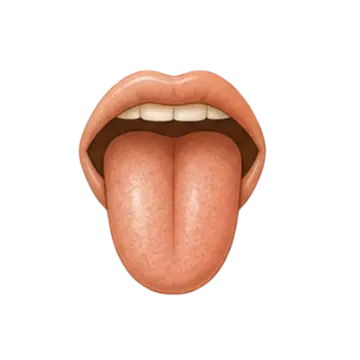
Looking at the tongue for ten seconds to read the state of the Blood, the body fluids and the digestion.
What this method answers
- Does this problem go back years, or did it start this week?
- Is something missing — Blood, Yin, Qi — or is something in excess: Heat, Dampness, Phlegm?
- Which area of the body is the imbalance concentrating in?
How to study it
- Start by understanding why the tongue changes slowly: that is exactly what makes it reliable.
- Learn to look before you learn to interpret — light, exposure time, and foods that stain.
- Always separate the two layers: tongue body first, coating second. Never look at both at once.
- Finish by practising the combined reading, especially when the two layers contradict each other.
The most honest window into the body
The tongue cannot pretend: it changes over weeks, not minutes, and the nerves of the appointment do not alter it.
The pulse reacts to everything: to running to arrive on time, to a coffee, to the fear of bad news. The tongue does not. Its colour and its coating build up over days and weeks, so what you see is the underlying state, not today’s scare. That is why, when signs contradict each other, the tongue carries the most weight.
Think of the difference between someone’s mood and their handwriting. Mood turns over in a morning: one piece of bad news and it is another person. Handwriting takes years to shift, which is why you can recognise it on an envelope. The pulse is the body’s mood. The tongue is its handwriting.
- Compare the same tongue across two visits weeks apart: that is where the real change shows.
- If the pulse says one thing and the tongue another, ask which of the two is describing the underlying state.
- Write down what you see before you hear the symptoms: it stops the story from steering your eye.
- A photo is no substitute for looking. Camera and screen shift the colour.
Tongue diagnosis (舌诊 shé zhěn) Systematic observation of the muscle of the tongue and of the layer covering it, in order to infer the internal state.
How to look without spoiling what you are looking at
Before interpreting anything, secure the conditions: natural light, ten seconds, and no staining food.
A coffee, a curry or a coloured sweet taken half an hour earlier may have painted the coating. A warm bulb turns any tongue yellow. And if the patient holds the tongue out for half a minute, it congests and looks redder than it is. Almost every beginner error is an error of conditions, not of interpretation.
It is like judging the colour of a wall with the blinds down and an orange lamp on. You are not seeing the wall, you are seeing the lamp. Open the window first; give your verdict on the colour afterwards.
- Look next to a window, in indirect daylight. Never under fluorescent or warm bulbs.
- Ask what was eaten or drunk in the last hour: coffee, tea, beetroot, curry, sweets, chewing gum, tobacco.
- Ask for a relaxed tongue, neither tensed nor stretched, and have it withdrawn after ten seconds.
- If you need a longer look, let it rest and repeat. Do not extend the same exposure.
- Record in this order: body colour, shape, coating. Writing it down forces you to look at it.
Stained coating (染苔 rǎn tāi) Colour of the tongue coating produced by a food, a drink or tobacco rather than by the internal state. It is not interpreted — it is ruled out.
The tongue body: the long story
The colour of the muscle of the tongue speaks of Blood and Yin — of what has been settled in for months.
The tongue body is the tissue: what is left when you ignore the layer covering it. Its colour depends on how much Blood reaches it and how much Yin — the cool, moist side of the body — remains available. Pale means material is missing: Blood, Qi, or the Yang that moves them. Red means heat is in excess. And red matters less for its intensity than for what comes with it.
Picture the tongue as a red cloth hung out in the sun. Wash it many times and wring it out and it loses colour: that is the pallor of deficiency. Leave it in the August sun and it overheats and dries out: that is the red of Heat. Cloth takes time to change, which is why what you see has been happening for a while.
- Mentally ignore the coating and look only at the tissue, especially at the edges and under the tip.
- Pale and moist points to Yang deficiency and cold; pale and dry, to Blood deficiency.
- Red with a thick yellow coating reads as full Heat; red with no coating, as Yin deficiency.
- A purple or bluish tone points to Blood that is not circulating, not to temperature.
- Compare with the colour of the lips and the inner eyelid: they give context about the Blood.
Tongue body (舌质 shé zhì) The tissue of the tongue itself, not counting the layer that covers it: it reflects the state of Blood, Yin and the internal organs.
The coating: today’s news
The layer covering the tongue arises from Stomach Qi and changes over days: it is the daily bulletin on the pathogenic factor.
The coating — the layer covering the surface of the tongue — is understood in this framework as vapour rising from the Stomach. It is read along three independent axes: thickness says how much pathogenic factor there is; colour says at what temperature — white cold, yellow heat; and moisture says how the fluids are doing. It can change from one day to the next, and that is precisely its value: it reports the acute.
Think of the mist on a bathroom mirror. How much mist there is depends on how much vapour rises: if it is thin you can still see the mirror behind, if it is thick you cannot. The tongue works the same way. When the coating still lets the tissue show through, the problem is on the surface; when it hides it, the problem has settled inside.
- Thickness: can you see the tongue body through the coating? If you can, it is thin; if not, it is thick.
- Colour: white points to Cold or an early stage; yellow, to internal Heat; grey and black, to extreme pictures that need other signs before deciding.
- Moisture: shiny and waterlogged points to Dampness; dry and rough, to consumed fluids.
- Distribution: see whether the coating covers everything or is missing in patches. Partial absence is called peeled coating.
- A thin, even, slightly moist white coating is normal, not a finding.
Tongue coating (舌苔 shé tāi) Layer covering the surface of the tongue; in this framework it is attributed to Stomach Qi and describes the pathogenic factor present right now.
Shape, marks, cracks and zones
Size and edges tell you how much fluid the body is holding; the zone map tells you where.
A swollen tongue presses against the teeth and comes back scalloped at the edges: the classic sign that the Spleen is not transforming fluids and Dampness is in excess. A thin tongue points the other way: Blood or fluids are lacking. Cracks speak of consumed Yin, and their depth matters more than their number. On top of all this sits a map: tip, edges, centre and root.
The zone map is like the floor plan of a house where each room has its own damp. The tip is Heart and Lung, upstairs, where whatever burns and keeps you awake collects. The edges are Liver and Gallbladder, where held-in tension shows. The centre is Spleen and Stomach: the kitchen. The root is the Kidney: the foundations. A crack in the centre does not say the same thing as a crack at the root.
- Teeth marks at the edges: look at the outline, not the colour. They point to Dampness and Spleen Qi deficiency.
- Cracks: check whether they are deep and whether coating is missing inside them. That counts for more than how many there are.
- An isolated red tip points to Heat in the Heart; red edges, to Heat in the Liver.
- One zone without coating while the rest keeps it locates where Yin has been consumed.
- Trembling or deviation when the tongue comes out is recorded separately: those are signs of movement, not of colour.
Tongue with teeth marks (齿痕舌 chǐ hén shé) A tongue whose edges are scalloped by the pressure of the teeth, because its volume is greater than the mouth allows.
When body and coating do not agree
When the two layers contradict each other there is no observation error: there are two different timescales laid on top of one another.
A pale body with a thick yellow coating looks like nonsense: pale says cold and lack, yellow says heat and excess. It is not a contradiction, it is two clocks. The pale tissue tells you about the underlying deficiency, months old. The yellow coating tells you about the heat added this week. It reads as underlying deficiency with superimposed Heat, and the order matters: the acute is addressed first, without forgetting that something is missing underneath.
It is like a house with structural damp where a small fire has also broken out. Putting out the fire is what is urgent, but if you only put out the fire the damp is still there. And if you start on the damp without putting anything out, the house burns down. The tongue is showing you both things at once, in two layers.
- Always ask in what order the signs appeared: the tiredness first, or the bitter mouth first.
- Pale body + yellow coating: chronic deficiency with recent Heat on top.
- Red body + thin white coating: underlying Heat with a newly arrived external picture.
- Normal body + thick coating: the problem has not sunk in yet, the terrain is intact.
- When in doubt, count the time: the coating moves in days, the tissue in months.
Root and branch (本 běn / 标 biāo) The root is the underlying imbalance; the branch is what has been added on top and is causing trouble today. The tongue shows both layers at once.
Solved case: A tongue that does not fit the textbook
A 42-year-old office worker. Tiredness for two years, worse in the afternoon. For the last ten days she also wakes with a bitter taste, sleeps badly and finds digestion heavy. She has had two work dinners this week.
Observations
- Pale tongue body, somewhat swollen, with clear teeth marks at the edges.
- Thick yellowish coating concentrated in the centre of the tongue.
- The tip and the edges keep a thin white coating.
- The surface is moist, almost shiny.
- She drank coffee three hours ago; the yellow was already there yesterday, before any coffee.
Reasoning
- Rule out the artefact first: the yellow was there yesterday with no coffee involved, so it is not a stained coating.
- Read the tissue: pale, swollen and teeth-marked points to deficient Spleen Qi with retained Dampness. It fits two years of tiredness that worsens in the afternoon.
- Read the coating: thick means a pathogenic factor has accumulated; yellow means that factor carries heat. Ten days, not two years.
- Locate it: the yellow coating sits in the centre, the Spleen and Stomach zone. Tip and edges are still clean, so the heat has not spread to the Heart or the Liver.
- Order the timescales: the deficient terrain is old; the heat with food retention is recent and matches the two dinners.
Glossary
- 舌诊Tongue diagnosisshé zhěn
- Structured observation of the tongue — the organ — in order to infer the internal state. It is done in natural light, for about ten seconds, recording the tissue and the layer covering it separately.
- 舌苔Tongue coatingshé tāi
- Layer covering the surface of the tongue. In this framework it comes from Stomach Qi and describes the pathogenic factor present now: thickness = how much, colour = at what temperature, moisture = how the fluids are.
- 舌质Tongue bodyshé zhì
- The tissue of the tongue, not counting the layer covering it. Its colour and shape reflect the state of Blood, Yin and the internal organs, and change over months, not days.
- 齿痕舌Tongue with teeth markschǐ hén shé
- A tongue with scalloped edges from the pressure of the teeth, because its volume exceeds what the mouth allows. In this framework it is associated with retained Dampness and Spleen Qi deficiency.
- 剥苔Peeled coatingbō tāi
- Patches where the coating is missing while the rest keeps it, like a map. It locates where Yin or Stomach Qi has been consumed; if it is missing altogether, the tongue is left peeled and shiny.
Test what you've learned
Tap each question to see the correct answer and its explanation.
1. A patient arrives with an orange-stained coating. He had a coffee with milk twenty minutes ago. What do you do?
- Record it as a yellow coating and read it as internal Heat.
- Note the doubt and look again on another day, before eating, before interpreting the colour.
- Discount the intensity a little and read it as mild Heat.
- Ignore the coating entirely and diagnose from the tongue body alone.
A recent colour that coincides with what the person has just consumed is a stained coating until proven otherwise. Reading it as Heat was tempting because yellow is the colour of Heat, but the decisive fact here is timing: twenty minutes is not enough for a coating to change. Discarding the whole layer does not work either — thickness and moisture remain valid even when the colour is not.
2. A red, shiny tongue with no coating at all and fine cracks. What does it most strongly point to?
- Full Heat, because of how intense the red is.
- Yin deficiency: the red shows because there is no coolness left to hold it back, and the absent coating confirms it.
- Blood deficiency, because of the cracks.
- Blood stasis, because of the shine on the surface.
Full Heat is tempting because red is striking, but full Heat comes with a thick yellow coating: there is a pathogen and there is material to form a layer. Here there is no layer at all. A peeled tongue indicates that Stomach Qi is no longer generating a coating, and together with the red and the cracks it reads as consumed Yin.
3. What difference justifies giving the tongue more weight than the pulse when the two contradict each other?
- That the tongue can be photographed and the pulse cannot.
- That only practitioners with years of practice can take the pulse.
- That the tongue changes over days or weeks and is not altered by the emotional state of the moment, while the pulse responds within minutes to a run, a coffee or nerves.
- That the pulse only reflects the state of the Heart.
The difference is the timescale, not the technical difficulty or the scope. The pulse is an excellent sign, but it is fast: it also reflects what has happened in the last twenty minutes. The tongue takes days or weeks to shift, so it describes the underlying state. None of the other options changes what each sign is measuring.
4. A pale tongue body with a thick yellow coating. How is it read?
- It is an impossible observation; it has to be repeated another day.
- Cold, because the tongue body always overrules the coating.
- Heat, because the coating is the more recent sign and therefore the more informative one.
- Underlying deficiency, told by the pale tissue, with Heat added recently, told by the coating.
Discarding the observation or picking a single layer are the two easy ways out, and both lose information. The layers do not compete: they speak about different moments. The pale tissue took months to form and reports the deficiency; the yellow coating formed in days and reports the recent Heat. That combination is exactly what explains why someone with long-standing tiredness comes in today.
5. What information does the thickness of the coating specifically provide?
- The temperature of the pathogenic factor.
- How much pathogenic factor there is, and whether it has penetrated inwards.
- The state of the body fluids.
- The specific organ that is affected.
The three axes of the coating are easily confused because they are read at the same time, but they are independent: thickness says how much there is and how deep it has reached; colour says at what temperature; moisture says how the fluids are. The organ is located by the zone of the tongue, not by the coating.
Health notice. Educational and study content. It describes concepts of Traditional Chinese Medicine and does not replace diagnosis or treatment by a healthcare professional. Needling, medicinal herbs and invasive techniques must be applied by trained professionals. Safety guide.