Zang-Fu organ diagnosis
It gives the imbalance a full name: which body function is failing, what it lacks or has in excess, and which way it has drifted.
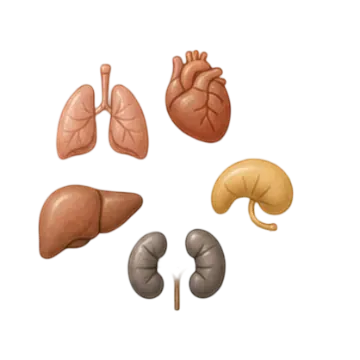
What this method answers
- Which system of functions is involved in these symptoms: the one that digests, breathes, moves, or stores?
- Does that system lack something (deficiency) or is something blocking it (excess), and which substance is it: Qi, Blood, Yin or Yang?
- When two or three organs show up at once, which one is at the root and which merely echoes it?
How to study it
- Start by reading organ names as names of functions, not of anatomy. It is the only thing you must accept before going on.
- Learn the functions of each of the five Zang before touching a single pattern: patterns are those functions failing.
- Break every pattern name into three pieces — organ, substance, nature — and practise rebuilding it from the symptoms.
- Finish with two-organ cases: sort the symptoms by when they appeared and separate root from branch.
The method the others all lead to
The other methods describe the imbalance; Zang-Fu says which body function is producing it.
The Eight Principles tell you the picture is internal, cold and deficient. Tongue and pulse confirm it. The Five Elements tell you which system is in play. None of them yet tells you what to do. Zang-Fu finishes the sentence: it names the organ, the substance that is lacking or in excess, and the direction of the failure — and from there a concrete treatment principle follows.
It is the difference between "there is a leak in the house" and "the seal under the kitchen sink has gone". Both are true; only the second tells you which wrench to pick up. The earlier methods walk you to the right room; Zang-Fu puts your hand on the part.
- Before opening this method, already have an Eight Principles answer: interior or exterior, cold or hot, deficient or excess.
- Ask which everyday function has changed: digesting, sleeping, breathing, moving, urinating, menstruating.
- Check that the name you arrive at explains all the main symptoms, not only the loudest one.
The “Spleen” is not the spleen
Capitalised organ names stand for sets of functions, not for the viscera you see on a scan.
When Chinese medicine says “Spleen” it is not talking about the organ under your left ribs: it means the set of functions that turn food into usable energy and distribute it — roughly what you would call digestion and metabolism today. When it says “Kidney” it includes reproduction, bones, hearing, growth from childhood and ageing. Two different vocabularies using the same words.
Think of “the Post”. The word does not point at a building: it points at everything that gets a letter from your hand to another city — carriers, vans, sorting, timetables. If someone says “the Post is slow”, nobody inspects the bricks of the office. The “Spleen” works the same way: when its function slows, you get bloating after meals, tiredness and loose stools — and no scan of the spleen will show a thing.
- Every time you read an organ name, translate it in your head into its function: Spleen = transform and transport; Lung = Qi and breathing; Liver = free flow; Kidney = Essence, bones and development; Heart = Blood and Shen (mind and awareness).
- Ask about symptoms of that function, not of the anatomical organ: about appetite and stool form, not about the spleen.
- Accept the overlaps: bones and hearing sit under Kidney, eyes under Liver, because the division is functional, not anatomical.
- Do not turn this into a medical diagnosis: “Spleen Qi deficiency” is not a disease of the spleen and does not replace one.
Functional organ An organ name in TCM stands for a group of functions and their manifestations (tissue, sense, emotion), not a specific viscus.
Zang that store, Fu that transport
The five Zang are solid and keep; the six Fu are hollow and pass things through. That difference sets the tempo of the picture: chronic and deficient versus acute and excess.
The Zang (Heart, Lung, Spleen, Liver, Kidney) store Qi, Blood, Yin, Yang and Essence. What is stored is spent slowly, so their pictures settle in over months or years and tend to be deficient. The Fu (Stomach, Large Intestine, Small Intestine, Bladder, Gallbladder and Sanjiao) receive, break down and expel. A pipe blocks all at once, so their pictures arrive fast, hurt, and tend to be excess — heat, damp or stagnation.
Compare a pantry with a pipe. The pantry empties without anyone noticing until one day nothing is left: that is a Zang in deficiency. The pipe complains the very day it blocks, and it complains loudly: that is a Fu in excess. And a Fu is not only “the tube”: Gallbladder and Sanjiao belong here as distribution functions, and the Sanjiao has no physical form of its own at all.
- Ask how long it has been going on first: weeks or months of build-up push toward Zang; hours or days push toward Fu.
- Look at the kind of complaint: tiredness, pallor and weakness come from an empty store; pain, distension, burning and urgency come from a blocked pipe.
- Check whether a passing function is disturbed — eating, moving the bowels, urinating, belching: that is a Fu signature.
- Remember the two sides coexist: a Fu that has failed for years ends up emptying the Zang it is paired with.
Zang and Fu Five solid Zang that store substances and must not empty; six hollow Fu that receive and expel and must not stay full.
The five couples, and why the symptom shows up in the other one
Each Zang has a Fu paired with it through one channel; when one fails, the other gives it away.
The five couples are Heart–Small Intestine, Lung–Large Intestine, Spleen–Stomach, Liver–Gallbladder and Kidney–Bladder. It is not an arbitrary list: each couple shares a pair of meridians (the routes Qi travels along) that connect to one another, one interior and one exterior. That is why an imbalance in one shows up on the other’s territory, and why a deep Zang can be worked on through the Fu that is easier to reach.
Think of two rooms with a door between them. If something burns in one, the smoke comes out of the other; and the window you open to clear it may be in either room. That is how a dry, stubborn constipation leads you to look at the Lung, or a bitter, pasty mouth to the Liver–Gallbladder couple: the symptom sits in one room, the fire may be in the other.
- Memorise the five couples before any pattern: Heart–Small Intestine, Lung–Large Intestine, Spleen–Stomach, Liver–Gallbladder, Kidney–Bladder.
- Faced with a Fu symptom, always ask about its Zang’s function: does the constipation come with a cough and shortness of breath? does the burning urine come with insomnia and mouth ulcers?
- Spleen and Stomach are the most misread couple: the Spleen raises the clear, the Stomach sends the turbid down; nausea and belching point to the Stomach, loose stools and tiredness to the Spleen.
- Use the reverse direction too: if the Zang has been weak for years, check whether its Fu has started to fail.
Interior-exterior relationship (Biao Li) The meridian link between a Zang (interior) and its Fu (exterior): they share territory, pass imbalances to each other and can be approached through one another.
Anatomy of a pattern name
Every pattern name carries three pieces: the organ, the substance involved and the nature of the failure. Read them and the name turns into instructions.
Read “Spleen Qi deficiency” backwards: Spleen (which function), Qi (which substance), deficiency (what is happening: it is lacking). “Liver Fire blazing”: Liver, Fire, in excess and rising. “Liver Qi stagnation”: Liver, Qi, stuck. There are only four common substances — Qi, Blood, Yin, Yang — and a handful of natures: deficiency, stagnation, fire or heat, damp, cold, stasis, rising. Those two short lists cover most patterns.
It is like reading a number plate: each block says something different and together they identify one vehicle. Practise in both directions. Forwards: you are given “Kidney Yang deficiency” and you predict a cold lower back, aversion to cold, copious pale urine, deep tiredness. Backwards: you are given those symptoms and you rebuild the name. When the two directions agree, the pattern is understood.
- Always split the name in three: organ / substance / nature. If a piece is missing, ask whether the name is incomplete.
- Note that the substance decides the signs: lack of Qi gives tiredness and prolapse; lack of Yang adds cold; lack of Yin adds dry night-time heat; lack of Blood gives pallor, dizziness and dryness.
- Check the name against tongue and pulse before accepting it: a deficiency pattern with a full, rapid pulse does not add up.
- Learn one pattern per organ and substance first; the variants come by themselves afterwards.
Pattern (Zheng) The set of symptoms and signs that appear together and get a three-part name; it is not a disease but a state of the body at a given moment.
When two organs are involved: root and branch
Almost no real case involves a single organ; what decides the treatment is which one started it.
In textbooks each pattern lives alone. In the clinic they arrive in pairs: Spleen and Lung, Liver and Spleen, Kidney and Heart. Chinese medicine then separates the root (本, běn), the imbalance that started everything, from the branch (标, biāo), whatever is most troublesome today. They do not always coincide, and that is where the clinical decision lies.
It is like a leak that has stained the ceiling. The stain is what you see and what bothers you; the broken pipe is what needs fixing. Paint only, and it comes back. Replace the pipe only, and the stain stays a while. The classical rule is to treat the branch when it is urgent and the root when the situation allows; often both are done, but knowing which is which.
- Always ask what came first: chronology points to the root better than intensity does.
- A deficiency pattern of several years alongside a recent excess pattern almost always means old root, new branch.
- If one organ explains the other’s symptoms but not the other way round, that one is the root.
- Faced with an acute, intense picture, the branch is treated first even when you know the root.
Root and branch (标本, biāo běn) Běn is the underlying imbalance that started the picture; biāo is the manifestation the patient notices. Telling them apart is what stops you treating the symptom and leaving the cause untouched.
Health notice. Educational and study content. It describes concepts of Traditional Chinese Medicine and does not replace diagnosis or treatment by a healthcare professional. Needling, medicinal herbs and invasive techniques must be applied by trained professionals. Safety guide.