The Four Methods
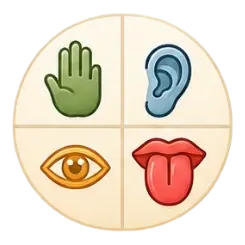
Observing, listening/smelling, asking and palpating - the classic diagnostic methods.
Introduction
Diagnosis in TCM (Si Zhen, 四診, "the four examinations") is a holistic assessment system developed over millennia that lets the physician build a complete picture of the patient by meticulously observing the external signs that reflect the internal state. It is, in essence, the art of reading the body as a text in which every signal carries meaning.
The four methods are: Inspection (Wang Zhen, 望診) — looking at the spirit, the colour, the form and the tongue; Listening and Smelling (Wen Zhen, 聞診) — listening to the voice, the breathing and the cough; smelling the breath and the body; Inquiry (Wen Zhen, 問診) — asking systematically about symptoms and history; and Palpation (Qie Zhen, 切診) — taking the pulse and palpating the abdomen and acupuncture points.
These methods are not used in isolation but together: tongue and pulse are the two most important diagnostic pillars and must be correlated with each other and with the patient's symptoms. The Chinese physician's diagnostic skill is refined over years of clinical practice, and the great masters can identify complex patterns in minutes.
Key principles
- Observing the Shen (spirit) comes first: before examining any other sign, the Chinese physician assesses whether the patient "has Shen" — whether the eyes shine with life, whether the mind is present, whether there is a quality of vitality in the expression. Abundant Shen indicates a favourable prognosis even in serious illness; exhausted Shen ("no light in the eyes") indicates a poor prognosis even in apparently mild illness. This subtle, intuitive but trained capacity is the first diagnostic tool.
- Tongue diagnosis reflects the internal state like a map: the tongue is the only internal organ visible from outside. The root of the tongue reflects the Kidney; the edges the Liver/Gallbladder; the sides the Spleen/Stomach; the tip the Heart/Lung. A pale tongue indicates Qi or Blood deficiency; dark red indicates heat; purple indicates Blood stasis. The coating reveals the state of the Stomach and the level of "pathogenic evil": thin white (normal or mild cold), yellow (heat), grey-black (extreme heat or extreme cold).
- Pulse diagnosis is the most sophisticated art: the physician palpates the radial artery in three positions bilaterally (cun, guan and chi — corresponding respectively to Heart/Lung, Liver/Stomach, Kidney) and at three depths (superficial, middle, deep). The pulse has 28 classical qualities: from "floating" (indicating an exterior pattern or Yin deficiency), to "deep" (interior pattern), "rapid" (heat), "slow" (cold or deficiency), "slippery" (phlegm or pregnancy), "choppy" (Blood deficiency or stasis), "wiry" (Liver tension or pain).
- The Ten Questions (Shi Wen) systematise the inquiry: the Chinese physician asks systematically about 1) chills and fever, 2) sweating, 3) head and body, 4) urine and stool, 5) eating and thirst, 6) pain, 7) sleep, 8) deafness and tinnitus, 9) in women: menstruation and discharge, 10) past history and current medication. Each answer adds information which, combined with tongue and pulse, identifies the pattern of imbalance.
- The diagnostic synthesis produces "patterns" (Zheng), not diseases: the final TCM diagnosis is not a "disease" (like "gastritis" or "anxiety") but a "pattern" or "syndrome" describing that patient's specific imbalance. For example: "Liver Yin vacuity with Yang rising" or "Damp Heat in the Large Intestine". The same symptom (headache) can belong to six different patterns, each with a different treatment. Two patients with the same "Western disease" can receive completely different TCM treatments.
Examples
- Tongue inspection — everyday diagnosis: Look at your own tongue every morning before brushing: is it normal in size or swollen (with teeth marks on the edges → damp-phlegm, weak Spleen)? Is the colour pink-red (normal), pale (Qi/Blood deficiency), red (heat), or purple (stasis)? Does it have a thin white coat (normal), a thick one (overloaded digestion), or a yellow one (internal heat, infection)? Is it moist (normal) or dry (Yin or fluid deficiency)? With daily practice, the tongue becomes a monitoring panel for your internal health.
- Taking a basic pulse: Place the index, middle and ring fingers on the radial artery at the wrist, starting from the wrist crease. The three positions (cun, guan, chi) correspond to the three burners. Assess: is it rapid (>80 bpm → heat) or slow (<60 → cold/deficiency)? Floating (felt with minimal pressure → exterior pattern or deficient Yang) or deep (needs firm pressure → interior pattern)? Is it strong (excess) or weak (deficiency)? Slippery (like jade beads under the finger → phlegm/pregnancy) or choppy (it scrapes → stagnant Blood)?
- Face inspection — the facial map: In TCM the face is a map of the internal organs. Forehead: Heart and Mind. Nose: Spleen-Stomach (the tip) and Lung (the wings). Cheeks: Lung (the lateral zones). Chin: Kidney. Between the brows: Liver. Colour informs too: yellowish → Spleen-Stomach deficiency; red on the cheeks → Lung heat or deficient Lung Yin; grey-green → Liver; blue-black under the eyes → exhausted Kidney; pale white → Qi or Blood deficiency.
- Listening: the voice as diagnosis: Voice quality tells you about the state of Lung and Heart Qi. Strong, clear voice → abundant Qi. Low, weak voice → deficient Qi (especially Lung or Spleen). Hoarse or broken voice → Lung dryness or Heat. Talking a great deal and fast → excessive Heart Yang or phlegm misting the Heart orifice. Frequent sighing → stagnant Liver Qi. Dry cough without sputum → deficient Lung Yin. Cough with white watery sputum → Cold-Damp in the Lung.
Practical applications
- Daily tongue diagnosis: build the habit of looking at your tongue for 30 seconds every morning (before brushing). Photograph it once a week for a month to see how it evolves. Bringing that record to a TCM consultation provides valuable information about patterns over time, not just one isolated moment.
- Self-palpation of the pulse for monitoring: practise taking your own pulse for 60 seconds before getting up each morning. Over time you will learn to tell the variations: faster after a bad night, stronger when you have overeaten, weaker at the end of the working week. You do not need to identify the 28 classical types — the variation from your own "normal" is already useful information.
- A symptom diary by the Chinese clock: note when your most frequent symptoms get worse. If digestion is worst from 9 to 11 a.m. → possible Spleen weakness. If insomnia is worst from 1 to 3 a.m. → possible Liver Heat or deficient Liver Blood. If cough worsens from 3 to 5 a.m. → the Lung is involved. If headache is worst from 11 a.m. to 1 p.m. → the Heart or Small Intestine is involved. Keeping this diary for two weeks can reveal the underlying pattern.
- The Ten Questions as a monthly self-assessment: once a month, answer these and compare with last month. 1) Do you often feel chilly or hot? 2) Do you sweat normally (neither too little nor too much)? 3) Do you have head or body aches? 4) What is your urine like (colour, frequency) and your stool? 5) How are your appetite and thirst? 6) Do you have pain? Where? 7) How do you sleep? 8) Any ringing in the ears? 9) (Women) How is your cycle? 10) Has anything changed significantly? Changes between months indicate improvement or decline.
- Learn the six basic tongue patterns: spend 10 minutes studying images of the six fundamental tongue patterns (look them up in TCM books or diagnostic apps). The six key patterns: 1) Pale with a white coat → Qi/Blood vacuity. 2) Red with a yellow coat → internal Heat. 3) Red without coat → Yin vacuity. 4) Purple or spotted → Blood stasis. 5) Swollen with teeth marks → Damp-Phlegm, weak Spleen. 6) Bright red only at the tip → Heart Heat. With these six you can make a basic reading of your own health.
Related concepts
Health notice. Educational and study content. It describes concepts of Traditional Chinese Medicine and does not replace diagnosis or treatment by a healthcare professional. Needling, medicinal herbs and invasive techniques must be applied by trained professionals. Safety guide.