Meridians
Network of channels that transport Qi and blood throughout the body.
Introduction
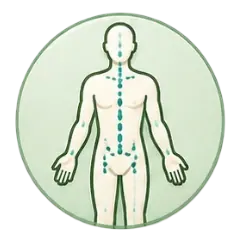
The channels (Jing Luo, 經絡) are a network distributed throughout the body that carries Qi, Blood and fluids to every tissue, organ and limb. "Jing" (經) means "longitudinal passage" and "Luo" (絡) "connecting net": the first are the main channels, the second the branches that interconnect them.
The channel system comprises 12 primary channels (one per Zang-Fu organ), 8 extraordinary or curious vessels (which act as Qi reservoirs and regulate overall energy distribution), 12 divergent channels, 15 Luo-connecting vessels, 12 sinew-muscle zones and the superficial cutaneous vessels. In TCM terms this network is the body's largest communication infrastructure.
Qi circulates through the 12 primary channels in sequence over a 24-hour cycle, staying about two hours in each channel at its peak. Knowing this biological clock explains why certain symptoms appear or worsen at specific hours, and lets you time treatment to each organ's energetic peak.
Key principles
- The 12 primary channels form the central circuit: starting at the Lung (3–5 a.m.), Qi flows to the Large Intestine (5–7 a.m.), Stomach (7–9 a.m.), Spleen (9–11 a.m.), Heart (11 a.m.–1 p.m.), Small Intestine (1–3 p.m.), Bladder (3–5 p.m.), Kidney (5–7 p.m.), Pericardium (7–9 p.m.), Sanjiao (9–11 p.m.), Gallbladder (11 p.m.–1 a.m.) and Liver (1–3 a.m.). The cycle repeats continuously for as long as we live.
- The 8 extraordinary vessels regulate and store energy: the Du Mai (Governing Vessel) runs the posterior midline and governs Yang throughout the body; the Ren Mai (Conception Vessel) runs the anterior midline and governs Yin. The other six connect the 12 channels and act as reservoirs: when the primary channels have excess Qi they store it; when there is deficiency they release it.
- Acupuncture points are access nodes to the system: there are 361 classical points on the 12 primary channels, plus hundreds of extra and auricular points. Each has a precise anatomical location, specific indications and contraindications. A needle, moxibustion, pressure (acupressure) or heat applied at the right point produces measurable physiological change.
- The channel pathway determines how pain is distributed: pain along the Gallbladder channel (temples, side of the neck, ribs, outer thigh, calf down to the fourth toe) indicates GB-system pathology. Knowing the pathways lets you identify which channel is affected before any further examination.
- The Luo-connecting vessels join Interior–Exterior pairs: each Yin channel has a Luo connecting it to its Yang partner. The Lung Luo (LU-7) connects to the Large Intestine, and vice versa. That is why chronic Lung problems can show up in the skin (governed by the LI), and chronic constipation can produce respiratory symptoms.
- The eight influential points (Hui Xue, 會穴) are nodes of maximum Qi concentration for eight tissue categories: BL-11 (Dashu) influences all bone; GB-34 (Yang Ling Quan) all sinews and ligaments; BL-17 (Geshu) the Blood; LU-9 (Tai Yuan) the blood vessels; CV-17 (Shan Zhong) the Qi; CV-12 (Zhong Wan) the Fu (hollow) organs; LV-13 (Zhang Men) the Zang (solid) organs; GB-39 (Xuan Zhong) the marrow. Knowing these eight lets you treat any tissue category systemically, whatever channel is affected: a sinew problem (sprain, tendinitis, contracture) always benefits from GB-34, no matter which channel crosses the area.
Examples
- Lung channel (Hand Tai Yin): Active from 3 to 5 a.m. It leaves the chest (LU-1 Zhongfu) and descends the inner arm to the thumb (LU-11 Shaoshang). It has 11 points. It governs Qi, breathing and the distribution of defensive fluids. LU-7 (Lieque) is the key point of the Ren Mai, indicated in cough, colds, occipital headache and neck problems. When Lung Qi is weak: low voice, spontaneous sweating, sensitivity to wind and frequent colds.
- Liver channel (Foot Jue Yin): Active from 1 to 3 a.m. It starts at the big toe (LV-1 Dadun), ascends the inner leg, encircles the external genitals and ends at the vertex (DU-20, where it meets the Du Mai). It has 14 points. LV-3 (Tai Chong) — the "great surge" — is the most important Yuan point for stress, irritability, headaches and period pain. Insomnia between 1 and 3 a.m. suggests Heat or stagnant Qi in the Liver.
- Stomach channel (Foot Yang Ming): Active from 7 to 9 a.m.: the best moment for the most nourishing meal of the day. With 45 points it is the longest channel. It descends from the face (ST-1 below the eye) to the second toe (ST-45). ST-36 (Zu San Li, "three miles on foot") is the most used point in TCM: it tonifies Qi, Blood and the defences, improves digestion and raises overall energy. Legend has it Chinese soldiers applied moxibustion here so they could march "three miles more".
- Kidney channel (Foot Shao Yin): Active from 5 to 7 p.m. It starts on the sole of the foot (KD-1 Yongquan, "bubbling spring"), ascends the inner leg and abdomen to the collarbone (KD-27). It has 27 points. KD-3 (Tai Xi) is the Yuan point that tonifies both Kidney Yin and Yang, indicated in low back pain, tinnitus, weak knees, premature baldness and reproductive problems. KD-1 (Yongquan) is used in hypertensive emergencies and severe panic states.
Practical applications
- Morning massage following the flow of Qi: on waking (5–7 a.m., the Large Intestine hour), massage the LI pathway from the index finger to the shoulder to stimulate evacuation and start the daily energy cycle. During the Stomach hour (7–9 a.m.) massage the facial pathway and the legs to prepare for digesting breakfast.
- Diagnosing pain by channel: when something hurts, identify the pathway affected. Mid-back pain running to the heel → Bladder channel. Pain in the flank and the fourth toe → Gallbladder channel. Chest pain radiating down the inner arm to the little finger → Heart channel. This orients treatment before a consultation.
- Channel stretching (as in Taoist yoga): each posture stretches specific channels. The "camel" opens the Stomach channel along the front of the body. Seated forward folds stretch the Bladder channel down the whole back line. Practising these stretches consciously activates Qi flow in the corresponding channels.
- The point PC-6 (Nei Guan, "inner gate") on the Pericardium: three fingers from the wrist on the palm side. It is one of the most versatile points in all of TCM: it reduces nausea (effective even in clinical trials for post-operative nausea), calms anxiety, regulates heart rhythm and treats insomnia. An acupressure band over this point can relieve travel sickness.
- A 10-minute daily self-acupressure routine: LI-4 (in the web of the thumb, for headache and the defences), ST-36 (four fingers below the knee, for energy and digestion), SP-6 (four fingers above the inner ankle bone, for gynaecology and digestion — contraindicated in pregnancy), KD-3 (between the inner ankle and the Achilles tendon, for low back pain and vitality), LV-3 (between the first two metatarsals, for stress). Two minutes of circular pressure on each, both sides.
Related concepts
Health notice. Educational and study content. It describes concepts of Traditional Chinese Medicine and does not replace diagnosis or treatment by a healthcare professional. Needling, medicinal herbs and invasive techniques must be applied by trained professionals. Safety guide.