Yin Yang
The fundamental concept of duality and balance in nature and the human body.
Introduction
Yin and Yang are the two primordial forces that shape all of reality. The concept came out of watching natural cycles: day alternating with night, summer with winter, activity with rest. In Chinese, Yin (陰) originally meant "the shady slope of the mountain" and Yang (陽) "the sunny slope" — two aspects of the same thing, each defined by the other.
In the human body, Yin stands for the dense, nourishing substances: blood, fluids, the solid organs, the interior, what is cold and what descends. Yang stands for the dynamic functions: movement, warmth, defence, the exterior, what rises and what is active. Health is not the absence of disease but the constant, dynamic balance between the two. When Yin declines, Yang becomes relatively excessive, producing heat, insomnia and restlessness. When Yang declines, Yin prevails, producing cold, fatigue and oedema.
The Yin–Yang relationship has four fundamental aspects a Chinese physician has to grasp: opposition, interdependence, mutual consumption and transformation. These principles explain everything from normal physiology to how every disease appears and evolves.
Key principles
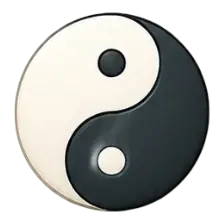
- Opposition and mutual root: Yin and Yang are opposites that define each other. Heat would not exist without cold as a reference, nor activity without rest. Yet each contains the seed of the other: at the peak of Yang, Yin is born, and vice versa. The small dark circle inside the white area of the Taiji symbol says it exactly.
- Interdependence: neither can exist without the other. Qi (Yang) needs Blood (Yin) as its material substrate, and Blood needs Qi in order to circulate. "Qi is the commander of Blood; Blood is the mother of Qi." A pathological excess of one always carries a relative deficiency of the other.
- Mutual consumption and growth: under normal conditions, as Yin grows Yang moderately declines, and the other way round. This rhythmic cycle regulates the day, the seasons and physiological processes. In pathology the balance breaks: an overactive Yang consumes Yin, producing vacuity-heat patterns.
- Mutual transformation: under certain conditions Yin can turn into Yang and vice versa. Extreme cold produces a burning sensation; a high fever can collapse into hypothermia. Therapeutically this principle is used to turn heat into cold (draining fire) or cold into heat (warming the yang).
- Infinite divisibility: within each Yin or Yang category there are further subdivisions. Yin divides into Yin-within-Yin and Yang-within-Yin; Yang into Yang-within-Yang and Yin-within-Yang. Midday (Yang of Yang) is more Yang than the morning (Yang of Yin). This allows an endlessly refined classification of natural and clinical phenomena.
Examples
- Fever and chills: In flu, the initial fever (ascending Yang fighting the external pathogen) alternates with chills (the cold-Yin pathogen blocking Yang). Treatment aims to expel the exterior cold-Yin so defensive Yang can be restored without damaging internal Yin.
- Insomnia from yin vacuity: When Heart and Kidney Yin are exhausted (by stress, overwork or poor nutrition), nocturnal Yang cannot be contained and rises, disturbing the mind. The result: insomnia with heat in the palms and soles, night sweats, and thirst with a preference for small amounts of cold liquid.
- Morning and evening energy: Yang peaks at midday (most energy, mental clarity) and Yin at midnight (greatest regenerative capacity). Syncing activity with this rhythm — hard work in the morning, rest and light digestion in the afternoon — is the basis of living in accord with the Tao.
- Acute versus chronic pain: Acute pain that is stabbing and moving tends to be Yang (excess, heat, movement); dull, fixed pain that improves with warmth and worsens with prolonged rest tends to be Yin (deficiency, cold, stasis). This distinction guides treatment: disperse in the first case, tonify in the second.
Practical applications
- Watch your daily energy: if you flag in the afternoon but struggle to sleep, that is the classic sign of deficient Yin with relatively excessive Yang. Cut back on coffee, add nourishing bone broths and practise restorative yoga instead of intense evening exercise.
- Apply the principle of "tonify the opposite": faced with excess Yang (heat, inflammation, irritability), do not only drain the heat — also tonify Yin with moistening foods such as pear, black sesame, goat's milk and winter melon.
- Adjust your diet by season: in summer (peak Yang) favour cool and raw foods in moderation, mint, cucumber, watermelon. In winter (peak Yin) cook with long, warming methods: stews, broths with ginger and astragalus root.
- Practise Yin–Yang breathing: inhale (Yang, expansion, exterior) for 4 counts; hold for 2 (transformation); exhale slowly (Yin, contraction, interior) for 6–8 counts. This balances the autonomic nervous system and regulates the body's Yin–Yang axis.
- In acupuncture, the Yuan-source point of each channel regulates the Yin–Yang balance of its organ: LU-9 (Taiyuan) for Lung-Yin, LI-4 (Hegu) for Large Intestine-Yang. Check with an acupuncturist which imbalance pattern predominates before acting.
Related concepts
Health notice. Educational and study content. It describes concepts of Traditional Chinese Medicine and does not replace diagnosis or treatment by a healthcare professional. Needling, medicinal herbs and invasive techniques must be applied by trained professionals. Safety guide.