Shāng Hán Lùn: Treatise on Cold Damage
Central text for six-conformation differentiation and reasoned formula use according to dynamic presentation.
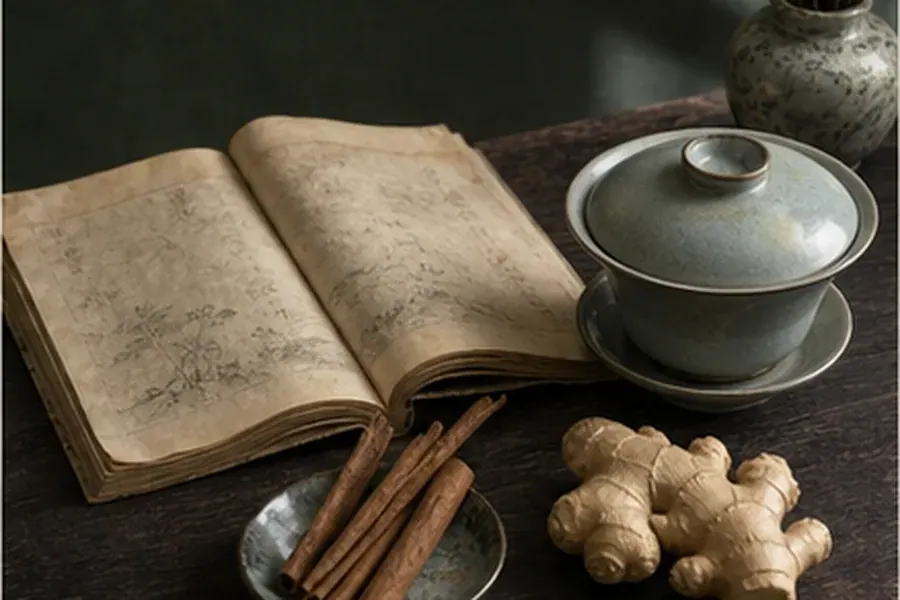
About the work
- Chinese title
- 伤寒论
- Pinyin
- Shāng Hán Lùn
- Period
- Eastern Han, c. third century
- Category
- Formulas and patterns
- Authorship
- Associated with Zhang Zhongjing. The transmitted work derives from later reorganizations of the Shang Han Za Bing Lun.
- Structure
- Concise lines ordered by Taiyang, Yangming, Shaoyang, Taiyin, Shaoyin, and Jueyin, with formulas and modifications.
Legacy
The Shang Han Lun taught the tradition to reason in time. Before it, a medical text described diseases; after it, a medical text describes trajectories: where the process sits, where it is heading, what deflects it. From this comes the habit of pairing a presentation with a formula and modifying that formula when the presentation shifts — a habit that still organizes the teaching of Chinese pharmacology and that founded entire schools, from the Japanese Koho-ha to the classical-formula current in China.
- Pattern reasoning and temporal evolution.
- Architecture of classical formulas.
- Relationship among key signs, pulse, and treatment.
A book broken by history
What the Shang Han Za Bing Lun was, and why it did not reach us whole.
The work Zhang Zhongjing is said to have composed near the end of the Eastern Han was not titled Shang Han Lun but Shang Han Za Bing Lun: “on cold damage and miscellaneous diseases”. A single treatise held both acute-onset presentations and prolonged internal processes. That book was scattered during the wars and dynastic collapse of the third century, and what we read today are two halves reconstituted by later editors: the Shang Han Lun and the Jin Gui Yao Lue.
About Zhang Ji, courtesy name Zhongjing, almost nothing is firmly established. He has no biography in the standard dynastic histories, and the earliest mentions of his name come from later medical sources. The preface ascribed to him, which claims that a large share of his clan died of epidemic disease within a few years, is the most quoted passage of the work and also one of the most contested: much textual scholarship treats it as a later addition, or at least as a reworked text.
- The original title, Shang Han Za Bing Lun, covered cold damage and miscellaneous diseases together.
- The book scattered in the third century and reaches us reconstituted and split in two.
- Almost nothing in Zhang Zhongjing’s biography is verifiable.
- The authenticity of the preface with the epidemic account is under debate.
Shang Han 伤寒 “Cold damage”. In the text it names not a specific infection but a class of acute-onset processes attributed to an external factor entering the body.
Wang Shuhe, the Song, and the received text
Who gathered the fragments, and why “numbered lines” are an editor’s decision.
Tradition credits Wang Shuhe, a Western Jin court physician and author of the Mai Jing, with collecting and reordering the surviving scattered material on cold damage. His recension is the root of all later ones. The decisive step comes in the eleventh century: the Bureau for Revising Medical Texts, the Song imperial office created to edit the medical classics, fixed under Lin Yi the text printed in the 1060s, which forms the basis of the received Shang Han Lun.
That text kept moving. In the twelfth century Cheng Wuji published the first complete commentary, and his annotated version circulated for centuries more widely than the plain Song text; the Song edition is known above all through Zhao Kaimei’s Ming reprint of 1599. Japan additionally transmitted recensions with a different layout that visually separates what appear to be layers of text and gloss. The line numbering used in today’s manuals is a modern reference device — convenient, but not ancient.
- Wang Shuhe gathered and reordered the scattered material in the third century.
- The eleventh-century Song edition is the basis of the text studied today.
- Cheng Wuji’s commentary was for centuries the usual route of access.
- Line numbering is a modern editorial device, not part of the original.
Recension A version of a text produced by gathering, collating, and ordering earlier witnesses. Every recension makes decisions that become part of the text and are rarely flagged to the reader.
The six conformations
What taiyang, yangming, shaoyang, taiyin, shaoyin, and jueyin order — and why they are argued over.
The book’s frame is six rubrics — taiyang, yangming, shaoyang, taiyin, shaoyin, and jueyin — under which the lines are grouped. Each opens with a minimal definition listing the signs that characterize it, and from there the text unfolds variants, complications, and treatment errors. The three yang describe presentations with more reaction and more apparent heat; the three yin, presentations with fewer resources and a drift toward cold and exhaustion. Together they order depth, dynamics, and prognosis at once.
How those six rubrics should be understood is the oldest controversy in the commentarial literature. For some they are the channels of the Neijing; for others, successive stages of an illness; Ke Qin, in the Qing, proposed reading them as “terrains”, territories of the body with their own climate rather than phases of a calendar; contemporary authors of the classical-formula current tend to treat them as combinations of location and nature of the presentation. The text does not adjudicate: it lists cases and leaves the frame open.
- Six rubrics organize the lines: three yang and three yin.
- Each rubric opens with a minimal definition by signs and pulse.
- They order depth, dynamics, and prognosis at once, not only time.
- Their interpretation — channels, stages, terrains, or categories — has been argued for over a thousand years.
Liu Jing 六经 The six conformations. Rendering it “six channels” prejudges the debate: jing here means warp or weave as much as channel, and the text itself never defines the term.
Transmission, error, and spoiled presentations
How the text follows a process that changes — even when what changed it was the physician.
The book’s unit of reasoning is not the disease but the presentation of a moment. That is why the lines chain together: they describe a picture, give the accompanying pulse and signs, then record what happens if it evolves, if two rubrics overlap, or if the treatment applied was not the fitting one. The text has its own terms for these situations — combined presentations, overlapping presentations — and devotes striking space to what follows a mistaken intervention.
That space is the work’s most singular feature. A huai bing, a “spoiled presentation”, is a picture that is no longer the original one because a prior manoeuvre — sweating, inducing vomiting, precipitating, warming with a needle — displaced it. The book does not hide the error: it turns it into study material and instructs the reader to look again. The treatise’s most quoted methodological instruction, to observe pulse and signs and treat according to what is found, appears precisely in that context.
- The unit of analysis is the present presentation, not a fixed diagnosis.
- The text allows for combined and overlapping presentations across rubrics.
- Huai bing: a presentation altered by an unsuitable prior treatment.
- Therapeutic error is documented and studied rather than omitted.
Chuan Bian 传变 “Transmission and transformation”. It names the passage from one presentation to another within the model, whether by its own evolution or through what was done to it.
Formula families and minimal variation
Why the corpus’s formulas are studied in groups, and what changing one component means.
The formulas of the Shang Han Lun are not a hundred independent inventions: they are a handful of base structures with many variants. Around a core — the Guizhi Tang family, the Mahuang Tang family, the Chai Hu family, the Cheng Qi family, the Si Ni family — the text adds one component, removes another, shifts the proportion of a single one, and thereby names a different formula tied to a different presentation. Studying the corpus means learning that system of variations, not memorizing loose recipes.
The sovereign–minister–assistant–envoy hierarchy used to analyse these formulas today does not come from Zhang Zhongjing: it is an earlier scheme from the materia medica tradition that later commentators applied to his corpus. It works well as an analytical tool and should not be confused with the text. It must also be stressed that no composition or quantity is transcribed here: parts of the corpus involve toxic or regulated substances — processed aconite and ephedra are the obvious examples — whose handling is subject to law and professional training.
- A few base structures generate most of the formulas in the text.
- Adding, removing, or reweighting a single component defines a new formula.
- The sovereign–minister–assistant–envoy hierarchy is a later analytical frame applied to the corpus.
- The corpus involves toxic or regulated substances; studying it authorizes neither preparing nor taking them.
Jing Fang 经方 “Classical formulas”. It names the repertoire ascribed to Zhang Zhongjing and, by extension, the current that takes it as a methodological basis over formulas of later periods.
How to study it today
Editions, living schools, and the line between understanding the text and using it.
To read it in a European language, prefer a translation that declares its base text and shows its apparatus: the version by Craig Mitchell, Feng Ye, and Nigel Wiseman (1999) is a standard reference because it documents terminology and translation decisions instead of smoothing them away. Alongside the translation you need commentary, since the lines are deliberately terse and their sense depends on the series they sit in. Reading isolated lines out of sequence is the fastest way to misunderstand the book.
The text remains alive in two traditions best not blurred together. In Japan, the ancient-formula school, articulated in the eighteenth century around Yoshimasu Todo, pared back speculative theory and developed abdominal diagnosis and a direct correspondence between presentation and formula. In China, the classical-formula current reread the six conformations in terms of location and nature. Both are readings of the same text with different assumptions, and neither turns a reader into a prescriber.
- Choose translations that declare base text, terminology, and variants.
- Read each line inside its series, never in isolation.
- Distinguish the Japanese Kanpo reading from the Chinese classical-formula current.
- Historical study authorizes no one to prescribe, prepare, or consume anything.
Fang Zheng Xiang Dui 方证相对 “Formula–presentation correspondence”. A principle associated with the Japanese ancient-formula school: the formula is matched to a set of observable signs rather than to a causal theory.
Annotated passages
太阳之为病,脉浮,头项强痛而恶寒。Tài yáng zhī wéi bìng, mài fú, tóu xiàng jiàng tòng ér wù hán.
When taiyang constitutes the disease: a floating pulse, stiff and painful head and nape, and aversion to cold.
The treatise’s first line sets the pattern for all the rest: a rubric, a pulse, and two or three signs, with no cause and no disease name. Note the economy — three data define the book’s broadest category — and that the definition is one of recognition, not of explanation.
观其脉证,知犯何逆,随证治之。Guān qí mài zhèng, zhī fàn hé nì, suí zhèng zhì zhī.
Observe the pulse and the signs, recognize what transgression has been committed, and treat according to the presentation.
The work’s most quoted methodological line, and it appears while discussing a presentation already spoiled by a prior treatment. It is an instruction in humility as much as in method: when the map stops matching the ground, go back and look at the ground.
阳明之为病,胃家实是也。Yáng míng zhī wéi bìng, wèi jiā shí shì yě.
When yangming constitutes the disease, it is repletion of the stomach domain.
A definition even terser than taiyang’s, and of a different kind: rather than listing signs it names an internal state. “Stomach domain” designates a functional territory of the model, not the anatomical organ, and “repletion” describes a dynamic of accumulation, not a measurable finding.
少阴之为病,脉微细,但欲寐也。Shào yīn zhī wéi bìng, mài wēi xì, dàn yù mèi yě.
When shaoyin constitutes the disease: a faint, fine pulse, and only the wish to doze.
The contrast with taiyang sums up the book’s logic: there, a broad pulse at the surface and a vigorous reaction; here, a barely perceptible pulse and a consciousness withdrawing. The lines in this section are the ones that most often warn about grave prognosis.
How to study it
- Learn the six-conformation logic first.
- Compare formula families, not isolated recipes.
- Work with supervised teaching cases.
Glossary
- 六经Six conformationsLiù jīng
- The six rubrics structuring the treatise. Their nature — channels, stages, terrains, or categories of location and dynamics — has been debated since the earliest commentators.
- 伤寒Cold damageShāng hán
- A class of acute-onset processes attributed in the model to an external factor entering the body. It names no infectious agent and matches no current diagnosis.
- 传变Transmission and transformationChuán biàn
- The passage from one presentation to another within the six-conformation system, whether through spontaneous evolution or as an effect of a prior intervention.
- 坏病Spoiled presentationHuài bìng
- A picture that no longer matches its original rubric because an unsuitable therapeutic manoeuvre displaced it. The text devotes whole series of lines to it.
- 经方Classical formulasJīng fāng
- The repertoire ascribed to Zhang Zhongjing and, by extension, the current that takes it as a methodological basis over the repertoires of later periods.
- 方证相对Formula–presentation correspondenceFāng zhèng xiāng duì
- A principle of the Japanese ancient-formula school: match the formula to a set of observable signs rather than to a theoretical explanation of the cause.
Test what you've learned
Tap each question to see the correct answer and its explanation.
1. What was the Shang Han Za Bing Lun in relation to the Shang Han Lun we read?
- The original work, covering cold damage and miscellaneous diseases, which was scattered
- A Song commentary on the Shang Han Lun
- A pharmacopoeia compiled in the Ming dynasty
- An acupuncture manual predating the Ling Shu
The original treatise held both subjects. After scattering in the third century it was reconstituted and transmitted as two halves: the Shang Han Lun and the Jin Gui Yao Lue.
2. What role did the Bureau for Revising Medical Texts play in the eleventh century?
- It discovered Zhang Zhongjing’s autograph manuscript
- It fixed and published the edition underlying the received text
- It translated the treatise for circulation in Japan
- It added the six conformations, absent until then
The Song imperial office, led by Lin Yi, edited and printed in the 1060s the version at the root of every modern edition.
3. How do the six conformations function within the treatise?
- As a fixed six-day calendar, one day per conformation
- As six specific anatomical organs
- As frames ordering the location, dynamics, and prognosis of a presentation
- As six categories of pulse
The text uses day counts but also contradicts them: the rubrics order where the process sits and where it tends. Their exact interpretation has been debated for centuries.
4. What does the term huai bing designate?
- A terminal disease beyond treatment
- A presentation altered by an unsuitable prior therapeutic manoeuvre
- A contagious disease with an epidemic course
- A chronic process lasting more than a year
Literally a “spoiled presentation”. The treatise documents in detail what follows sweating, precipitating, or warming when they did not fit, and instructs the reader to reassess from scratch.
5. What does studying this corpus allow, and what does it not?
- Preparing the formulas at home following the historical quantities
- Replacing medical evaluation in an acute febrile illness
- Understanding pattern reasoning historically, without qualifying anyone to prescribe
- Identifying the right substance for each isolated symptom
The corpus involves toxic or regulated substances and quantities in Han units that do not convert directly. Its interest for the reader is historical and methodological.
Health notice. Educational and study content. It describes concepts of Traditional Chinese Medicine and does not replace diagnosis or treatment by a healthcare professional. Needling, medicinal herbs and invasive techniques must be applied by trained professionals. Safety guide.