Shén Nóng Běn Cǎo Jīng: Shennong’s Classic of Materia Medica
The earliest transmitted major canon of medicinal substances, organized into upper, middle, and lower grades.
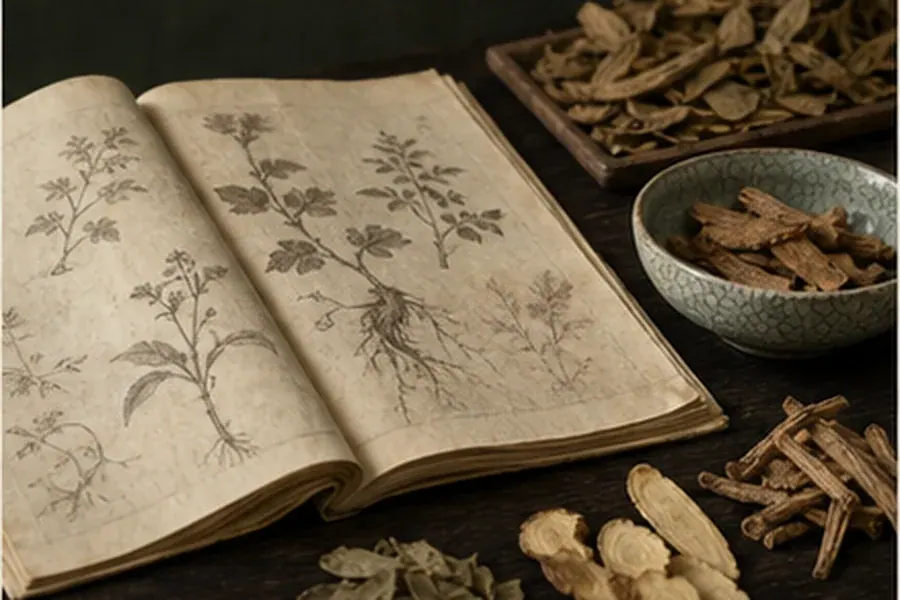
About the work
- Chinese title
- 神农本草经
- Pinyin
- Shén Nóng Běn Cǎo Jīng
- Period
- Late Han; reconstructed from quotations
- Category
- Materia medica
- Authorship
- Symbolically attributed to Shennong. The original was lost, and current versions are later reconstructions.
- Structure
- Traditionally describes 365 substances and summarizes flavor, nature, toxicity, and uses through a three-grade hierarchy.
Legacy
All later Chinese pharmacology speaks the language this book fixed. Flavor and nature as descriptors of a substance, the scale of toxicity, the seven relations that order combinations, and the hierarchy of sovereign, minister, assistant, and envoy still structure the manuals two millennia on. Its influence comes not from the number of materials it gathers — three hundred and sixty-five, against the nearly two thousand of the Bencao Gangmu — but from having created a standard descriptive entry that every later bencao reused.
- Early language of flavor and nature.
- Historical differentiation of toxicity and prolonged use.
- Foundation for later bencao and commentaries.
A classic with no original
How a lost book is rebuilt from the quotations of its successors.
The Shennong Bencao Jing is the earliest transmitted bencao of the Chinese tradition, and yet nobody has seen its manuscript. The text was lost as an independent work, and what is read today are reconstructions: editions assembled by gleaning the quotations that later repertories preserved. The operation is possible because Chinese materia medica was for centuries a cumulative genre, in which each author reproduced his predecessors before adding his own material.
The decisive link is Tao Hongjing, who around the year 500 composed the Bencao Jing Jizhu, doubling the repertory to some seven hundred and thirty entries and — crucially — distinguishing the inherited material from his own additions by ink colour. That marking let philologists separate the layers centuries later. The reconstructions in circulation come mainly from the Qing period, such as Sun Xingyan’s (1799), and from the Japanese scholar Mori Tateyuki (1854); they differ from one another in order and in some entries.
- The original work was lost; no ancient manuscript survives.
- It is reconstructed from quotations in later bencao.
- Tao Hongjing (c. 500) marked inherited text and his own additions in different inks.
- The standard reconstructions are Qing-period and nineteenth-century Japanese, and do not fully agree.
Bencao 本草 Literally “roots and herbs”. The name of the Chinese materia medica genre: repertories of substances with names, properties, and uses, chained together by citation for almost two thousand years.
Shennong, the divine farmer
What the attribution means and the intellectual world the text came from.
Shennong, the “divine farmer”, is a mythical culture hero credited by tradition with inventing agriculture and testing medicinal plants. The legend that he tasted a hundred herbs already circulates in texts older than this work, such as the Han-period Huainanzi: it does not come from the book, the book claims it. Placing a body of knowledge under the name of an ancestral sage was, in early China, a way of granting it authority, not of documenting who wrote it.
The compilation is placed in the late Han, around the first and second centuries, and probably grew by accretion. Its horizon is not merely therapeutic: the vocabulary of the upper grade — “lightening the body”, “extending the years” — belongs to the longevity practices and the pursuit of transcendence characteristic of the period. Reading those formulas as contemporary pharmacological claims is an anachronism; they are the cultural goals of a specific historical moment.
- Shennong is a mythical figure, not an author.
- The hundred-herbs legend predates the book and is external to it.
- Accepted dating: late Han, formed by accretion.
- The upper grade’s language reflects Han-period longevity practices.
Ascribed work A text assigned to a prestigious figure of the past to lend it authority. Recognizing the device prevents mistaking a cultural emblem for a fact about authorship.
The three grades and the 365 materials
The architecture of the text and the logic that orders its entries.
The work distributes three hundred and sixty-five substances — as many as the year has days, an explicit and deliberate correspondence — across three grades. The upper gathers one hundred and twenty materials called “sovereigns”, described as free of toxicity and fit for prolonged use. The middle, another hundred and twenty, are “ministers”, of variable toxicity, whose use calls for discrimination. The lower, one hundred and twenty-five, are “assistants and envoys”, described as mostly toxic and not meant for continued use.
The hierarchy is at once cosmological and practical: the three grades are made to correspond with heaven, man, and earth, and those same titles — sovereign, minister, assistant, envoy — reappear as the grammar of formula composition, ordering each ingredient’s role. It bears stressing that “free of toxicity” is a classical category here, not a safety assessment: among the upper-grade materials stands cinnabar, that is, mercury sulfide.
- 365 substances corresponding to the days of the year.
- Shang (120), Zhong (120), and Xia (125): sovereigns, ministers, assistants, and envoys.
- The grades align with heaven, man, and earth.
- The upper grade’s freedom from toxicity is a classical category, not a warrant of safety.
San Pin 三品 The “three grades” into which substances are classified — upper, middle, and lower — ordered by declared toxicity and by fitness for prolonged use.
Flavor, nature, and toxicity
The descriptive vocabulary the text inaugurates and that is still in use.
Every entry follows a fixed pattern: name and synonyms, flavor, nature, presence or absence of toxicity, what the substance “governs”, and often where it is gathered. The flavors are five — sour, salty, sweet, bitter, acrid; the natures four: cold, hot, warm, and cool. The text does not explain why a plant is cold: it declares it. That minimal format became the standard entry for all subsequent Chinese materia medica.
Flavor and nature are neither organoleptic observations nor thermal measurements: they are conventional descriptors placing a substance within the Yin-Yang system and the Five Phases, allowing it to be reasoned about before being used. The preface itself further warns that the time of gathering, drying in shade or sun, processing, the place of origin, and the distinction between genuine and counterfeit material all change what one is holding: the identity of a drug was never a trivial matter.
- Fixed entry: name, flavor, nature, toxicity, principal action, and provenance.
- Five flavors and four natures as conventional descriptors.
- They are categories of the system, not measured properties.
- The preface already distinguishes origin, gathering, processing, and authenticity.
Qi and Wei 气味 “Nature and flavor”. The descriptive pair with which the tradition characterizes a substance: four thermal natures and five flavors, both understood as categories of a model.
The seven relations between substances
How the text thinks about combinations and about controlling toxicity.
The preface lists seven ways two substances can relate when combined, known as qi qing, the “seven relations”. They run from use on its own, through mutual reinforcement between like materials, one assisting another, one restraining another’s toxicity, reciprocal cancelling of effects, open antagonism, and the active suppression of another’s toxicity. It is the first formulation of a Chinese theory of interaction between materials.
The practical consequence the text itself draws is methodological: combinations that reinforce or assist are suitable, antagonistic ones are to be avoided, and where toxicity is present one turns to the relations that restrain or suppress it. From this grammar derive, centuries later, the mnemonic lists of incompatibilities that circulated from the Jin-Yuan period onward. The scheme is remarkable for its conceptual ambition; it is not, however, a pharmacology of interactions in the current sense.
- Seven relations: alone, mutual reinforcement, assistance, restraint, aversion, antagonism, and suppression.
- The text’s criterion: prefer reinforcement and assistance, avoid antagonism.
- Toxicity is managed through the relations that restrain it.
- Later lists of incompatibilities derive from this scheme but are far later.
Qi Qing 七情 The “seven relations” between combined substances. The term reuses the expression that elsewhere names the seven emotions, with no connection to them.
Why it is not a manual of use
Botanical identity, toxicity, and legality: three mandatory filters.
This book documents how materia medica was thought about two thousand years ago, and that is its value. It does not work as a guide to use, for three cumulative reasons. The first is identity: one historical name has designated different species by period and region, and the best-documented case is substitution by species of the genus Aristolochia, whose aristolochic acid is associated with severe nephropathy and urothelial cancer. Change the name and you change what is in the jar.
The second reason is toxicity: the text includes minerals such as cinnabar, mercury sulfide, and substances handled today under strict control or not used at all. The third is legal: part of the bencao tradition draws on animal materials from species protected under CITES, whose trade is illegal. To this add that the text offers no doses interpretable today. Study it as history of pharmacy; for any decision about health, consult a qualified professional.
- The botanical identity behind a historical name has shifted with time and place.
- The Aristolochia case documents the real harm of a name substitution.
- It includes toxic minerals, such as cinnabar, mercury sulfide.
- Part of the tradition uses species now protected and illegal to trade.
Botanical identity The correspondence between a drug name and the species that actually supplies it. In historical materia medica it is unstable, and verifying it is the first step of any serious reading.
Annotated passages
上药一百二十种为君,主养命以应天,无毒,多服久服不伤人。Shàng yào yī bǎi èr shí zhǒng wéi jūn, zhǔ yǎng mìng yǐ yìng tiān, wú dú, duō fú jiǔ fú bù shāng rén.
The one hundred and twenty upper drugs are the sovereigns; they govern the nourishing of life in correspondence with heaven, are free of toxicity, and taken in quantity or over a long time do not harm the person.
The opening of the upper grade and the matrix of the whole three-grade system. It must be read as a classical classification, not a safety assessment: among these “sovereigns” stands cinnabar, mercury sulfide, and “nourishing life” points to the Han longevity ideal.
药有酸咸甘苦辛五味,又有寒热温凉四气,及有毒无毒。Yào yǒu suān xián gān kǔ xīn wǔ wèi, yòu yǒu hán rè wēn liáng sì qì, jí yǒu dú wú dú.
Drugs have five flavors — sour, salty, sweet, bitter, and acrid — and also four natures — cold, hot, warm, and cool — and some are toxic and some are not.
A single line fixes the descriptive vocabulary Chinese pharmacology would use for two millennia. These are categories of a model, not measurements: “cold” indicates no temperature, and “sweet” no taste perceived in the mouth.
有单行者,有相须者,有相使者,有相畏者,有相恶者,有相反者,有相杀者。凡此七情,合和视之。Yǒu dān xíng zhě, yǒu xiāng xū zhě, yǒu xiāng shǐ zhě, yǒu xiāng wèi zhě, yǒu xiāng wù zhě, yǒu xiāng fǎn zhě, yǒu xiāng shā zhě. Fán cǐ qī qíng, hé hé shì zhī.
Some act alone, some need one another, some assist one another, some fear one another, some detest one another, some oppose one another, and some kill one another. These seven relations are to be considered when combining them.
The first Chinese theory of combination between substances. Its interest is conceptual: it asks systematically what happens when two materials are mixed, including the possibility of restraining one’s toxicity with another. It is not an interaction table in the modern sense.
药有君臣佐使,以相宣摄合和。Yào yǒu jūn chén zuǒ shǐ, yǐ xiāng xuān shè hé hé.
Drugs have sovereign, minister, assistant, and envoy, so as to unfold and restrain one another when combined.
The political metaphor becomes a grammar of composition: a formula is thought of as a court, with a principal ingredient and others that support, moderate, or direct it. This scheme still structures the teaching of formulas.
How to study it
- Study historical names alongside modern botanical identification.
- Do not turn classical descriptions into current doses.
- Compare with current law and pharmacovigilance.
Glossary
- 本草BencaoBěn cǎo
- “Roots and herbs”. The Chinese materia medica genre: repertories of substances with names, properties, and uses, transmitted by cumulative citation for almost two thousand years.
- 三品Three gradesSān pǐn
- Classification into upper, middle, and lower according to declared toxicity and fitness for prolonged use. It is the work’s architecture and corresponds to heaven, man, and earth.
- 四气Four naturesSì qì
- Cold, hot, warm, and cool. Labels of the model that place a substance on the Yin-Yang axis; they describe no measurable temperature.
- 五味Five flavorsWǔ wèi
- Sour, salty, sweet, bitter, and acrid. Linked to the Five Phases, they work as conventional descriptors rather than necessarily as perceived taste.
- 七情Seven relationsQī qíng
- The seven ways two substances may relate when combined, from use on its own to open antagonism and the suppression of another’s toxicity.
- 毒Du (toxicity)Dú
- A classical category combining potency and harmfulness. It marks the limit of prolonged use and orders the three grades; it is not equivalent to a current toxicological assessment.
Test what you've learned
Tap each question to see the correct answer and its explanation.
1. Why are current editions of the work reconstructions?
- Because the original is written in an undeciphered language
- Because the independent text was lost and remade from quotations in later bencao
- Because it survives only in Japanese translation
- Because the author left the work unfinished
The work disappeared as a standalone text. Recovery was possible because later repertories, beginning with Tao Hongjing’s, quoted it extensively and marked their own additions.
2. What accounts for the figure of 365 substances?
- It is the total of plants known in the Han period
- It corresponds to the days of the year
- It derives from the number of acupuncture points
- It is simply the sum of the three grades, with no prior criterion
The correspondence with the calendar is explicit and deliberate: it presents materia medica as a complete order mirroring the annual cycle, rather than as an exhaustive inventory.
3. How does the text describe the upper grade?
- As fast-acting substances for acute cases
- As “sovereigns”, free of toxicity and fit for prolonged use
- As the most expensive and hardest to obtain materials
- As those reserved exclusively for the imperial court
The preface calls them sovereigns and describes them as free of toxicity and not harmful with continued use. It is a classical category: cinnabar, mercury sulfide, is among them.
4. What do the seven relations, or qi qing, refer to?
- The seven emotions that cause illness
- The ways two substances behave when combined
- The seven stages of preparing a drug
- The seven recognized degrees of toxicity
They run from use on its own to open antagonism, and include restraining one substance’s toxicity with another. The term reuses the seven-emotions expression with no connection to it.
5. What is the main problem with using an entry from the text today?
- That classical Chinese has no plant names
- That one historical name has designated different species, with real risks
- That entries do not record the substance’s flavor
- That the work describes only minerals
Botanical identity is unstable. Substitution by species of the genus Aristolochia, associated with nephropathy and urothelial cancer, is the best-documented case of that risk.
Health notice. Educational and study content. It describes concepts of Traditional Chinese Medicine and does not replace diagnosis or treatment by a healthcare professional. Needling, medicinal herbs and invasive techniques must be applied by trained professionals. Safety guide.