Zhēn Jiǔ Jiǎ Yǐ Jīng: Systematic Classic of Acupuncture and Moxibustion
One of the earliest systematizations of channels, points, indications, and techniques from earlier sources.
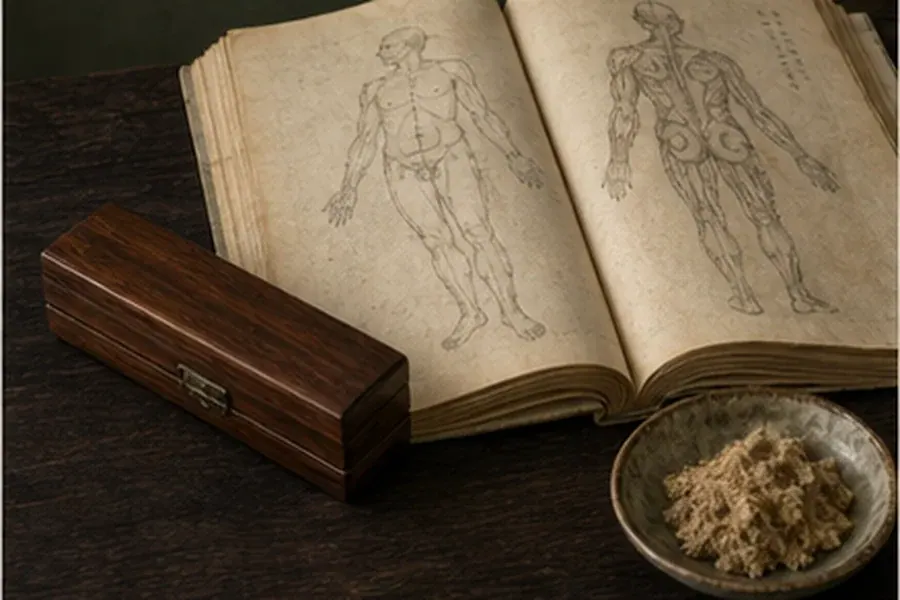
About the work
- Chinese title
- 针灸甲乙经
- Pinyin
- Zhēn Jiǔ Jiǎ Yǐ Jīng
- Period
- Western Jin, c. 282
- Category
- Acupuncture
- Authorship
- Compiled by Huangfu Mi, who organized material from the Su Wen, Zhen Jing, and Ming Tang.
- Structure
- Twelve scrolls and 128 chapters in the received tradition, covering anatomy, channels, points, and disease categories.
Legacy
Every later acupuncture manual — the Song Tong Ren, the Ming Zhen Jiu Da Cheng, the textbooks used in schools today — inherits from this work one apparently minor and in fact decisive decision: that points can be ordered, searched, and looked up. Before the Jiayi Jing there were points; after it there is a system of points. And because it absorbed a text that was later lost, the work is also the indirect archive of a whole layer of Han medical literature.
- Early point location and nomenclature.
- Systematic organization of indications.
- Bridge between the Neijing and later manuals.
Huangfu Mi: a scholar who arrived through illness
Who compiled the work, and why a literatus with no practice ended up writing the first systematic acupuncture manual.
Huangfu Mi (215-282) was not a physician by trade. He was a Western Jin literatus, author of historical and biographical works, who repeatedly declined the offices the court offered him. According to his own preface and his later biography, a prolonged illness — described as a wind disorder accompanied by deafness — pushed him to study the medical texts circulating in his time. Out of that forced reading came an editorial decision: rather than write a new treatise, reorder the ones that already existed.
Two sources should be kept apart. The preface ascribed to Huangfu Mi speaks in the first person about his ailment and his method; the biography preserved in the Jin Shu, compiled in the seventh century, adds the portrait of the reclusive scholar who turns down honours. The second is later historiographical material and follows a literary genre with its own conventions. The image of a sage who becomes a physician out of personal need is plausible and well transmitted, but it is a constructed image, not a case file.
- Huangfu Mi (215-282) was a literatus and historian before he was a medical compiler.
- His route into medicine is explained by the sources as a long personal illness.
- He declined the official posts offered by the Western Jin court.
- The work proposes no new doctrine: it reorganizes earlier material.
Jiayi 甲乙 The first and second of the ten Heavenly Stems, used as serial markers equivalent to “A, B, C”. In the title they signal that the material is systematically arranged, not that the book covers two subjects.
Three books fused into one
The compilation method, and why this work preserves a text that would otherwise be lost.
The preface explains the procedure with unusual clarity. Huangfu Mi worked from three texts: the Su Wen, the Zhen Jing — the “Needle Classic”, which we now read as the Ling Shu — and the Ming Tang Kong Xue Zhen Jiu Zhi Yao, a manual devoted to point location. All three, he says, agreed in substance while repeating and contradicting one another in form. His solution was to dissolve them and recompose them by subject, cutting superfluous rhetoric and duplication, until twelve scrolls remained.
The third of those texts, the Ming Tang, was lost. Because the Jiayi Jing absorbed it by fusing it with the other two, the work has become the principal route of access to that material — but only indirectly: the reader receives Huangfu Mi’s synthesis, not the original. The same preface also carries the earliest surviving testimony identifying the Neijing with the sum of Su Wen and Zhen Jing, a datum Chinese medical philology still cites.
- Declared sources: Su Wen, Zhen Jing (Ling Shu), and Ming Tang Kong Xue Zhen Jiu Zhi Yao.
- The method was thematic: fuse by subject, remove duplication and superfluous rhetoric.
- The Ming Tang was lost; the Jiayi Jing is its main route of access, and an indirect one.
- The received tradition counts twelve scrolls and 128 chapters.
Ming Tang 明堂 “Hall of Light”. In acupuncture literature it names the treatises and charts devoted to point location. The manual of that name used by Huangfu Mi does not survive.
From body to page: how the points are ordered
The double arrangement by anatomical region and by channel that turned a scattered list into a searchable system.
In the Neijing, points appear scattered across chapters on physiology, diagnosis, and technique. The Jiayi Jing gathers and orders them twice. First by region of the body: the head traversed in successive lines, then the face, neck, chest, abdomen, back, and limbs, so that anyone looking for a point can find it by where it is. Then by channel, grouping the points belonging to a single course. Each entry gives the name, surface references for locating it, and associated indications.
That double entry is why the work served as a manual for centuries. It also imposed a format: name, location, indications. Later treatises inherit the scheme even when their contents change. It is worth adding that the surface references are verbal descriptions relative to bones, creases, and depressions on an idealized body, not coordinates: reading them calls for a current anatomical atlas and supervised training.
- It orders points by body region and, in parallel, by channel.
- It fixes an entry format: name, location, indications.
- Later manuals inherit that editorial scheme.
- Locations are verbal surface descriptions, not coordinates usable on their own.
Kong Xue 孔穴 “Aperture” or “hollow”. The ancient term for what modern manuals call an acupuncture point (shu xue 腧穴). It names a palpable depression, not a defined anatomical object.
Ancient names, modern codes
Why an alphanumeric code and a Chinese point name are not quite the same thing.
The points of the Jiayi Jing are identified by Chinese names, many with variants and synonyms the text itself records. The alphanumeric codes that feel familiar today — a channel abbreviation followed by a number — are a twentieth-century convention: the World Health Organization promoted a standard nomenclature for the points of the regular channels, published in 1991, and in 2008 a guide to point locations for the Western Pacific Region. These are instruments of international communication, not the numbering of the ancient text.
The gap matters. The Jiayi Jing’s point count does not match the modern standard, and editions differ among themselves; some ancient names now designate slightly different locations and others have fallen out of use. Matching a third-century name to a contemporary code is a scholarly reconstruction, reasonable in most cases and disputed in a few. Always recording the edition consulted keeps an identification hypothesis from hardening into a fact.
- The text identifies points by name, with synonyms and variants.
- Alphanumeric codes come from twentieth-century standardization promoted by the WHO.
- The ancient point count does not match the current standard.
- Equivalence between an old name and a modern code is a reconstruction, not an identity.
Zhen Jing 针经 “Needle Classic”. The title under which the text we now know as the Ling Shu circulated, and one of the three sources Huangfu Mi declares.
Indications, prohibitions, and the limit of the actionable
What kind of information the indication lists hold, and why they are not a protocol.
Much of the closing scrolls groups clinical pictures — fevers, headaches, digestive disorders, disorders of the senses — and lists the points the tradition associated with each. Alongside those lists the text records prohibitions: regions not to be treated, states in which to refrain, warnings about manipulation. Figures for depth and for moxa applications also appear, expressed in ancient units that are proportional to the body and equivalent to no current metric measure.
This material is the history of therapeutics, not clinical evidence: it records what the tradition associated, not what works. And the figures are not instructions. The system’s unit of length is relative — derived from proportions of the subject’s own body through the bone-measurement scheme inherited from the Ling Shu — so converting it into millimetres is a category error. Needling is an invasive procedure, regulated in most countries, requiring formal training and supervision.
- The closing scrolls link disease categories to specific points.
- The text includes explicit prohibitions and warnings.
- Depths and units are proportional and historical, not metric measures.
- The lists document what the tradition associated; they do not demonstrate efficacy.
Gu Du 骨度 “Bone measurement”. The scheme inherited from the Ling Shu that fixes distances through proportions between bony landmarks on the subject’s own body. It is why ancient units are relative and not convertible into centimetres.
Reading it today
Editions, transmission across East Asia, and the limits of what historical study authorizes.
The text circulating today passed through the Northern Song bureau for revising medical books in the eleventh century, which fixed the printed version from which later editions descend. It had already travelled before that: the statutes regulating medical education in eighth-century Japan list it among the prescribed texts, and the Korean tradition transmitted it as well. For the Western reader a complete English translation exists, published by Yang Shou-zhong and Charles Chace in 1994.
When reading, it helps to separate three layers, as with any classic: the third-century and earlier material, the Song editorial intervention, and the contemporary teaching synthesis that reorganizes everything into a curriculum. Many claims circulating as “the Jiayi Jing says” come from the third. And none of the three qualifies anyone to treat: historical study and clinical practice are distinct activities with distinct legal and training requirements.
- The received version depends on the eleventh-century Song edition.
- It circulated early in Japan and Korea and appears among the texts prescribed for teaching in eighth-century Japan.
- A complete English translation has existed since 1994.
- Always separate ancient text, Song edition, and modern teaching synthesis.
Jin Ji 禁忌 “Prohibitions”. The category under which classical literature gathers the regions, situations, and states in which needling or moxibustion must not be applied.
Annotated passages
黄帝三部针灸甲乙经Huáng Dì Sān Bù Zhēn Jiǔ Jiǎ Yǐ Jīng
Yellow Emperor’s Three-Part Systematic Classic of Acupuncture and Moxibustion.
The full title under which the work was transmitted already says the essential: the “three parts” are the three texts Huangfu Mi fused, and jiayi, the first and second Heavenly Stems, signals orderly arrangement. Attribution to the Yellow Emperor follows the convention of the genre and indicates no authorship.
今有《针经》九卷,《素问》九卷,二九十八卷,即《内经》也。Jīn yǒu Zhēn Jīng jiǔ juàn, Sù Wèn jiǔ juàn, èr jiǔ shí bā juàn, jí Nèi Jīng yě.
Today there exist the Needle Classic in nine scrolls and the Su Wen in nine scrolls: twice nine is eighteen scrolls, and that is the Neijing.
The line from the preface most cited by philologists. It is the earliest surviving testimony identifying the Neijing of the Han catalogues with the sum of Su Wen and Zhen Jing, and it underpins much of the later debate on how the corpus was composed. A bibliographical calculation, not a medical claim.
又有《明堂孔穴针灸治要》,皆黄帝岐伯选事也。Yòu yǒu Míng Táng Kǒng Xué Zhēn Jiǔ Zhì Yào, jiē Huáng Dì Qí Bó xuǎn shì yě.
There is also the Essentials of Needle and Moxa Treatment at the Apertures of the Hall of Light; all of these are matters selected by Huangdi and Qibo.
Here the third source is named: a point-location manual that was subsequently lost. The sentence is therefore one of the few direct testimonies to its existence and its title. Attribution to Huangdi and Qibo is, as always in this genre, a device of authority rather than information about an author.
使事类相从,删其浮辞,除其重复,论其精要。Shǐ shì lèi xiāng cóng, shān qí fú cí, chú qí chóng fù, lùn qí jīng yào.
Making matters of a kind follow one another, cutting away superfluous wording, removing repetitions, and setting out the essentials.
The method described in four clauses. It does not say “I wrote”, it says “I ordered”: the work presents itself as an editorial operation on other people’s texts. That transparency about procedure is precisely what allows it to be used today as a source for reconstructing its materials.
How to study it
- Compare ancient names with modern codes.
- Use current anatomical atlases for safe orientation.
- Study indications as history, not clinical proof.
Glossary
- 甲乙JiayiJiǎ yǐ
- The first and second of the ten Heavenly Stems, used in classical Chinese as serial markers. In the title they signal systematic arrangement, not a content divided in two.
- 明堂Ming TangMíng táng
- “Hall of Light”. In acupuncture it names the genre of treatises and charts devoted to point location. The Ming Tang used by Huangfu Mi has been lost.
- 孔穴Kong XueKǒng xué
- The ancient term for an acupuncture point, literally “aperture”. It names a palpable surface depression, not a defined anatomical structure.
- 针经Zhen JingZhēn jīng
- “Needle Classic”. The title under which the text we now call the Ling Shu circulated. It is one of the three sources declared in the preface.
- 骨度Gu DuGǔ dù
- “Bone measurement”. A scheme of proportions between the subject’s own bony landmarks by which the tradition fixes distances. It makes ancient units relative and not convertible into centimetres.
- 禁忌Jin Ji (prohibitions)Jìn jì
- The classical category gathering regions, situations, and states in which the text forbids needling or moxibustion. It is the most conservative and most quoted part of the technical corpus.
Test what you've learned
Tap each question to see the correct answer and its explanation.
1. Which three texts did Huangfu Mi fuse to compose the work?
- Su Wen, Zhen Jing, and Ming Tang Kong Xue Zhen Jiu Zhi Yao
- Su Wen, Nan Jing, and Shang Han Lun
- Ling Shu, Nan Jing, and Ming Tang Kong Xue Zhen Jiu Zhi Yao
- Su Wen, Jin Gui Yao Lue, and Zhen Jing
The preface names them explicitly. The Zhen Jing, “Needle Classic”, is the text we now read as the Ling Shu; the Ming Tang was a point-location manual.
2. Why is the Jiayi Jing the main route of access to the Ming Tang Kong Xue Zhen Jiu Zhi Yao?
- Because Huangfu Mi reproduced it whole and unchanged
- Because that text was lost and survives only through this recasting and through quotations
- Because the Ming Tang never circulated outside the imperial court
- Because the Jiayi Jing includes its original preface
The access is indirect: what one reads is Huangfu Mi’s thematic synthesis. Attributing a specific line to the lost text requires philological argument.
3. What is the Jiayi Jing’s organizational innovation relative to the Neijing?
- It reduces the regular channels from twelve to six
- It introduces the alphanumeric point codes
- It orders points by body region as well as by channel
- It replaces channel theory with the Five Phases
In the Neijing, points appear scattered. The Jiayi Jing gathers them and makes them searchable through a double entry: by region of the body and by channel.
4. What are codes such as LI4 or ST36?
- The original point numbering of the Jiayi Jing
- Abbreviations introduced by Huangfu Mi in the third century
- A twentieth-century standardization convention, far later than the text
- Shelf marks from the eleventh-century Song edition
They come from the standard nomenclature promoted by the WHO in the twentieth century. The ancient text identifies points by their Chinese names, with synonyms and variants.
5. How should the depths and units appearing in the text be read?
- As millimetres with a fixed equivalence
- As the technical standard currently in force in practice
- As measures identical for every person
- As historical data from a proportional system, which are not instructions
The unit of length derives from proportions of the subject’s own body through the bone-measurement scheme. Converting it into a metric figure and applying it is both a category error and a hazard.
Health notice. Educational and study content. It describes concepts of Traditional Chinese Medicine and does not replace diagnosis or treatment by a healthcare professional. Needling, medicinal herbs and invasive techniques must be applied by trained professionals. Safety guide.