Tongue diagnosis in Chinese medicine: color and coating
Tongue diagnosis (she zhen) is an observation technique of Traditional Chinese Medicine that interprets the color, shape, moisture and coating of the tongue as a reflection of the state of Qi, Blood and the organs. It is part of the four diagnostic methods and is used alongside the pulse and questioning, not on its own.
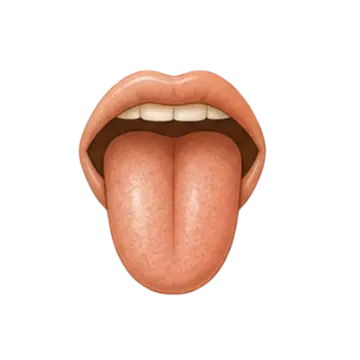
Key points
- In Chinese medicine, the tongue is considered a visible reflection of the body's internal state.
- Practitioners assess the tongue body (color, shape, moisture, mobility) and the coating (color, thickness and texture).
- A tongue considered healthy is pale pink, moist, of normal size and with a thin, white coating.
- Each area of the tongue is traditionally associated with a group of organs.
- Food, drinks, tobacco, medications and lighting can alter the appearance of the tongue and confuse the observation.
Tongue observation, called she zhen (舌诊, shé zhěn) in Chinese, is one of the most recognizable techniques of Traditional Chinese Medicine (TCM). It is part of observation, the first of the four diagnostic methods, and is based on the idea that the tongue visibly reflects the state of Qi (气, qì), Blood (血, xuè), fluids and the organs. In the consultation, the practitioner looks at its color, its shape and the layer that covers it, the coating, and combines what they observe with the rest of the information. On this page we explain what is assessed and how it is interpreted according to tradition, as well as its limits.
What is observed on the tongue?
Tradition distinguishes two main aspects:
- The tongue body (舌质, shé zhì): its color, shape, size, moisture and mobility. It is related mainly to the state of Blood, Qi and the organs, and to the underlying nature of the imbalance.
- The coating (舌苔, shé tāi): the layer covering the surface. It is related to the Stomach and Spleen, to the depth of the problem and to the presence of factors such as cold, heat or dampness.
A tongue considered normal is pale pink, flexible, proportionate in size, moist and has a thin, white coating through which the tongue body can be seen.
Table for interpreting color and coating
The following table lists the most common traditional interpretations. They are guidelines within the TCM framework, not medical diagnoses.
| Aspect | Observation | Traditional interpretation |
|---|---|---|
| Body color | Pale pink | Normal or mild imbalance |
| Body color | Pale | Qi or Blood deficiency; yang deficiency if pale and moist |
| Body color | Red | Heat; if there is no coating, heat from yin deficiency |
| Body color | Dark red or crimson | Intense heat that has penetrated deeply |
| Body color | Purple or violet | Blood stagnation; bluish purple is associated with cold |
| Coating | Thin and white | Normal or superficial involvement |
| Coating | White and thick | Cold or dampness |
| Coating | Yellow | Heat; the yellower, the more intense |
| Coating | Greasy or sticky | Dampness or phlegm |
| Coating | Gray or black | Extreme cold or heat, depending on the moisture of the tongue |
| Coating | Absent or peeled in patches | Deficiency of yin or of Stomach Qi |
As you can see, the table uses the categories of the eight principles, such as cold and heat or deficiency and excess, to classify what is observed.
The shape, moisture and movement of the tongue
Besides color, tradition interprets other characteristics:
Shape and size
- Swollen tongue, often with teeth marks along the edges: associated with Spleen Qi deficiency and accumulation of dampness.
- Thin tongue: associated with Blood or yin deficiency.
- Cracks: may indicate yin deficiency or heat consuming the fluids, although some cracks are constitutional and have no significance.
- Red spots: related to heat.
Moisture
A very wet tongue is associated with cold or dampness; a dry tongue, with heat or lack of fluids.
Mobility
A trembling, stiff or deviated tongue is traditionally interpreted as a sign of internal wind or deficiency. In conventional medicine, changes in tongue mobility can have neurological causes that require urgent medical assessment if they appear suddenly.
The tongue map: areas and organs
Tradition assigns each region of the tongue to a group of organs:
| Area of the tongue | Associated organs |
|---|---|
| Tip | Heart and Lung |
| Center | Spleen and Stomach |
| Sides | Liver and Gallbladder |
| Root (back part) | Kidney, Bladder and intestines |
So, for example, a redder tip would be interpreted as heat in the Heart. These correspondences are based on the theory of the Zang Fu. There are some variants of this map depending on the school.
How to observe the tongue correctly
For the observation to be useful, tradition recommends:
- Using natural light or an even white light.
- Observing it preferably in the morning, before eating, drinking or brushing the tongue.
- Taking into account foods and substances that stain it: coffee, tea, wine, tobacco, candy or some medications.
- Sticking the tongue out in a relaxed and brief way, because tension can change its color.
The tongue changes more slowly than the pulse, so it is considered useful for following progress over weeks. It is usually assessed together with pulse diagnosis.
What the scientific evidence says about tongue diagnosis
From a scientific point of view, the evidence on the diagnostic value of the tongue according to TCM is limited. Interpretation depends to a large extent on the observer's experience and on lighting conditions, and agreement between practitioners is not always high. In recent years, digital tongue photography and analysis systems have been developed to make it more objective, but their clinical usefulness has not been demonstrated.
On the other hand, conventional medicine also pays attention to the tongue: certain changes can be related to nutritional deficiencies, infections, dry mouth or other diseases. That is why, if you notice persistent changes in your tongue, sores that do not heal, lumps or pain, the right thing to do is to see a doctor or a dentist.
Visual tongue atlas
What each feature looks like and which pattern is traditionally associated with it. This is study material: a tongue alone is not enough to diagnose.
Tongue Color
Observe the color of the tongue body.


Tongue Coating
Observe the tongue coating.


Tongue Shape
The shape also reveals imbalances.


Moisture
Observe the degree of tongue moisture.


Frequently asked questions
What does a healthy tongue look like according to Chinese medicine?
According to tradition, a healthy tongue has a lively pale pink color, is flexible, proportionate in size, slightly moist and has a thin, white, well-rooted coating through which the tongue body can be seen. This description is a general guide: small variations are common and the appearance changes with age, diet or time of day.
What does a white tongue mean?
In Chinese medicine, a thin white coating is considered normal. If it is white and thick, it is traditionally associated with cold or dampness. If it is the tongue body that is pale, it is interpreted as Qi or Blood deficiency. From the standpoint of conventional medicine, a white tongue can be due to causes such as dry mouth or oral thrush, so it is advisable to see a doctor if it persists.
What does a tongue with teeth marks indicate?
A swollen tongue with teeth marks along the edges is traditionally interpreted as a sign of Spleen Qi deficiency, often with accumulation of dampness. It is a common finding and, on its own, does not indicate disease. In conventional medicine, an enlarged tongue has various causes that should be assessed by a health professional.
When is the best time to look at the tongue?
It is recommended to look at it in natural light, preferably in the morning and before brushing the tongue, eating or drinking. It is best to avoid foods and drinks that stain it, such as coffee, tea, candy or some juices. The tongue should be stuck out in a relaxed way and only briefly, because holding it out with tension can change its color.
Health notice. This content is educational and describes concepts of Traditional Chinese Medicine together with the available scientific evidence. It does not replace diagnosis or treatment by a healthcare professional. If symptoms are persistent or severe, consult your doctor. Safety guide.