Pulse diagnosis in Chinese medicine: positions and types
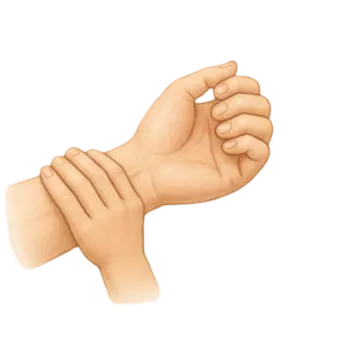
Pulse diagnosis (mai zhen) is a palpation technique of Traditional Chinese Medicine in which the radial pulse of both wrists is assessed at three positions (cun, guan and chi) and at three depths. Its rate, strength, rhythm and shape are interpreted as a reflection of the state of Qi, Blood and the organs.
Key points
- The pulse is taken at the radial artery of both wrists, in an area called cunkou.
- Three fingers are used on three positions: cun (distal), guan (middle) and chi (proximal).
- Each position on each wrist is traditionally associated with one or more organs.
- Practitioners assess depth, rate, strength, rhythm, width and the shape of the wave.
- Tradition describes around 28 types of pulse, although in practice several features are combined.
Taking the pulse, called mai zhen (脉诊, mài zhěn), is probably the most characteristic technique of Traditional Chinese Medicine (TCM) and also one of the hardest to master. It is part of palpation, the fourth of the four diagnostic methods. With three fingers placed on the wrist, the practitioner tries to perceive not only how many times the heart beats per minute, but also the depth, strength and shape of the pulse. According to tradition, these qualities reflect the state of Qi (气, qì), Blood (血, xuè) and the organs. The Huangdi Neijing already pays attention to the pulse, and in the 3rd century Wang Shuhe systematized it in the Mai Jing (脉经, "Pulse Classic").
Where is the pulse taken in Chinese medicine?
Although ancient texts describe several locations, current practice focuses on the radial pulse of both wrists, in the area called cunkou (寸口, cùn kǒu). Three positions are distinguished there:
- Cun (寸, cùn): the one closest to the hand (distal).
- Guan (关, guān): the middle position, at the level of the styloid process of the radius, the small bone that sticks out at the wrist.
- Chi (尺, chǐ): the one closest to the elbow (proximal).
The practitioner first locates guan with the middle finger and then places the index finger on cun and the ring finger on chi.
The three positions and their associated organs
Each position on each wrist is traditionally related to one or more Zang Fu organs. The most widespread distribution is the following, although there are variants depending on the school:
| Position | Left wrist | Right wrist | Traditional region |
|---|---|---|---|
| Cun (distal) | Heart | Lung | Upper burner (chest) |
| Guan (middle) | Liver and Gallbladder | Spleen and Stomach | Middle burner (upper abdomen) |
| Chi (proximal) | Kidney (yin) | Kidney (yang) | Lower burner (lower abdomen) |
So, for example, a weak pulse at the chi position on both wrists would be interpreted as a sign of Kidney weakness.
The three depths and the qualities of the pulse
In addition to the positions, three levels of pressure are assessed: superficial (light pressure), middle and deep (firm pressure). Traditionally, the superficial level is related to the exterior and Qi, and the deep level to the interior, Blood and yin.
At each position and level, the practitioner pays attention to:
- Depth: whether the pulse is felt better at the surface or deep down.
- Rate: traditionally measured in beats per breathing cycle of the practitioner; about four or five beats per breath are considered normal.
- Strength: whether it beats strongly or is weak.
- Rhythm: regular or irregular.
- Width and length: thin or broad, short or long.
- Shape of the wave: smooth, tense, choppy, and so on.
A pulse considered healthy is regular, neither superficial nor deep, neither fast nor slow, has moderate strength and a soft, flexible quality. Tradition says it has "spirit, Stomach Qi and root".
Common pulses and their traditional interpretation
Tradition describes around 28 types of pulse. Li Shizhen, author of the Bencao Gangmu, described 27 in a treatise on the pulse that became a reference. These are some of the most common:
| Pulse | Hanzi and pinyin | Description | Traditional interpretation |
|---|---|---|---|
| Floating | 浮, fú | Felt with light pressure and weakens when pressed | Exterior pattern |
| Deep | 沉, chén | Only felt with firm pressure | Interior pattern |
| Slow | 迟, chí | Fewer than four beats per breath | Cold |
| Rapid | 数, shuò | More than five beats per breath | Heat |
| Weak or empty | 虚, xū | No strength at any level | Qi or Blood deficiency |
| Full | 实, shí | Strong at all levels | Fullness or excess |
| Slippery | 滑, huá | Smooth, like rolling pearls | Phlegm, dampness, food retention; also in pregnancy |
| Choppy | 涩, sè | Rough, uneven | Blood stagnation or deficiency |
| Wiry | 弦, xián | Taut, like the string of an instrument | Liver disharmony, pain |
| Tight | 紧, jǐn | Taut, like a twisted rope | Cold, pain |
| Thin | 细, xì | Thin as a thread, but distinct | Blood or yin deficiency |
As you can see, the first pairs in the table correspond to the eight principles: exterior and interior, cold and heat, deficiency and excess.
How is the pulse taken in a consultation?
Tradition recommends taking the pulse with the person calm, sitting or lying down, after a few minutes of rest and with the arm relaxed at heart level. It is best to avoid doing it right after eating, exercising or drinking coffee. The practitioner first examines the three positions at once and then each one separately, on both wrists, for at least one minute. The result is compared with what was observed in tongue diagnosis and in questioning.
Scientific limits of pulse diagnosis
Taking the pulse according to TCM is a subjective skill that depends heavily on experience. Studies that have evaluated its reliability suggest that agreement between practitioners is variable and often low, and it has not been shown that it can detect specific diseases. Sensors are being developed to record the pulse objectively, but their clinical usefulness has not yet been established.
For this reason, Chinese pulse diagnosis should be understood within its traditional framework. A pulse that is very irregular, very fast or very slow, or accompanied by dizziness, chest pain or shortness of breath, requires immediate medical assessment.
Frequently asked questions
What are the cun, guan and chi positions?
They are the three positions into which the radial pulse at the wrist is divided. Guan (关) is located at the level of the styloid process of the radius; cun (寸) lies just in front of it, toward the hand; and chi (尺) lies behind it, toward the elbow. The practitioner places the index finger on cun, the middle finger on guan and the ring finger on chi, and assesses them on both wrists.
How many types of pulse are there in Chinese medicine?
Tradition usually describes 28 types of pulse, a classification found in classical works such as those of Li Shizhen, who described 27, and later expanded. Among the most common are the floating, deep, slow, rapid, weak, full, slippery, choppy, wiry and thin pulses. In practice, a person's pulse usually combines several of these features.
Can a disease be diagnosed from the pulse alone?
Tradition insists that the pulse should be assessed together with the tongue, observation and questioning, never on its own. In addition, pulse diagnosis identifies Chinese medicine patterns, not specific diseases. There is no solid evidence that it can detect diseases, and its interpretation varies considerably between practitioners.
How is it different from the pulse a doctor takes?
In conventional medicine, the pulse is taken mainly to measure heart rate, rhythm and sometimes amplitude. In Chinese medicine, practitioners also assess depth, the shape of the wave and the differences between the three positions on each wrist, which are related to different organs according to traditional theory.
Health notice. This content is educational and describes concepts of Traditional Chinese Medicine together with the available scientific evidence. It does not replace diagnosis or treatment by a healthcare professional. If symptoms are persistent or severe, consult your doctor. Safety guide.