Zang Fu: The Organs and Viscera in Chinese Medicine
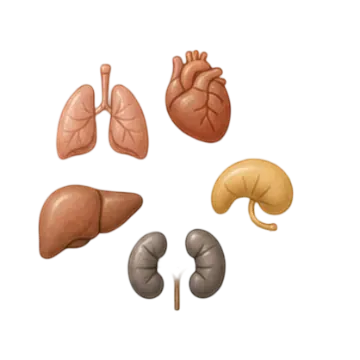
The Zang Fu are the system of organs and viscera in traditional Chinese medicine: five yin organs (Zang) that store vital substances and six yang viscera (Fu) that transform and transport. They do not correspond exactly to the anatomical organs, but to sets of interrelated physiological, emotional and energetic functions.
Key points
- The five Zang (Liver, Heart, Spleen, Lung and Kidney) store and preserve vital substances such as Qi, Blood and Essence.
- The six Fu (Gallbladder, Small Intestine, Stomach, Large Intestine, Bladder and Sanjiao) receive, transform and excrete.
- The Pericardium is often considered a sixth yin organ that protects the Heart and has its own meridian.
- Each Zang is paired with a Fu and associated with an element, a tissue, a sense organ and an emotion.
- The Zang Fu are a traditional functional model and should not be confused with the anatomy and physiology of modern medicine.
The theory of the Zang Fu (脏腑, zàng fǔ) is one of the pillars of traditional Chinese medicine (TCM). It describes how the body works through a set of organs and viscera that relate to one another, to the vital substances and to the environment. To understand it, it helps to keep one idea in mind from the start: when Chinese medicine talks about the Heart or the Spleen, it does not refer only to an anatomical structure, but to a network of physical, mental and emotional functions. This model, already present in the Huangdi Neijing, was built from clinical observation over centuries and remains the basis of traditional diagnosis.
What are the Zang and the Fu?
The Zang (脏, zàng) are organs considered solid and yin in nature. Their main function is to produce, store and preserve the vital substances: Qi (气, qì), Blood (血, xuè), Body Fluids (津液, jīn yè) and Essence (精, jīng). According to the classical texts, they "store and do not discharge."
The Fu (腑, fǔ) are hollow viscera of yang nature. They are responsible for receiving food, digesting it, separating what is useful from what is waste and eliminating the residues. They are said to "transmit and not store," so their proper functioning depends on staying in motion.
This distinction rests on the theory of yin and yang: what preserves and nourishes is yin; what transforms and moves is yang.
Table of the five Zang and the Pericardium
Tradition speaks of five Zang, to which the Pericardium is usually added as the protective organ of the Heart. The table summarizes their main traditional functions.
| Organ (Zang) | Hanzi and pinyin | Element | Traditional functions | Opens into / tissue | Associated emotion |
|---|---|---|---|---|---|
| Liver | 肝, gān | Wood | Stores Blood; ensures the free flow of Qi | Eyes / tendons | Anger |
| Heart | 心, xīn | Fire | Governs Blood and the vessels; houses the Spirit (Shen) | Tongue / vessels | Joy |
| Spleen | 脾, pí | Earth | Transforms and transports food; keeps Blood in the vessels | Mouth / muscles | Worry |
| Lung | 肺, fèi | Metal | Governs Qi and respiration; disperses and descends | Nose / skin | Sadness |
| Kidney | 肾, shèn | Water | Stores Essence; governs water and growth | Ears / bones | Fear |
| Pericardium | 心包, xīn bāo | Fire | Protects the Heart from external attacks | — | Joy |
The correspondences with elements, senses and emotions come from the theory of the five elements, which is used to explain how the organs nourish and control one another.
Table of the six Fu viscera
| Viscus (Fu) | Hanzi and pinyin | Paired Zang | Traditional functions |
|---|---|---|---|
| Gallbladder | 胆, dǎn | Liver | Stores and excretes bile; related to decision-making |
| Small Intestine | 小肠, xiǎo cháng | Heart | Receives digested food and separates the pure from the impure |
| Stomach | 胃, wèi | Spleen | Receives and "ripens" food; its Qi descends |
| Large Intestine | 大肠, dà cháng | Lung | Absorbs fluids and eliminates waste |
| Bladder | 膀胱, páng guāng | Kidney | Stores and excretes urine |
| Sanjiao (Triple Burner) | 三焦, sān jiāo | Pericardium | Passageway for Qi and water through the three "burners" |
In addition, Chinese medicine describes the so-called extraordinary viscera (奇恒之腑, qí héng zhī fǔ): brain, marrow, bones, vessels, uterus and the Gallbladder itself. They have the form of a viscus but store substances, like the Zang.
How do the organs relate to one another?
No organ works in isolation. TCM describes several types of relationship:
Interior-exterior pairs
Each Zang is linked to a Fu through their meridians: Lung with Large Intestine, Spleen with Stomach, Heart with Small Intestine, Kidney with Bladder, Pericardium with Sanjiao, and Liver with Gallbladder. Traditionally, an imbalance in one is considered able to show up in the other.
Relationships among the Zang
The Spleen produces Qi and Blood from food, the Heart circulates the Blood, the Liver stores it and the Kidney preserves the Essence that nourishes the others. The Lung and the Kidney work together in respiration: the Lung is said to "descend" Qi and the Kidney to "receive" it.
Relationship with the vital substances
The Zang Fu produce and regulate the vital substances. In turn, those substances nourish the organs. That is why traditional diagnosis often speaks of patterns such as "Spleen Qi deficiency" or "Liver Qi stagnation."
What is Zang Fu theory used for in practice?
In traditional practice, the Zang Fu are used to organize signs and symptoms into patterns. A TCM practitioner looks at the tongue, takes the pulse and asks about digestion, sleep or mood, and tries to identify which organs are involved and in what way. This process is described in the four diagnostic methods.
For example, tiredness, poor appetite and loose stools would traditionally be interpreted as signs of Spleen weakness. Irritability, tension in the flanks and frequent sighing would be associated with the Liver.
The time of day when, according to tradition, each organ is at its peak activity is shown in the organ clock.
Traditional concept and modern medicine
It is important not to confuse the two frameworks. The Zang Fu are a traditional theoretical model that does not correspond to current anatomy or physiology, and a diagnosis of "Kidney deficiency" does not mean that there is kidney disease. Likewise, a kidney disease diagnosed by conventional medicine is not necessarily interpreted as a problem of the Kidney in the Chinese sense.
This model is useful for understanding how Chinese medicine reasons, but its value as a diagnostic tool has not been demonstrated as solidly as the methods of evidence-based medicine. For any persistent symptom, the prudent course is to consult a health professional and not to replace a medical diagnosis with a traditional assessment.
Frequently asked questions
Is the Liver in Chinese medicine the same as the anatomical liver?
Not exactly. In Chinese medicine the Liver is a set of functions: storing Blood, ensuring the free flow of Qi, and relating to the tendons, the eyes and anger. Some functions partly overlap with those of the anatomical liver, but many do not. That is why popular texts often capitalize the organs, to distinguish the traditional concept from the physical organ.
What is the difference between the Zang organs and the Fu viscera?
Traditionally, the Zang are solid organs of yin nature that store vital substances and must not be emptied. The Fu are hollow viscera of yang nature that receive, digest, transport and eliminate, so they must keep moving and not retain. Each Zang is related to a Fu through their meridians, forming interior-exterior pairs.
What is the Sanjiao or Triple Burner?
The Sanjiao is a Fu viscus with no specific anatomical form. It is described as three regions of the trunk (upper, middle and lower) through which Qi and fluids circulate. Its interpretation has been debated throughout history; in practice it is understood as a pathway for communication and for regulating water metabolism among the different organs.
Why does the Pericardium sometimes appear as a sixth organ?
The Pericardium, or Heart Protector, is described as the protective envelope of the Heart. Although the classics speak of five Zang, the Pericardium has its own meridian, which is paired with the Sanjiao. This completes the twelve main meridians, six yin and six yang, which explains why it is sometimes counted as a sixth yin organ.
Health notice. This content is educational and describes concepts of Traditional Chinese Medicine together with the available scientific evidence. It does not replace diagnosis or treatment by a healthcare professional. If symptoms are persistent or severe, consult your doctor. Safety guide.