Meridians: The chain
Twelve channels, one circuit. 10 activities, about 13 minutes.
What a channel is
In Chinese medicine, qi —the energy that moves and warms the body— flows through twelve channels, also called meridians. Each one is named after the organ it reaches and is either yin or yang.
- Channel or meridian
- pathway along which qi flows
- Yin
- the inner: inner side of arms and legs
- Yang
- the outer: outer side, back and head
- Handover
- where one channel ends and the next begins
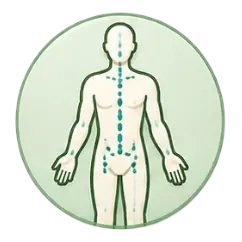
The chain has a logic, it is not a list
Channels hand over at the hands and the feet, alternating yin and yang. If you know where one ends, you know where the next begins without memorising the order.
- Arm yin channel
- ends at the hand
- Arm yang channel
- rises to the face
- Leg yang channel
- descends to the foot
Common mistake: Reciting all twelve without knowing why that order.
The first round, with names
The circuit starts at the Lung and runs through the four groups in order. Each group holds three channels, so the round repeats three times.
- Lung
- arm yin
- Large Intestine
- arm yang
- Stomach
- leg yang
- Spleen
- leg yin
Common mistake: Going back to the Lung after the Spleen: the next arm yin is the Heart, which opens the second round.
Order the handover starting from Lung.
- Lung
- Large Intestine
- Stomach
- Spleen
- Heart
A channel is not a nerve or a vein
A channel is defined by what it connects and what it does, not by a tissue you can dissect. It has a surface pathway, an internal branch reaching its organ, and a time slot. Those three are what get used in clinic.
- External pathway
- where you needle and where it hurts
- Internal branch
- links to its organ and its pair
- Time slot
- when it is at its peak
Common mistake: Hunting for the exact anatomical equivalent before using the map. The map works through what it relates.
Where does an arm yin channel hand over to the next yang channel?
Solid organ, yin channel; hollow organ, yang channel
Chinese medicine splits the organs into two groups: solid ones store and produce; hollow ones receive, transform and pass things on. Each group carries one channel polarity.
- Lung, Heart, Spleen, Liver, Kidney, Pericardium
- solid organs: yin channel
- Intestines, Stomach, Bladder, Gallbladder
- hollow organs: yang channel
- San Jiao
- formless organ that distributes water and warmth: yang channel
Sort each channel by its polarity.
- Lung
- Large Intestine
- Kidney
- Bladder
- Liver
- Gallbladder
If the circuit of twelve is continuous, what does a blockage in a single channel imply?
Why is it worth knowing the order of the chain and not just the twelve names?

Level complete!
Stretch covered. The next one will feel shorter.
Did you enjoy it? In the app you save your progress, review what you forget and unlock the 770 exercises.
Study content. The exercises describe concepts of Traditional Chinese Medicine; they are not medical advice.