Pulse diagnosis
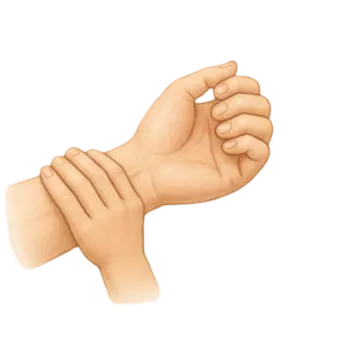
By resting three fingers on the wrist you read at what depth, at what speed and with how much reserve the body is working right now.
What this method answers
- Is the problem on the surface or has it already settled inside?
- Does the body have reserve to fight with, or is it running on what is left?
- Do the tongue and the pulse tell the same story, or contradict each other?
How to study it
- Learn the normal pulse on yourself first: take it at the same hour for several days until you know what it feels like when nothing is wrong.
- Practise one distinction at a time. Start with superficial versus deep, the one that is easiest to feel.
- Before giving anything diagnostic weight, rule out what alters the pulse on its own: exercise, a meal, cold, a fright.
- Always cross-check against the tongue. When both agree you can trust it; when they do not, you have a question, not a conclusion.
What the pulse tells you that nothing else does
The pulse measures the state of the system at the moment you touch it, not what the patient remembers.
The tongue changes slowly: it reflects weeks. What the patient says passes through memory and through how they explain themselves. The pulse is what is happening under your fingers right now: how deep the conflict is being fought, how hard the body is pushing, whether something has jammed. That is why the pulse breaks the tie when the other examinations disagree.
Think of a building with a plumbing fault. The neighbour tells you what he hears; the stain on the wall tells you it has been weeks. The pulse is putting your hand on the pipe: you feel the actual pressure, now. None of the three is redundant, but only one is in the present tense.
- Compare the timescales: the tongue changes over weeks, the pulse can change within hours.
- When the story and the tongue contradict each other, see what the pulse says.
- Take the pulse before deciding what you expect to find.
- Write down what you feel in your own words, even if you do not yet know the technical name.
脉诊 (mài zhěn), pulse diagnosis Palpating the artery at the wrist in three positions and three depths to read the state of Qi (the body's functional energy) and Blood.
Three fingers, three pressures
Before interpreting anything, place your fingers properly and rule out what changes the pulse without being illness.
Index, middle and ring finger on the radial artery, with the middle finger over the bony prominence of the wrist. You feel the same spot three times: barely brushing, at medium pressure, and pressing down close to the bone. Give each wrist at least a minute and compare the two.
Think of tuning a guitar with the radio on. Before declaring the string out of tune, you switch the radio off. A recent meal, a flight of stairs, cold hands, an argument in the waiting room or a pregnancy all change the pulse without anything to interpret. That is the radio, and you switch it off by asking.
- Forearm supported, palm up, wrist at the level of the heart.
- Ask before you touch: exercise, food, cold, a recent upset, possible pregnancy.
- Allow for age (children run faster), build (in slim people the pulse sits nearer the surface) and season (spring tends towards wiry, summer towards full).
- Feel both wrists before concluding: the difference between them is data too.
- If any of those factors is in play, take it again later instead of interpreting.
举按寻 (jǔ àn xún): lift, press, seek The three pressure levels used to explore each position: brushing the skin, medium pressure, and pressing down to the bone.
Floating or deep: where the fight is happening
The depth at which you find the pulse tells you whether the problem is on the surface or already inside.
If the pulse is clear when you brush the skin and fades when you press, it is floating (浮脉, fú mài). If it only appears when you press close to the bone, it is deep (沉脉, chén mài). Floating reads as exterior: the body is fighting at the skin, typical of the first days of a cold. Deep reads as interior: the problem has settled in, or the Yang (the function that warms and moves) lacks the strength to carry the pulse upwards.
Think of a buoy and an anchor. If the illness floats at the surface, the body fights up there and the pulse comes out to meet your fingers. If it has settled inside, you have to push down to the bone to find it. You are not measuring strength: you are measuring at what depth the fight is happening.
- Go through the same position three times — brushing, medium, down to the bone — and mark where the beat is clearest.
- Floating and strong: pathogen outside, body responding. Floating and empty when you press: the pulse is up there because there is not enough Yin holding it down.
- Deep and strong: something dense stuck inside. Deep and weak: insufficient Yang.
- In very slim people the pulse comes up sooner; in heavier people it sits further in. Adjust your reference to the person.
表里 (biǎo lǐ): exterior and interior The axis that locates the problem: in the skin and channels (exterior) or in the organs (interior). The pulse reads it through depth.
Rate and strength: the thermometer and the scoreboard
Rate points to cold or heat; strength says whether the body is holding out or worn down.
Slow (迟脉, chí mài: under about 60 beats a minute) reads as cold, because cold slows circulation. Rapid (数脉, shuò mài: above about 90) reads as heat. Strength is another matter: a full pulse (实脉, shí mài) pushes back against your fingers at every depth, while an empty one (虚脉, xū mài) gives way as soon as you press.
Rate is the thermometer: it says whether the system is running hot or slowed down. Strength is the scoreboard: it says who is winning between what attacks and what defends. A rapid, strong pulse is a feverish body still fighting; a rapid, weak pulse is a body racing because it has no reserve left. Same speed, opposite reading.
- Count for a full minute, not fifteen seconds multiplied by four.
- The classical method counts beats per breath of the examiner: four or five is normal.
- For strength, compare medium pressure with deep: if it empties when you press, that is deficiency.
- Ask the two questions separately, then combine: rapid and strong, rapid and weak, slow and strong, slow and weak are four different readings.
虚实 (xū shí): deficiency and excess If the pulse keeps its strength when you press, there is something to fight (excess); if it empties, what is missing is reserve (deficiency).
A pulse is never just one thing
In practice you find two or three qualities at once, and it is their combination that says something.
Textbooks present the qualities one by one because they have to be named, but under your fingers they arrive mixed. A “wiry and rapid” pulse is not a wiry pulse plus a rapid one: wiry says something is taut and not circulating, and rapid adds heat to that tautness. Each quality answers a different question — depth, rate, strength, shape — which is why they can coexist without contradicting each other.
Think of describing someone walking: you can say how fast they go, how heavily they tread, and whether they move stiffly or loosely. Three separate observations of one walk, and none cancels the others. The pulse works the same way: if you try to pick which quality it “really is”, you are throwing information away.
- Note each axis separately before interpreting: depth, rate, strength and shape.
- Read the combination as a sentence — “taut” plus “with heat” — not as two loose diagnoses.
- If the six positions do not agree, do not force a single pulse: disagreement between positions is itself a finding.
- When pulse and tongue contradict each other, the tongue usually rules on the chronic and the pulse on the acute.
Wiry pulse (弦脉, xián mài) It feels straight and taut under the fingers, like an instrument string. It is the quality that most often pairs with others, and tends to accompany whatever is tense or held in.
Health notice. Educational and study content. It describes concepts of Traditional Chinese Medicine and does not replace diagnosis or treatment by a healthcare professional. Needling, medicinal herbs and invasive techniques must be applied by trained professionals. Safety guide.