Hegu (LI4)
Hegu (LI4), “Joining Valley”, is a point on the Large Intestine meridian. It is point 4 of the 20 on the channel. Expels Wind-Cold, releases the exterior, regulates Stomach and Large Intestine Qi, relieves pain.
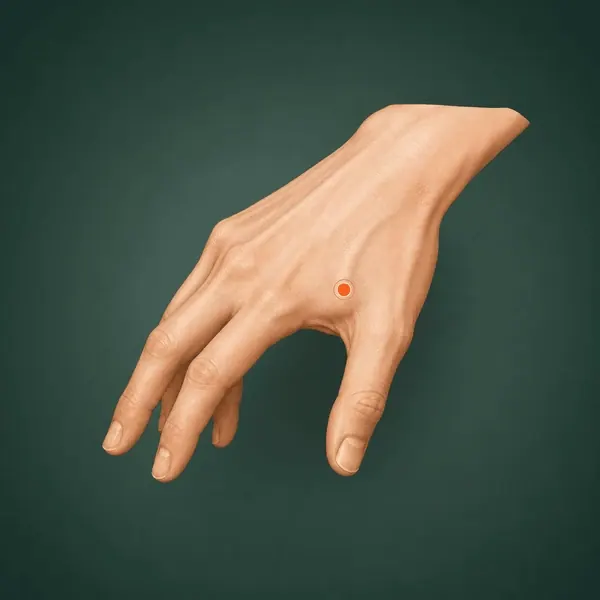
Location
Dorsum of the hand, between the 1st and 2nd metacarpals, at the midpoint of the 2nd metacarpal.
Functions according to tradition
Expels Wind-Cold, releases the exterior, regulates Stomach and Large Intestine Qi, relieves pain. Master point for face and mouth.
Traditional indications
- Headache
- Toothache
- Nasal congestion
- Fever
- Constipation
- Facial pain
- Common cold
Indications described by tradition; they do not amount to proven clinical effectiveness for each one.
What its classification means
Where the original Qi of the organ manifests. Tradition uses it both to examine and to treat the channel's organ.
It belongs to the small group of points that tradition associates with an entire region of the body (Zusanli with the abdomen, Weizhong with the back, Lieque with the head and nape, Hegu with the face and mouth…).
Precautions
Contraindicated during pregnancy.
Points on other channels with similar indications
They share several traditional indications with this point. Comparing them helps understand why one or the other is chosen.
- ST44 Neiting (Stomach): Facial pain, Fever, Toothache
- ST3 Juliao (Stomach): Nasal congestion, Toothache
- BL3 Meichong (Bladder): Headache, Nasal congestion
- BL6 Chengguang (Bladder): Headache, Nasal congestion
- GB12 Wangu (Gallbladder): Headache, Toothache
- GB15 Toulinqi (Gallbladder): Headache, Nasal congestion
Point profile
- Code
- LI4
- Pinyin name
- Hé Gǔ
- Characters
- 合谷
- Translation
- Joining Valley
- Meridian
- Large Intestine
- Element
- Metal
- Classification
- Yuan-Source, Command point
- Topics
- Pain Relief, Immunity, Face
Health notice. Educational and study content. It describes concepts of Traditional Chinese Medicine and does not replace diagnosis or treatment by a healthcare professional. Needling, medicinal herbs and invasive techniques must be applied by trained professionals. Safety guide.