Zhongfu (LU1)
Zhongfu (LU1), “Central Palace”, is a point on the Lung meridian. It is point 1 of the 11 on the channel. Front-Mu of the Lung: diffuses and descends Lung Qi, stops cough and transforms Phlegm.
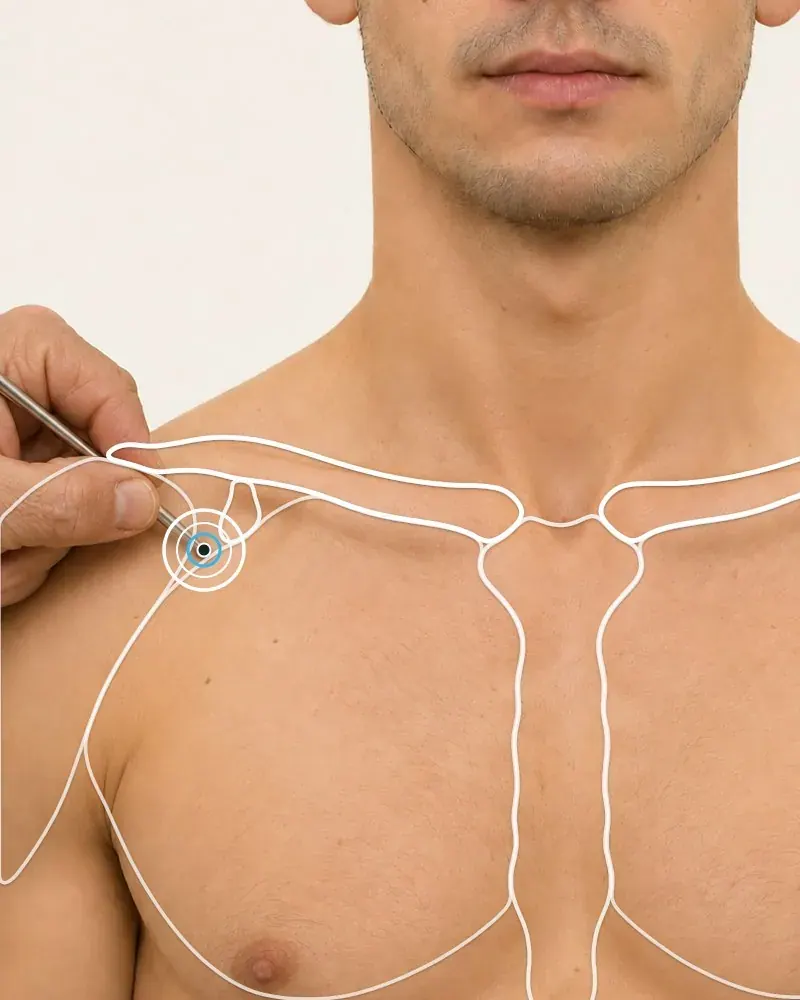
Location
On the anterolateral chest, 1 cun below the infraclavicular fossa, 6 cun lateral to the midline, level with the 1st intercostal space.
According to the WHO (2008): In the anterior thoracic region, at the same level as the first intercostal space, lateral to the infraclavicular fossa, 6 B-cun lateral to the anterior median line.
How to find it, step by step
Three steps with photos, from an easy landmark to the exact point. Measurements are in cun, the width of the person's own thumb.
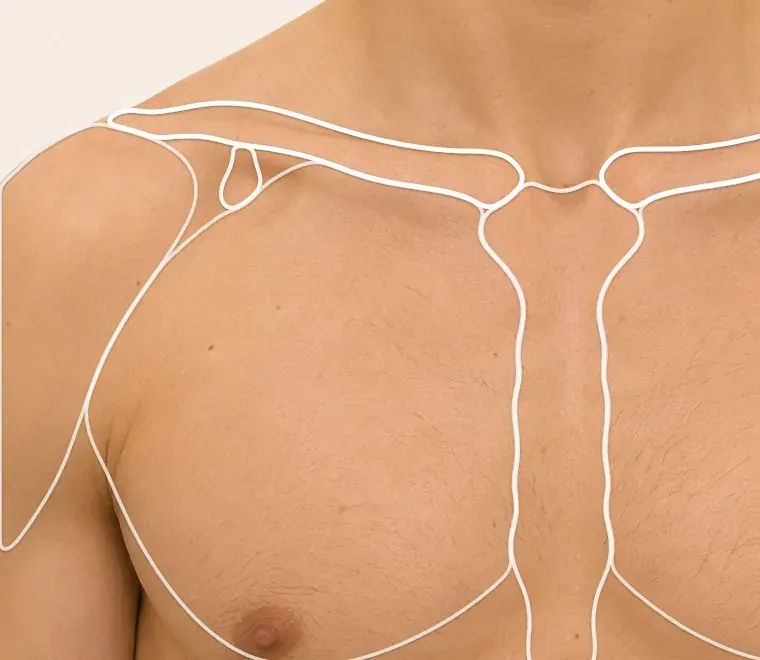 ClavicleCoracoid processDeltoidPectoralis major1
Find the collarbone and the hollow below it
Below the outer third of the collarbone there is a hollow (infraclavicular fossa), between the deltoid and the pectoral muscle. At its outer edge you can feel the coracoid process.
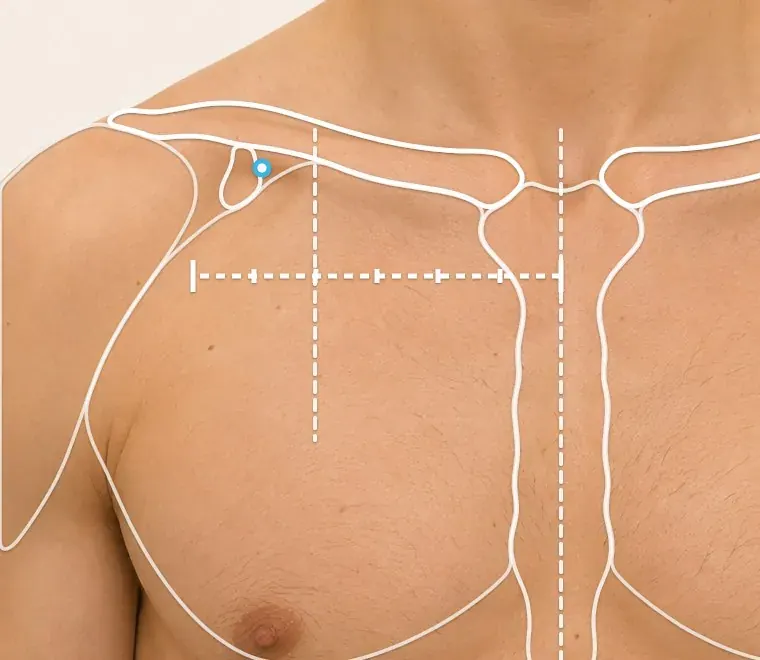 MidlineMidclavicular line (4 cun)Infraclavicular fossa (LU2)2
Count 6 cun from the midline
The line running down through the middle of the collarbone is 4 cun from the midline. LU2 is in the hollow of the fossa, medial to the coracoid process; LU1 lies outside and below that hollow, 6 cun from the midline, level with the 1st intercostal space.
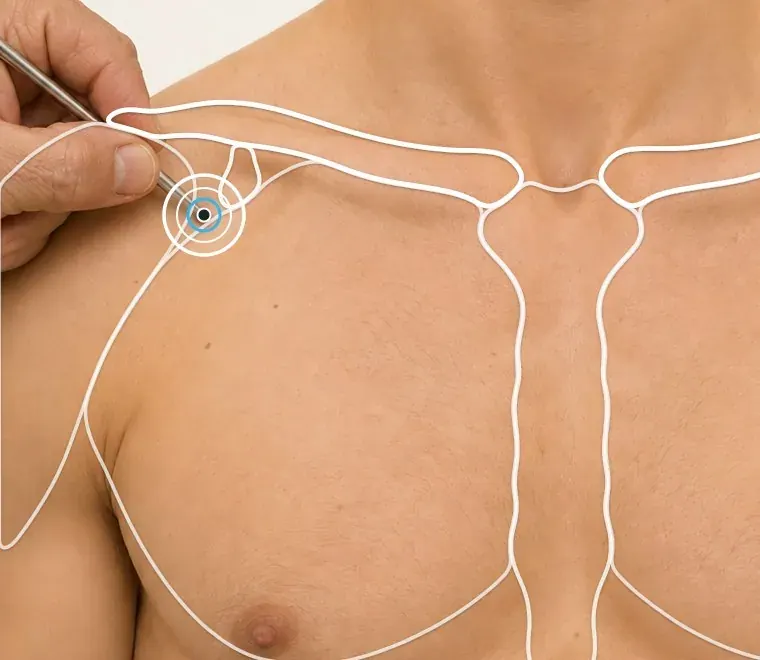 3
Press 1 cun below the hollow, outward
On the pectoral muscle, next to the groove of the deltoid. Needle obliquely outward: never perpendicular or inward, because of the lung.
Functions according to tradition
Front-Mu of the Lung: diffuses and descends Lung Qi, stops cough and transforms Phlegm.
Traditional indications
- Cough
- Asthma
- Chest oppression
- Shoulder and back pain
- Bronchitis
Indications described by tradition; they do not amount to proven clinical effectiveness for each one.
What its classification means
On the chest or abdomen, where the Qi of an organ “gathers”. Its tenderness to pressure guides diagnosis; it is used more in acute conditions and those of the fu organs.
Two or more channels meet here, so it is credited with acting on all of them.
Precautions
Risk of pneumothorax. Never perpendicular or inward: oblique outward, away from the lung.
- Needling depth
- 0.5–0.8 cun (oblique)
- Angle
- Oblique outward
Needling must always be done by a trained professional. At home, only gentle finger pressure.
Points on other channels with similar indications
They share several traditional indications with this point. Comparing them helps understand why one or the other is chosen.
- BL13 Feishu (Bladder): Asthma, Bronchitis, Cough
- KI22 Bulang (Kidney): Asthma, Chest oppression, Cough
- ST13 Qihu (Stomach): Asthma, Chest oppression, Cough
- BL42 Pohu (Bladder): Asthma, Cough
- CV18 Yutang (Ren Mai (Conception Vessel)): Asthma, Cough
- KI26 Yuzhong (Kidney): Asthma, Chest oppression
Point profile
- Code
- LU1
- Pinyin name
- Zhōng Fǔ
- Characters
- 中府
- Translation
- Central Palace
- Meridian
- Lung
- Element
- Metal
- Classification
- Front-Mu, Crossing point
- Topics
- Breathing, Cough
Health notice. Educational and study content. It describes concepts of Traditional Chinese Medicine and does not replace diagnosis or treatment by a healthcare professional. Needling, medicinal herbs and invasive techniques must be applied by trained professionals. Safety guide.
