Taichong (LV3)
Taichong (LV3), “Great Surge”, is a point on the Liver meridian. It is point 3 of the 14 on the channel. Moves Liver Qi and Blood, smooths the Liver, calms the spirit, expels Wind.
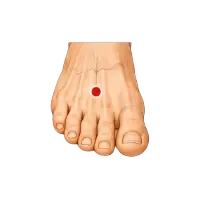
Location
2 cun proximal to the web margin between the 1st and 2nd toes, in the depression distal to the 1st and 2nd metatarsal junction.
Functions according to tradition
Moves Liver Qi and Blood, smooths the Liver, calms the spirit, expels Wind. The great point for stress and emotional tension.
Traditional indications
- Stress and irritability
- Migraine
- Menstrual problems
- Blurred vision
- Insomnia
- Hypertension
- Nausea
Indications described by tradition; they do not amount to proven clinical effectiveness for each one.
What its classification means
Where the original Qi of the organ manifests. Tradition uses it both to examine and to treat the channel's organ.
Third of the transport points: the Qi “flows”. It is associated with heaviness of the body and joint pain; in the yin channels it coincides with the Source point.
Precautions
Use with caution during pregnancy due to its strong Qi- and Blood-moving action.
Points on other channels with similar indications
They share several traditional indications with this point. Comparing them helps understand why one or the other is chosen.
- EX-HN3 Yintang (Extraordinary points): Hypertension, Insomnia
- SP6 Sanyinjiao (Spleen): Insomnia, Menstrual problems
- GB1 Tongziliao (Gallbladder): Blurred vision, Migraine
- GB37 Guangming (Gallbladder): Blurred vision, Migraine
- GV20 Baihui (Du Mai (Governing Vessel)): Hypertension, Insomnia
- KI1 Yongquan (Kidney): Hypertension, Insomnia
Point profile
- Code
- LV3
- Pinyin name
- Tài Chōng
- Characters
- 太冲
- Translation
- Great Surge
- Meridian
- Liver
- Element
- Wood
- Classification
- Yuan-Source, Shu-Stream
- Topics
- Stress, Liver, Women's Health
Health notice. Educational and study content. It describes concepts of Traditional Chinese Medicine and does not replace diagnosis or treatment by a healthcare professional. Needling, medicinal herbs and invasive techniques must be applied by trained professionals. Safety guide.