Yongquan (KI1)
Yongquan (KI1), “Bubbling Spring”, is a point on the Kidney meridian. It is point 1 of the 27 on the channel. Jing-Well of the Kidney: descends hyperactive Yang, restores consciousness and anchors Qi downward.
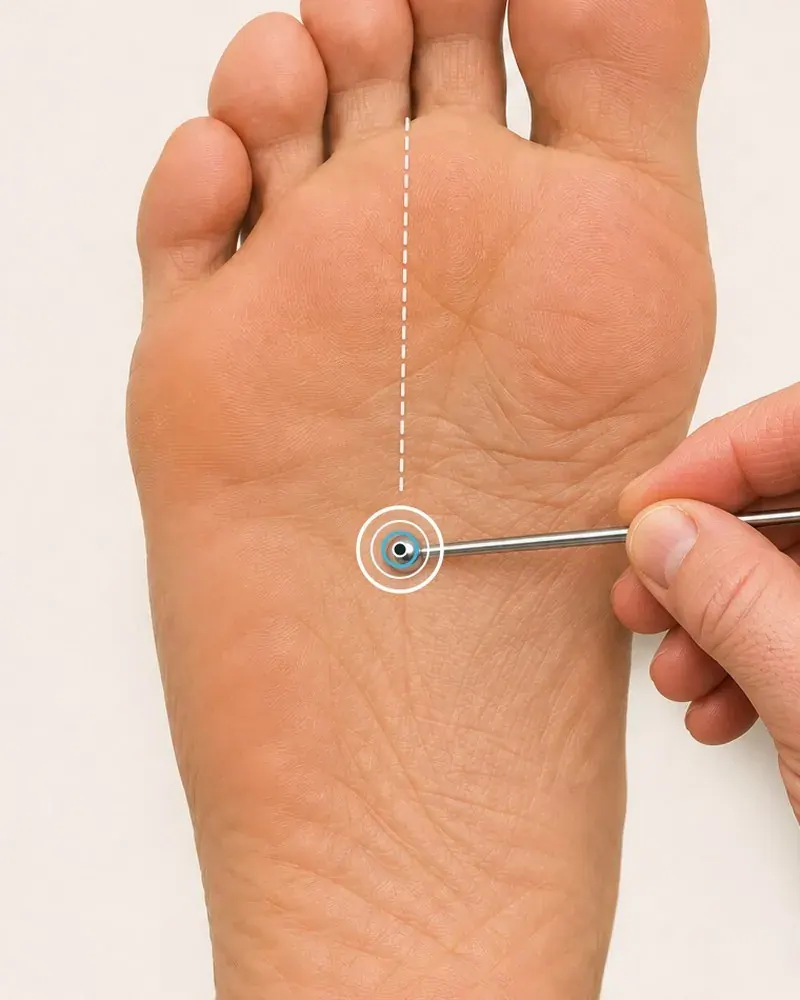
Location
On the sole of the foot, in the depression formed when the toes are flexed, at the junction of the anterior third and posterior two-thirds.
According to the WHO (2008): On the sole of the foot, in the deepest point of the depression of the sole when the toes are flexed. Note: when the toes are flexed, KI1 is located approximately in the depression at the junction of the anterior one third and the posterior two thirds of the line connecting the heel with the web margin between the bases of the second and third toes.
How to find it, step by step
Three steps with photos, from an easy landmark to the exact point. Measurements are in cun, the width of the person's own thumb.
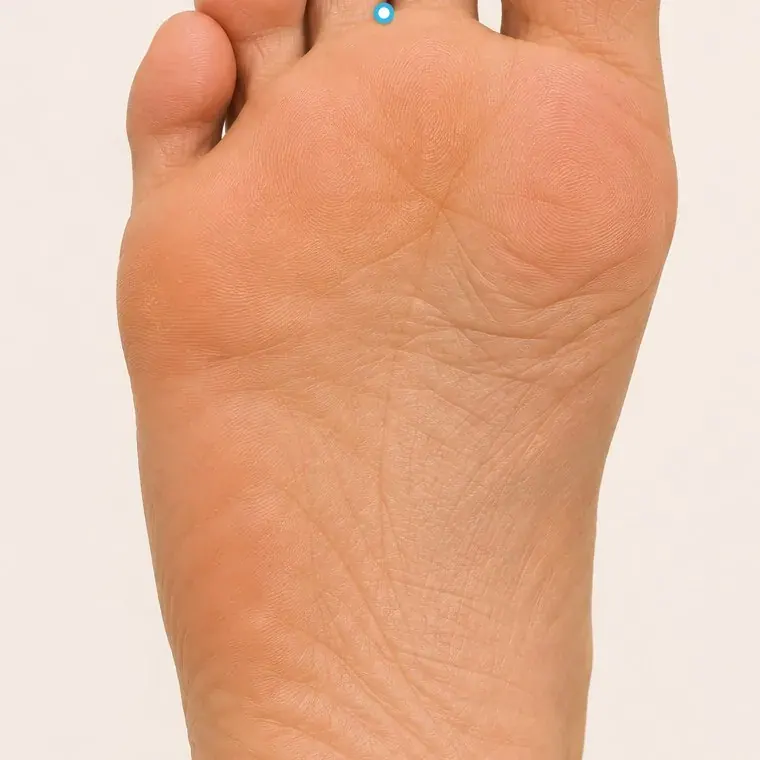 2nd–3rd toe web1
Curl the toes
Curl your toes: on the sole, just behind the ball of the foot, a hollow forms.
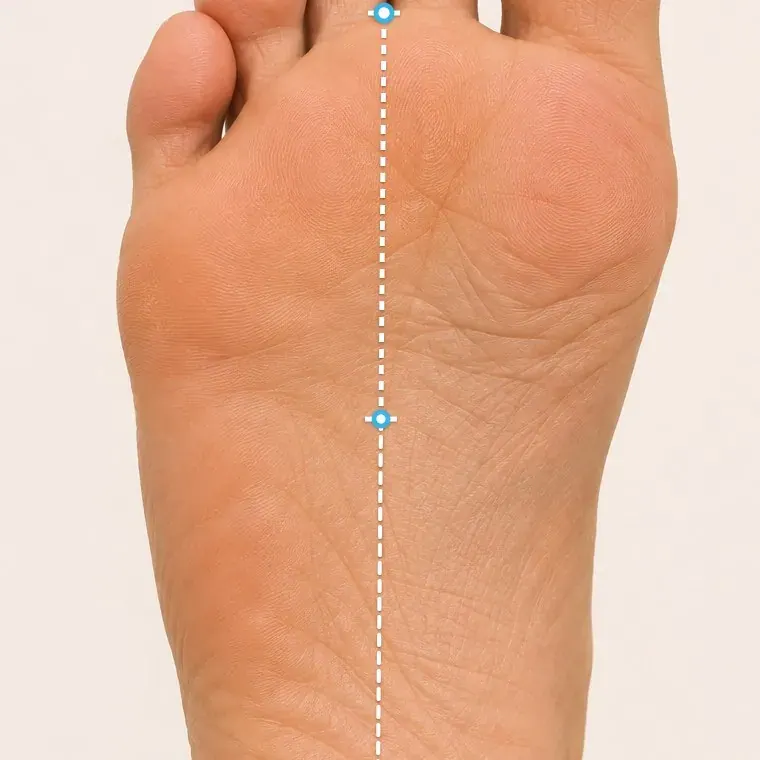 1/32/3 to heel2
Measure one third
Draw the line from the web between the 2nd and 3rd toes to the heel: Yǒngquán is at the end of the first third, in that hollow.
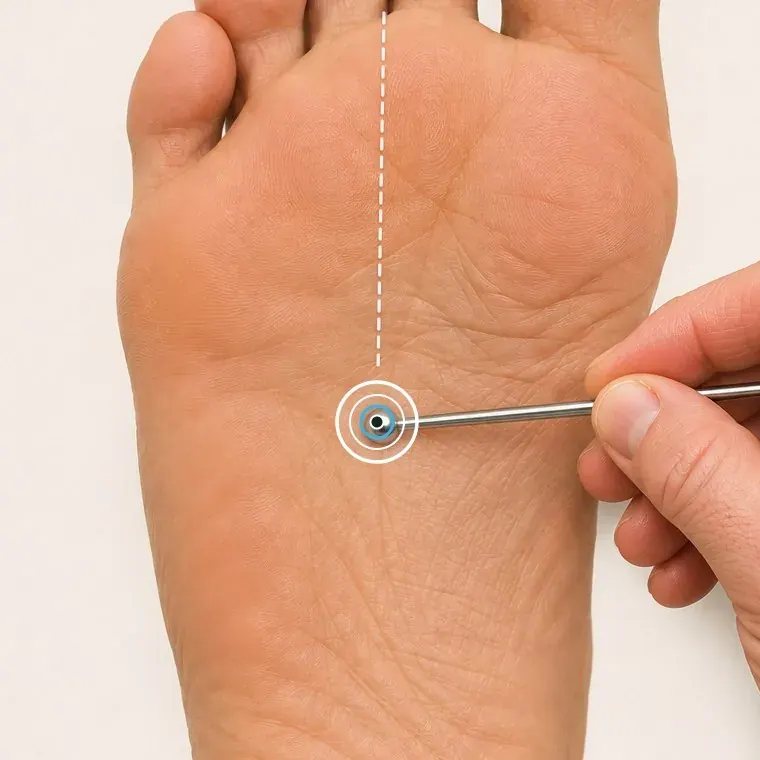 3
Press in the hollow
Perpendicular. It is a very sensitive point: firm but brief pressure.
Functions according to tradition
Jing-Well of the Kidney: descends hyperactive Yang, restores consciousness and anchors Qi downward.
Traditional indications
- Loss of consciousness
- Vertex headache
- Hypertension
- Insomnia
- Hot soles
Indications described by tradition; they do not amount to proven clinical effectiveness for each one.
What its classification means
It is the first or last point of the channel, at the tip of a finger or toe, where tradition says the Qi “wells up”. It is credited with a rapid effect and has been used to clear heat and in acute situations.
Precautions
- Needling depth
- 0.5–1 cun
- Angle
- Perpendicular
Needling must always be done by a trained professional. At home, only gentle finger pressure.
Points on other channels with similar indications
They share several traditional indications with this point. Comparing them helps understand why one or the other is chosen.
- EX-HN3 Yintang (Extraordinary points): Hypertension, Insomnia
- GV20 Baihui (Du Mai (Governing Vessel)): Hypertension, Insomnia
- LV3 Taichong (Liver): Hypertension, Insomnia
- BL15 Xinshu (Bladder): Insomnia
- BL62 Shenmai (Bladder): Insomnia
- CV14 Juque (Ren Mai (Conception Vessel)): Insomnia
Point profile
- Code
- KI1
- Pinyin name
- Yǒng Quán
- Characters
- 涌泉
- Translation
- Bubbling Spring
- Meridian
- Kidney
- Element
- Water
- Classification
- Jing-Well
- Topics
- Emergency, Calming
Health notice. Educational and study content. It describes concepts of Traditional Chinese Medicine and does not replace diagnosis or treatment by a healthcare professional. Needling, medicinal herbs and invasive techniques must be applied by trained professionals. Safety guide.
