Five Animal Frolics
A traditional practice exploring movement qualities inspired by tiger, deer, bear, monkey, and bird through adaptable patterns.
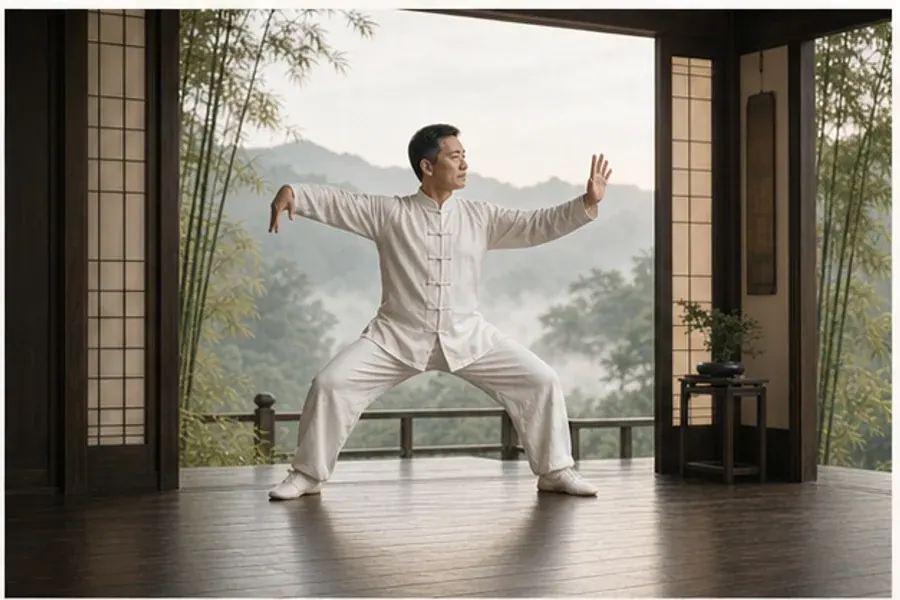
Traditional framework
The animals are traditionally associated with physical and emotional qualities and the Five Elements. Correspondences vary among lineages.
The 5 movements step by step
Tiger: Stability and Reach 虎戏 · Hǔ Xì
Use a stable base and shape relaxed claws while reaching without locking joints.
- Breathing
- Exhale through the reach; inhale on return.
- Repetitions
- 6
- Duration
- 42 s
Common mistakes
- Turning the claw into a maximal finger contraction.
- Rolling the shoulders forward on the reach instead of keeping the chest open.
Deer: Turning and Lightness 鹿戏 · Lù Xì
Alternate a gentle trunk turn with small controlled steps.
- Breathing
- Keep breathing continuously without holding through the turn.
- Repetitions
- 6
- Duration
- 42 s
Common mistakes
- Turning from the low back instead of spreading the rotation along the spine.
- Taking steps longer than balance allows.
Bear: Weight and Center 熊戏 · Xióng Xì
Shift weight slowly from side to side with heavy arms and free shoulders.
- Breathing
- Exhale while settling; inhale through center.
- Repetitions
- 6
- Duration
- 42 s
Common mistakes
- Moving only the arms: the weight has to actually travel from foot to foot.
- Tensing the shoulders to feel heavy; the weight comes from releasing them.
Monkey: Attention and Agility 猿戏 · Yuán Xì
Use small gestures, gaze changes, and short steps without sacrificing stability.
- Breathing
- Breathe naturally; do not speed the breath to follow the gesture.
- Repetitions
- 6
- Duration
- 36 s
Common mistakes
- Speeding up until the gesture loses its precision.
- Snapping the neck around when the gaze changes.
Bird: Expansion and Balance 鸟戏 · Niǎo Xì
Open the arms like wings and shift weight; single-leg balance is optional.
- Breathing
- Inhale while opening; exhale while closing and settling.
- Repetitions
- 6
- Duration
- 48 s
Common mistakes
- Attempting single-leg balance before balance is solid.
- Lifting the arms beyond a comfortable shoulder range.
What the evidence says
Studies commonly examine balance, coordination, and gentle activity. Animal imitation is a teaching structure, not a medical prescription.
Safety
Scale steps, turns, and single-leg balance to your ability. Keep a wall or chair nearby and avoid uneven ground.
Health notice. Educational and study content. It describes concepts of Traditional Chinese Medicine and does not replace diagnosis or treatment by a healthcare professional. Needling, medicinal herbs and invasive techniques must be applied by trained professionals. Safety guide.