The pulse: How it is taken
Technique decides whether the finding is worth anything. 6 activities, about 12 minutes.
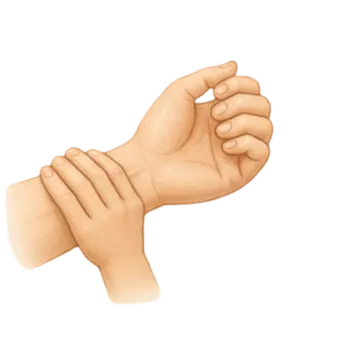
Before touching
脈診 mài zhěn
The pulse is the easiest sign in the whole examination to falsify, and it is nearly always the examiner who falsifies it, by rushing. Three calm breaths before starting change what you feel.
- Arm
- supported and at heart height
- Timing
- at rest, not just arrived and not after coffee
- The examiner
- calm too: hurry is contagious
- Duration
- at least a minute per wrist
Common mistake: Taking the pulse in the first thirty seconds of the consultation, with the patient still standing or just sat down.
Three fingers, three positions
The middle finger goes against the styloid process of the radius and the other two settle either side. The spacing adapts to the patient's build: on a small person the fingers sit together, on a tall one they spread.
- Index
- the position nearest the hand
- Middle
- the central position, against the bone
- Ring
- the furthest position, toward the elbow
- Bone landmark
- the radial process, always
Common mistake: Placing the fingers by eye. Without the bone landmark, the three positions move at every reading.
Three pressures, not one
You palpate at three levels and the finding is the comparison between them. A pulse that shows only on light touch and one that appears only under pressure tell opposite stories.
- Superficial
- brushing the skin: the exterior level
- Middle
- moderate pressure: the Stomach and Spleen level
- Deep
- pressing to the bone: the interior level
- What informs you
- at which level it feels strongest
Common mistake: Staying at one pressure. Without varying depth you cannot tell exterior from interior, or deficiency from excess.
Order the taking of a pulse.
- Let the patient settle and settle yourself
- Place the middle finger against the radial process
- Take a global impression, varying the three pressures
- Compare the three positions with each other
- Repeat on the other wrist and compare the two sides
Does this falsify the reading or is it a finding to record?
- The patient has just walked up three flights
- The pulse is thin and forceless after ten minutes at rest
- They have had two coffees this morning
- The pulse clearly speeds up when one topic comes up
- Their hands are freezing from the cold outside
- The left pulse is consistently weaker than the right
In learning, why start with the global impression rather than the positions?

Level complete!
Block complete. You observed before concluding.
Did you enjoy it? In the app you save your progress, review what you forget and unlock the 723 exercises.
Study content. The exercises describe concepts of Traditional Chinese Medicine; they are not medical advice.