What Is Chinese Medicine? A Clear and Rigorous Introduction
Traditional Chinese medicine (TCM) is a health system with more than two thousand years of history that understands the body as a set of interrelated functions, in balance with its environment. It uses concepts such as Qi, Yin and Yang and the five elements, and relies on therapies such as acupuncture, herbal medicine, moxibustion, tuina massage, dietary therapy and exercises such as qigong.
Key points
- Traditional Chinese medicine is a medical system with ancient origins that is still practiced today in China and in many other countries.
- Its view is holistic: it considers the person as a whole and in relation to climate, emotions and lifestyle.
- It is based on traditional concepts such as Qi, Yin and Yang, the five elements and the zang-fu organs, which are not equivalent to those of modern anatomy.
- Its main therapies are acupuncture, herbal medicine, moxibustion, cupping, tuina, dietary therapy and qigong or tai chi.
- The scientific evidence on its effectiveness varies depending on the therapy and the health problem, and it does not replace conventional medical care.
Traditional Chinese medicine (中医, zhōng yī), often known by its abbreviation TCM, is one of the oldest medical systems still in use. It originated in China more than two millennia ago, grew richer over the centuries through classic texts, schools and clinical experience, and today coexists with conventional medicine in Chinese hospitals and is practiced around the world. On this page we explain, without unnecessary jargon, the ideas it is based on, the therapies it uses and what we really know about its effectiveness.
What exactly is traditional Chinese medicine?
Chinese medicine is a complete system for understanding health and disease. It is not an isolated technique, but a theoretical framework of its own, with its own way of diagnosing and a set of therapies derived from it. Its most characteristic feature is its holistic view: the person is understood as a whole in which body, emotions and environment are connected.
From this perspective, health is a state of dynamic balance, and disease appears when that balance is disrupted, whether by external factors (such as cold or dampness), internal factors (such as intense and prolonged emotions) or lifestyle habits (diet, rest, exertion). The goal of traditional treatment is to restore that balance.
It is worth keeping in mind from the outset that many of its concepts are traditional ideas, born of philosophy and observation, and not anatomical or biochemical descriptions in the modern sense.
The basic concepts: Qi, Yin and Yang and the five elements
The theory of Chinese medicine rests on a few ideas that recur throughout the system:
- Qi (气, qì): usually translated as "vital energy," although it is a broader concept. It refers to what animates, moves and protects the body. Together with Blood, Fluids, Essence and Spirit, it makes up the vital substances.
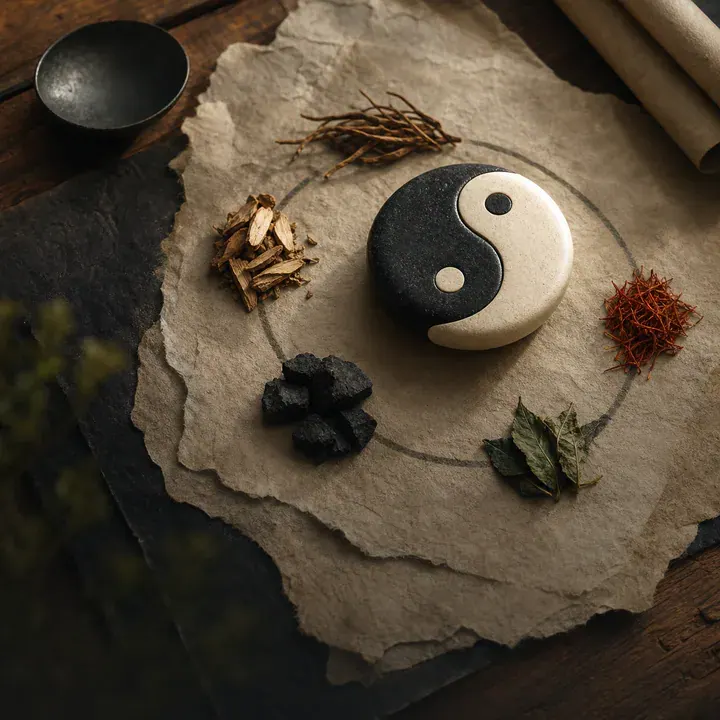
- Yin and Yang (阴阳, yīn yáng): two opposite and complementary aspects present in every phenomenon. Health is understood as their balance. We cover this in more depth on the page about Yin and Yang.
- Five elements (五行, wǔ xíng): Wood, Fire, Earth, Metal and Water, five phases used to relate organs, emotions, seasons or flavors. You can read about them in detail in the five elements.
- Zang-fu organs (脏腑, zàng fǔ): the "organs" of Chinese medicine are above all sets of functions. The traditional Spleen, for example, is related to digestion, which does not match the anatomical spleen. We explain this on the zang-fu page.
- Meridians (经络, jīng luò): a network of channels through which, according to traditional theory, Qi and Blood circulate, and on which the acupuncture points are located.
What therapies are part of Chinese medicine?
Chinese medicine combines several tools that share the same theoretical framework. This table summarizes the main ones:
| Therapy | What it involves |
|---|---|
| Acupuncture | Insertion of fine needles into specific points on the body |
| Herbal medicine | Formulas that combine plants and, sometimes, mineral or animal substances |
| Moxibustion | Application of heat by burning mugwort (moxa) |
| Cupping | Cups that create suction on the skin |
| Tuina | Therapeutic massage with specific manual techniques |
| Gua sha | Gentle scraping of the skin with a smooth-edged tool |
| Dietary therapy | Diet adapted to the person's constitution and the season |
| Qigong and tai chi | Exercises that combine movement, breathing and attention |
In the West the best-known therapy is acupuncture, but in China herbal medicine holds a central place in clinical practice.
How is diagnosis done in Chinese medicine?
Traditional diagnosis is based on the so-called four methods: looking (at the general appearance, the skin and especially the tongue), listening and smelling, asking (about sleep, digestion, thirst, cold or heat) and palpating, with special attention to the pulse at the wrist.
With this information, the practitioner is not looking so much for the name of a disease as for a pattern or syndrome: for example, "Spleen Qi deficiency" or "Liver Qi stagnation." Two people with the same conventional diagnosis may receive different traditional treatments if their pattern is different, and vice versa.
What does the scientific evidence say?
This is the most important question, and the honest answer is that it depends on the therapy and the health problem. It is necessary to distinguish between the traditional concept, which is part of the system's history and culture, and the scientific evidence, which is obtained through well-designed clinical trials.
A few facts help put things in context:
- Acupuncture has been one of the most studied therapies. The UK's NICE NG193 guideline (2021) on chronic primary pain considers offering a course of acupuncture in certain circumstances. For many other indications the evidence is limited or contradictory.
- Chinese herbal medicine has produced notable results in pharmacological research. The most famous case is artemisinin, an antimalarial obtained from the plant Artemisia annua, for whose discovery Tu Youyou received the Nobel Prize in Medicine in 2015. However, the fact that a plant contains a useful molecule does not prove that every traditional formula is effective.
- Herbs can also be dangerous: aristolochic acid nephropathy and the US FDA's ban on ephedra (ma huang) supplements in 2004 are reminders that "natural" does not mean harmless.
Many traditional concepts, such as the meridians or Qi itself, have no proven correspondence in modern anatomy or physiology.
How to approach Chinese medicine with good judgment
If you are interested in Chinese medicine, these guidelines will help you do so safely:
- Use it, where appropriate, as a complement and not as a substitute for conventional medical care.
- See professionals with accredited training and, for acupuncture, who use sterile single-use needles.
- Always tell your doctor and your pharmacist about any herbs or supplements you take, because they can interact with medications.
- Be wary of anyone who promises to cure serious illnesses or asks you to stop a prescribed treatment.
A living tradition
Chinese medicine is not a museum piece: it continues to evolve, is taught at universities, is researched and is integrated to varying degrees into health systems. To understand it well, it is worth learning about its history and its fundamental concepts, and approaching it with a mix of curiosity about its cultural richness and rigor regarding the evidence for its effectiveness.
Frequently asked questions
Is Chinese medicine the same as acupuncture?
No. Acupuncture is just one of the therapies of traditional Chinese medicine. The system also includes herbal medicine, which in China is actually the most widely used tool, as well as moxibustion, cupping, tuina massage, dietary therapy and exercises such as qigong and tai chi. They all share the same theoretical framework and the same way of diagnosing.
Is Chinese medicine recognized by the WHO?
In 2019 the World Health Organization included a chapter on traditional medicine (chapter 26) in the International Classification of Diseases ICD-11, which allows traditional diagnoses to be recorded for statistical purposes. That inclusion serves to document its use, but it does not mean the WHO endorses the effectiveness of each treatment.
Can Chinese medicine replace a doctor?
It shouldn't. Chinese medicine can be used as a complement in some cases, but it does not replace diagnosis or treatment by conventional medicine, especially in the case of serious illnesses or new or persistent symptoms. The sensible thing is to always tell your doctor about any therapy or herb you are using to avoid interactions or delays.
How is it different from Western medicine?
Conventional medicine is based on anatomy, physiology and experimental research, and looks for specific causes of disease. Chinese medicine starts from philosophical concepts and clinical observation accumulated over centuries, and describes patterns of imbalance in the body as a whole. They are different frameworks that cannot always be translated into one another.
Health notice. This content is educational and describes concepts of Traditional Chinese Medicine together with the available scientific evidence. It does not replace diagnosis or treatment by a healthcare professional. If symptoms are persistent or severe, consult your doctor. Safety guide.