Yin and Yang: the theory of complementary opposites
In Chinese philosophy and medicine, Yin and Yang are two opposite and complementary aspects present in all phenomena: Yin represents what is cold, still and nourishing, and Yang what is warm, active and functional. Traditional Chinese Medicine understands health as their dynamic balance and disease as their imbalance.
Key points
- Yin and Yang are two opposite and complementary qualities that do not exist without each other.
- Classical theory describes them with four principles: opposition, interdependence, dynamic balance and mutual transformation.
- In the body, Yin is associated with substance, coolness and rest, and Yang with function, warmth and activity.
- Traditional diagnosis distinguishes between excesses and deficiencies of Yin or Yang, which give rise to cold or heat patterns.
- It is a traditional conceptual framework, useful for understanding the reasoning of Chinese medicine, but not a proven physiological description.
Few ideas from Chinese culture are as well known as Yin and Yang (阴阳, yīn yáng). Its circular symbol appears everywhere, but its meaning goes far beyond aesthetics: it is a way of thinking about the world in terms of pairs of opposites that need each other. Traditional Chinese Medicine adopted it as one of its theoretical pillars to describe the body, health and disease. Here we explain what it means, what its principles are and how it is applied.
What are Yin and Yang?
Originally, the characters for Yin and Yang referred to the shady and sunny slopes of a mountain. From that simple image a broader idea emerged: all phenomena can be described as the interaction of two opposite and complementary aspects.
Yin represents what is dark, cold, moist, still, interior, descending and nourishing. Yang represents what is bright, warm, dry, active, exterior, ascending and functional. Neither is "good" or "bad": both are necessary, and what matters is the relationship between them.
They are also relative concepts. Something is Yin or Yang only in comparison with something else. The chest is Yin relative to the back, but Yang relative to the abdomen, for example.
The four principles of Yin and Yang
Classical theory, recorded in texts such as the Huangdi Neijing, is often summarized in four principles:
Opposition
Yin and Yang are opposites: cold opposes heat, rest opposes activity, night opposes day. This opposition allows them to control each other.
Interdependence
Neither exists without the other. There is no day without night and no up without down. In the body, activity (Yang) needs a material basis to sustain it (Yin), and that basis needs activity in order to form and renew itself.
Dynamic balance
The proportion between the two changes constantly, as over the course of the day or the seasons, but within certain limits. This ebb and flow is normal; the problem arises when one of the two predominates persistently.
Mutual transformation
When they reach an extreme, they can turn into each other: midday gives way to afternoon, summer to autumn. In medical theory, extreme heat can evolve into exhaustion with signs of cold.
How Yin and Yang apply to the human body
Chinese medicine classifies the parts and functions of the body according to these two poles. The following table lists some traditional correspondences:
| Yin | Yang |
|---|---|
| Interior of the body | Surface of the body |
| Lower part | Upper part |
| Front of the trunk | Back |
| Zang organs (store) | Fu organs (transform and transport) |
| Blood and fluids | Qi |
| Rest, sleep | Activity, wakefulness |
| Cold, dampness | Heat, dryness |
The organs that store substances, such as the Kidney or the Liver, are considered more Yin, while the hollow organs, such as the Stomach, are considered more Yang. We cover this in more depth on the page about the zang-fu organs. Similarly, Blood and fluids are considered Yin compared with Qi, which is Yang, as you will see in the vital substances.
Yin and Yang imbalances: excess and deficiency
According to traditional theory, disease appears when the balance is broken. Four basic situations are usually distinguished:
- Yang excess: a predominance of "true" heat, with signs such as feeling hot, a flushed face, thirst or restlessness.
- Yin excess: a predominance of "true" cold, for example after exposure to severe cold, with pain that improves with heat.
- Yin deficiency: Yin is not enough to cool the body and a relative heat appears, with night sweats or dryness.
- Yang deficiency: Yang is not enough to warm and activate the body, with a feeling of cold, tiredness or cold hands and feet.
This classification is the basis of one of the axes of the eight principles of diagnosis. Traditional treatment seeks to "cool" heat, "warm" cold, "nourish" what is lacking or "disperse" what is in excess.
Yin and Yang in everyday life
Chinese tradition proposes adapting habits to the rhythm of Yin and Yang: resting more in winter, the most Yin season, and making the most of the greater activity of summer; respecting nighttime sleep; or avoiding extremes in food, work and emotions. Chinese dietary therapy, for example, classifies foods according to their cold or hot nature.
Many of these recommendations, such as getting enough sleep or moderating excesses, coincide with general health advice, although the traditional justification is different.
Does the theory of Yin and Yang have a scientific basis?
Yin and Yang are a philosophical and conceptual framework, not a proven physiological theory. There is no measurable substance or structure that corresponds to the body's Yin or Yang, and science has not shown that patterns of "Yin deficiency" or "Yang excess" are defined biological entities.
That does not make it any less interesting: it helps explain how a Chinese medicine practitioner reasons and offers an intuitive way of thinking about balance. But it is important not to confuse this symbolic language with a medical diagnosis, and to consult a health professional about any symptom that worries you. The theory is complemented by that of the five elements, which adds nuance to this dual scheme.
Frequently asked questions
What does the Yin and Yang symbol mean?
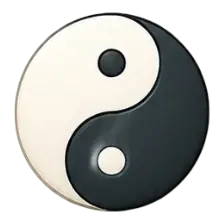
The well-known circular symbol, called the taijitu, shows a dark half (Yin) and a light half (Yang) that intertwine. Each half contains a dot of the opposite color, expressing that within Yin there is always some Yang and vice versa. The curved line separating them suggests movement and continuous transformation, not a static division.
What is Yin deficiency?
In Chinese medicine, Yin deficiency is a pattern in which the cooling and nourishing aspect of the body is lacking, and a relative heat appears. It is traditionally associated with signs such as heat in the palms and soles, night sweats, dry mouth or restless sleep. It is a traditional diagnostic concept and is not equivalent to any disease in conventional medicine.
Are there Yin foods and Yang foods?
Chinese dietary therapy classifies foods according to their thermal nature: cold, cool, neutral, warm and hot. Cool and cold foods are considered more Yin and warm and hot foods more Yang. This classification is traditional and has not been scientifically demonstrated; for a healthy diet, general nutritional recommendations remain valid.
Is Yin feminine and Yang masculine?
In Chinese tradition, Yin has been associated with the feminine and Yang with the masculine, along with other pairs such as night and day or earth and heaven. But these are relative qualities present in all people, not a division between the sexes. In medicine, men and women both have Yin and Yang, and both must be in balance.
Health notice. This content is educational and describes concepts of Traditional Chinese Medicine together with the available scientific evidence. It does not replace diagnosis or treatment by a healthcare professional. If symptoms are persistent or severe, consult your doctor. Safety guide.