Meridians: the channels of Qi in Chinese medicine
According to Traditional Chinese Medicine, the meridians (jing luo) are a network of channels through which Qi and Blood circulate and which connect the internal organs with the surface of the body. There are twelve main meridians, paired with the organs, and eight extraordinary vessels, the most notable of which are Ren Mai and Du Mai.
Key points
- Meridians are a traditional concept that describes pathways along which Qi and Blood circulate between the interior and exterior of the body.
- There are twelve main meridians: six yin and six yang, three of each type on the hand and three on the foot.
- Each main meridian is related to a Zang organ or a Fu organ and has a fixed number of acupuncture points.
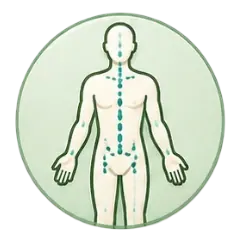
- The Ren (Conception) and Du (Governor) vessels run along the midline of the body and have their own points.
- It has not been shown that meridians correspond to any identifiable anatomical structure.
The meridians, called jing luo (经络, jīng luò) in Chinese, are one of the best-known concepts of Traditional Chinese Medicine (TCM). According to this tradition, they form a network of channels through which Qi (气, qì) and Blood (血, xuè) circulate, connecting the internal organs with the skin, muscles and joints. The points used in acupuncture and in other techniques such as moxibustion or tuina massage lie along this network. Understanding how it is organized helps explain how a TCM practitioner reasons.
What are meridians and what are they for according to TCM?
The term jing luo combines two ideas: jing (经), the main channels, which run lengthwise through the body, and luo (络), the collaterals, finer branches that connect one channel to another. Taken together, tradition attributes three functions to them:
- Circulating Qi and Blood to nourish the whole body.
- Connecting the interior (the Zang Fu organs) with the exterior (the body surface).
- Serving as a pathway through which, according to the theory, pathogenic factors can penetrate and through which therapeutic action can be taken.
The Huangdi Neijing already describes the pathways of the meridians in detail, and later tradition gradually systematized them.
The 12 main meridians
The twelve main meridians (十二经脉, shí'èr jīng mài) are distributed symmetrically on both sides of the body. Each one is named after an organ and is classified by three criteria: whether it is yin or yang, whether its pathway begins or ends in the hand or the foot, and its pair.
| Meridian | Abbreviation | Yin / Yang | Hand / Foot | No. of points |
|---|---|---|---|---|
| Lung | LU | Yin | Hand | 11 |
| Large Intestine | LI | Yang | Hand | 20 |
| Stomach | ST | Yang | Foot | 45 |
| Spleen | SP | Yin | Foot | 21 |
| Heart | HT | Yin | Hand | 9 |
| Small Intestine | SI | Yang | Hand | 19 |
| Bladder | BL | Yang | Foot | 67 |
| Kidney | KI | Yin | Foot | 27 |
| Pericardium | PC | Yin | Hand | 9 |
| Sanjiao (Triple Burner) | TE | Yang | Hand | 23 |
| Gallbladder | GB | Yang | Foot | 44 |
| Liver | LR | Yin | Foot | 14 |
The abbreviations are those of the standard international nomenclature, based on the English names. A point is thus identified by the abbreviation and its number: LI4 is the fourth point of the Large Intestine meridian, known as Hegu.
The order of circulation
Tradition describes a continuous circuit: Qi begins in the Lung meridian and passes, in the order of the table, through the twelve meridians until it reaches the Liver meridian, which connects back to the Lung meridian. This circuit is associated with a time of peak activity for each organ, explained in the organ clock.
Full names and pairs
In Chinese, each meridian has a compound name that indicates its limb and its yin or yang quality. For example, the Lung meridian is the "Hand Taiyin" and the Spleen meridian the "Foot Taiyin". The meridians are paired by interior-exterior relationship: Lung with Large Intestine, Stomach with Spleen, Heart with Small Intestine, Bladder with Kidney, Pericardium with Sanjiao and Gallbladder with Liver.
The Ren and Du vessels
In addition to the twelve main meridians, TCM describes eight extraordinary vessels (奇经八脉, qí jīng bā mài). They are considered reservoirs that regulate the Qi and Blood of the main meridians. Only two of them have their own points:
| Vessel | Hanzi and pinyin | Abbreviation | Pathway | No. of points |
|---|---|---|---|---|
| Ren Mai (Conception Vessel) | 任脉, rèn mài | CV | Anterior midline, from the perineum to the chin | 24 |
| Du Mai (Governor Vessel) | 督脉, dū mài | GV | Posterior midline, from the coccyx to the head and upper lip | 28 |
Traditionally, the Ren Mai is described as the "sea of the yin meridians" and is related to reproduction and pregnancy. The Du Mai is considered the "sea of the yang meridians" and is associated with the brain and the spine. The other six extraordinary vessels (Chong, Dai, Yinqiao, Yangqiao, Yinwei and Yangwei) use points from other meridians.
Other structures of the meridian system
The complete system is broader. It includes the collaterals (luo mai), the divergent meridians, the sinew (tendinomuscular) meridians, related to muscles and tendons, and the cutaneous regions, areas of skin associated with each channel. Within traditional theory, these structures explain how a point can influence areas far from where it is located.
What does science say about meridians?
Here it is important to separate the traditional concept from the scientific evidence. Meridians are a theoretical model of Chinese medicine and no anatomical structure has been identified that clearly corresponds to them. Hypotheses have been proposed linking them to connective tissue, nerve pathways or fascia, but none has been demonstrated.
On the other hand, studies on acupuncture for some forms of pain suggest some benefit, although they also show that the exact location of the points sometimes matters less than the theory predicts. For example, the NICE NG193 guideline (2021) considers acupuncture as an option for chronic primary pain, without taking a position on the existence of meridians. You can read more on this topic on our scientific evidence page.
In short, meridians are a useful conceptual tool for understanding the logic of TCM and for locating points, but they should not be interpreted as a proven anatomical reality.
Frequently asked questions
How many meridians are there in the body according to Chinese medicine?
Chinese medicine describes twelve main meridians, one for each organ, and eight extraordinary vessels. To these are added secondary branches, such as the collaterals, the sinew (tendinomuscular) meridians and the divergent meridians. The twelve main meridians and the Ren and Du vessels are the ones with their own points, which is why people often speak of the fourteen meridians.
How many acupuncture points are there on the meridians?
Adding up the twelve main meridians and the Ren and Du vessels, the standard nomenclature lists 361 points. The twelve main meridians have 309 points, counted on both sides of the body; Ren Mai has 24 and Du Mai 28, located on the midline. There are also numerous extra points outside the meridians.
Do meridians really exist?
Meridians are a concept of Traditional Chinese Medicine based on clinical observation and classical theory. To date, no anatomical structure, such as vessels or nerves, has been identified that clearly corresponds to them. Some hypotheses link them to connective tissue or to nerve pathways, but this has not been demonstrated.
What do the meridian abbreviations LU, ST or GB stand for?
They are the abbreviations of the standardized international nomenclature, based on the English names: LU is Lung, ST is Stomach and GB is Gallbladder. Each point is identified by the abbreviation and a number; for example, ST36 is point 36 of the Stomach meridian, known as Zusanli.
Health notice. This content is educational and describes concepts of Traditional Chinese Medicine together with the available scientific evidence. It does not replace diagnosis or treatment by a healthcare professional. If symptoms are persistent or severe, consult your doctor. Safety guide.