Jingmen (GB25)
Jingmen (GB25), “Capital Gate”, is a point on the Gallbladder meridian. It is point 25 of the 44 on the channel. Front-Mu of the Kidney: regulates water, strengthens the lower back and benefits urination.
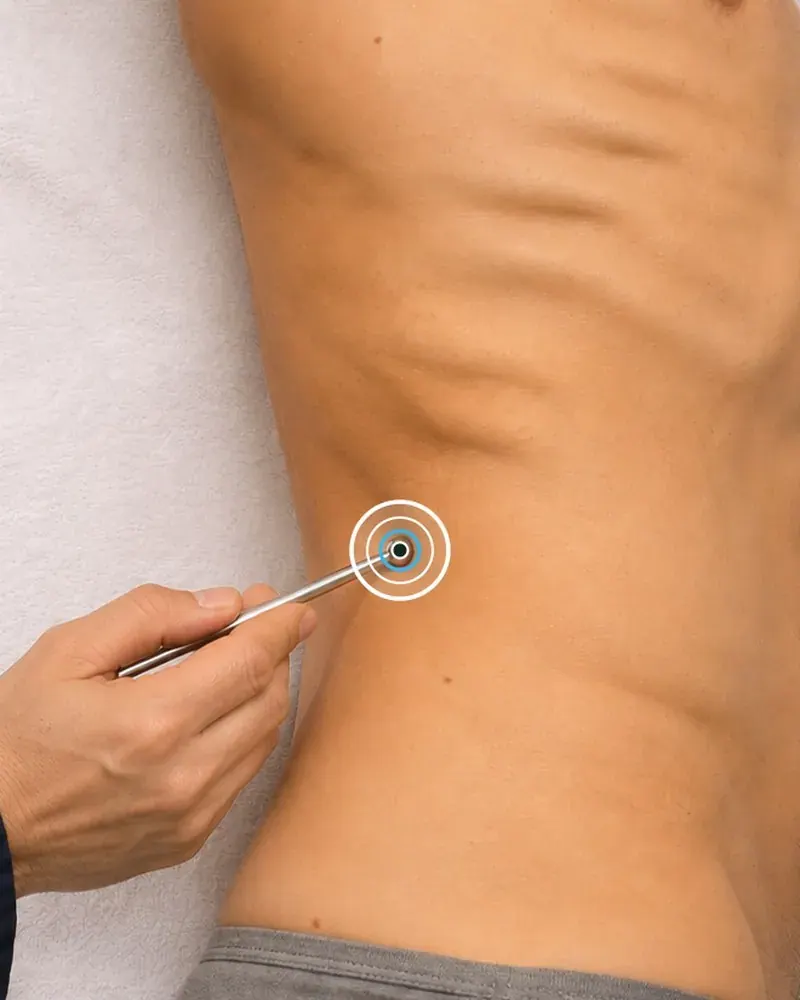
Location
On the lateral abdomen, below the free end of the twelfth rib.
According to the WHO (2008): On the lateral abdomen, inferior to the free extremity of the twelfth rib. Note: GB25 is located with the patient in the lateral recumbent position and the shoulder flexed. The free extremity of the twelfth rib can be palpated inferior to the inferior border of the costal arch, posterior to the posterior axillary line.
How to find it, step by step
Three steps with photos, from an easy landmark to the exact point. Measurements are in cun, the width of the person's own thumb.
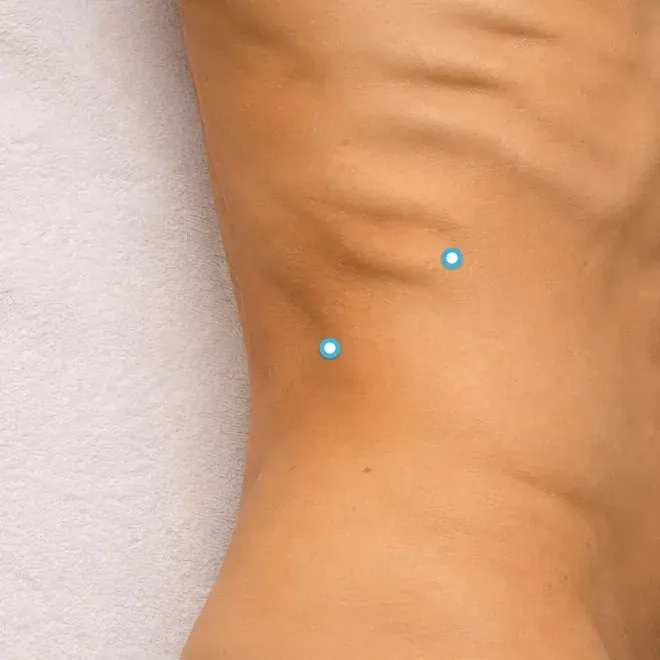 Tip of 11th rib (LR13)Tip of 12th rib1
Lie on your side
On the opposite side, with the arm above the head: this opens up the ribs.
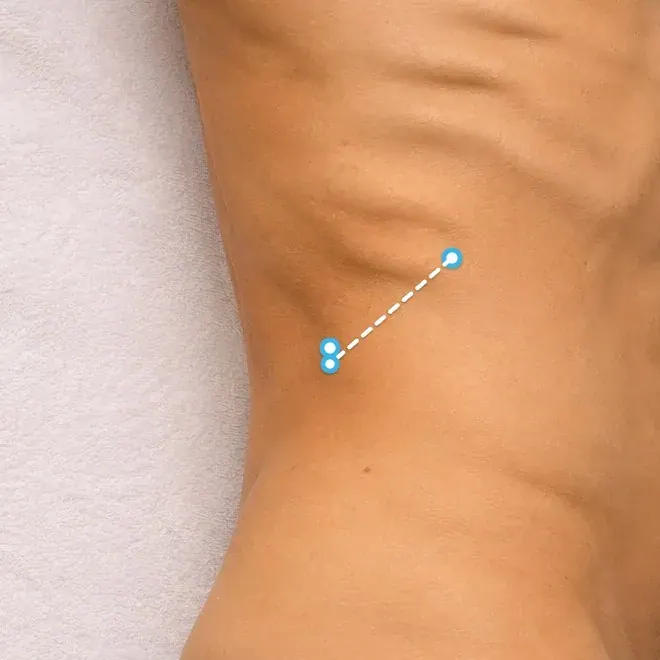 2
Find the tip of the 12th rib
Behind the tip of the 11th rib (LR13), further back and lower, you will feel the short tip of the last rib, the 12th.
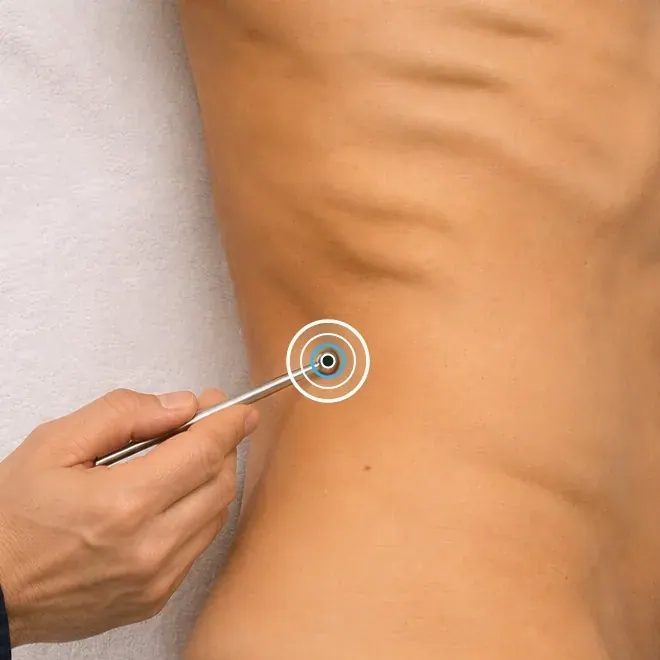 3
Press below the tip
Jīngmén is just below it. Oblique and not deep: at this level, the kidney lies beneath.
Functions according to tradition
Front-Mu of the Kidney: regulates water, strengthens the lower back and benefits urination.
Traditional indications
- Lower back pain
- Oedema
- Difficult urination
- Diarrhoea
- Abdominal distension
Indications described by tradition; they do not amount to proven clinical effectiveness for each one.
What its classification means
On the chest or abdomen, where the Qi of an organ “gathers”. Its tenderness to pressure guides diagnosis; it is used more in acute conditions and those of the fu organs.
Precautions
Needle obliquely: the kidney lies beneath at this level.
- Needling depth
- 0.5–1 cun
- Angle
- Oblique
Needling must always be done by a trained professional. At home, only gentle finger pressure.
Points on other channels with similar indications
They share several traditional indications with this point. Comparing them helps understand why one or the other is chosen.
- BL22 Sanjiaoshu (Bladder): Abdominal distension, Diarrhoea, Difficult urination, Lower back pain, Oedema
- BL26 Guanyuanshu (Bladder): Abdominal distension, Diarrhoea, Lower back pain
- CV9 Shuifen (Ren Mai (Conception Vessel)): Abdominal distension, Diarrhoea, Oedema
- KI13 Qixue (Kidney): Diarrhoea, Difficult urination, Lower back pain
- ST22 Guanmen (Stomach): Abdominal distension, Diarrhoea, Oedema
- BL27 Xiaochangshu (Bladder): Diarrhoea, Difficult urination
Point profile
- Code
- GB25
- Pinyin name
- Jīng Mén
- Characters
- 京门
- Translation
- Capital Gate
- Meridian
- Gallbladder
- Element
- Wood
- Classification
- Front-Mu (KI)
- Topics
- Kidney, Urination, Lower back
Health notice. Educational and study content. It describes concepts of Traditional Chinese Medicine and does not replace diagnosis or treatment by a healthcare professional. Needling, medicinal herbs and invasive techniques must be applied by trained professionals. Safety guide.