Xiyangguan (GB33)
Xiyangguan (GB33), “Knee Yang Joint”, is a point on the Gallbladder meridian. It is point 33 of the 44 on the channel. Relaxes the sinews and frees the knee; a local point for lateral knee pain.
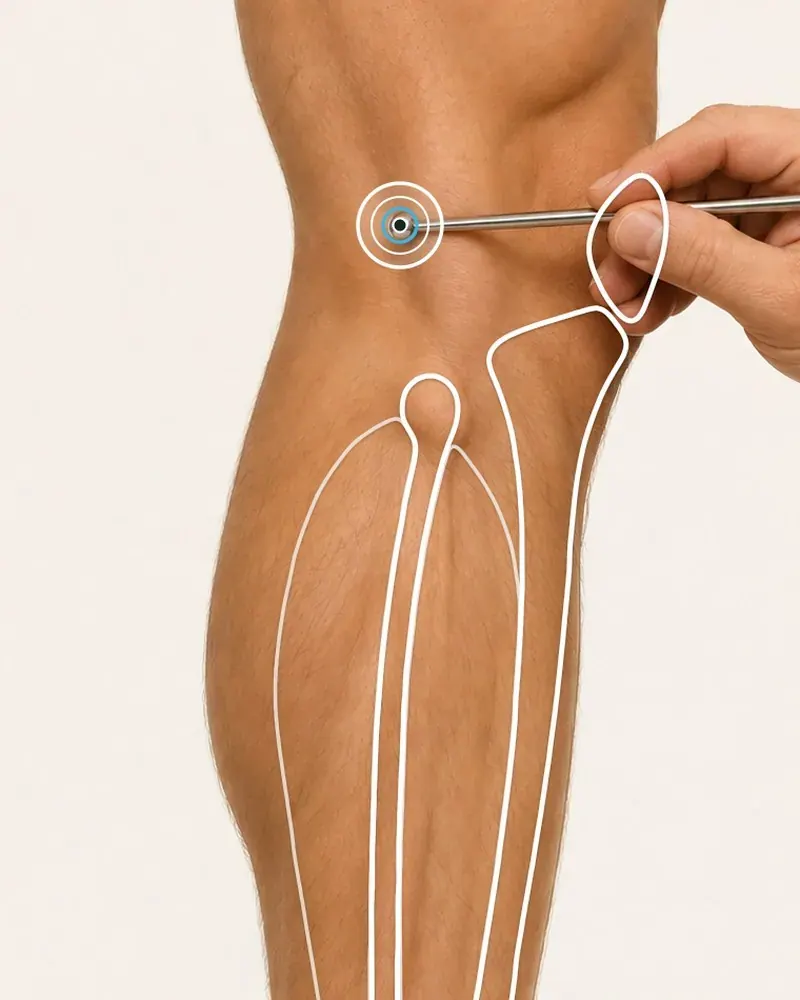
Location
On the lateral aspect of the knee, in the depression between the biceps femoris tendon and the iliotibial band, above the lateral epicondyle of the femur.
According to the WHO (2008): On the lateral aspect of the knee, in the depression between the biceps femoris tendon and the iliotibial band, posterior and proximal to the lateral epicondyle of the femur.
How to find it, step by step
Three steps with photos, from an easy landmark to the exact point. Measurements are in cun, the width of the person's own thumb.
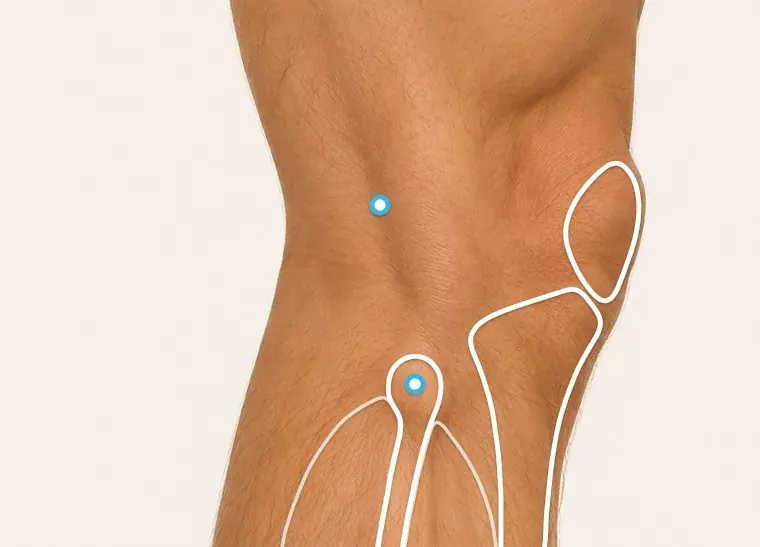 Head of fibulaBiceps–IT band groove1
Find the head of the fibula
It is the bony bump on the outer side, just below the knee. Above it, the knee has another bony prominence: the epicondyle of the femur.
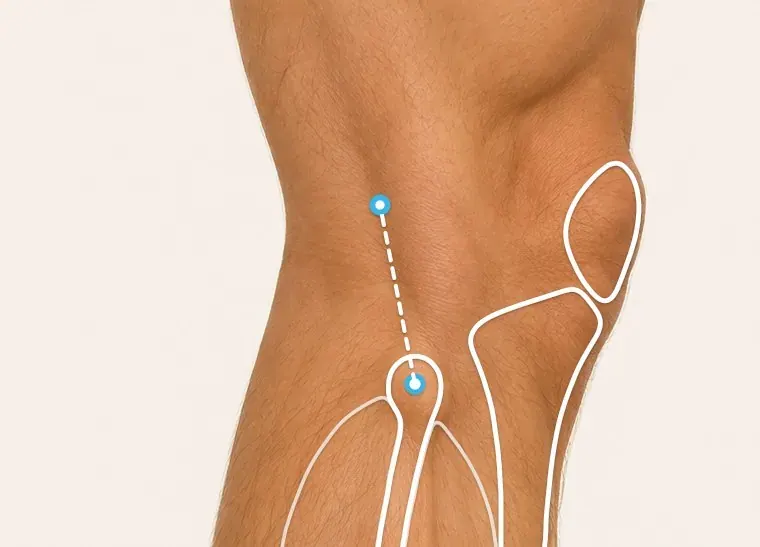 2
Go up along the groove
With the knee slightly bent, the biceps femoris tendon stands out behind and the iliotibial band in front. Xīyángguān is in the hollow between the two, just above and behind the epicondyle.
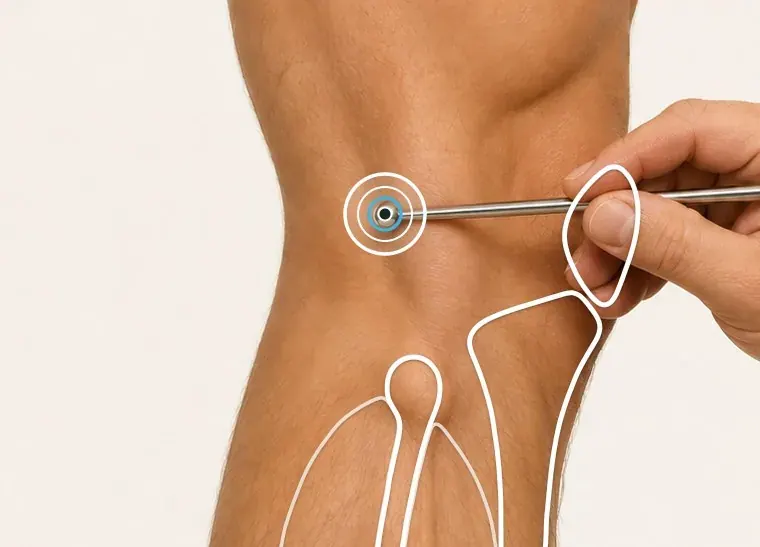 3
Press in the hollow
Perpendicular.
Functions according to tradition
Relaxes the sinews and frees the knee; a local point for lateral knee pain.
Traditional indications
- Lateral knee pain
- Knee stiffness
- Leg numbness
Indications described by tradition; they do not amount to proven clinical effectiveness for each one.
Precautions
- Needling depth
- 1–1.5 cun
- Angle
- Perpendicular
Needling must always be done by a trained professional. At home, only gentle finger pressure.
Points on other channels with similar indications
They share several traditional indications with this point. Comparing them helps understand why one or the other is chosen.
- BL38 Fuxi (Bladder): Leg numbness
Point profile
- Code
- GB33
- Pinyin name
- Xī Yáng Guān
- Characters
- 膝阳关
- Translation
- Knee Yang Joint
- Meridian
- Gallbladder
- Element
- Wood
- Topics
- Knee, Sinews, Pain
Health notice. Educational and study content. It describes concepts of Traditional Chinese Medicine and does not replace diagnosis or treatment by a healthcare professional. Needling, medicinal herbs and invasive techniques must be applied by trained professionals. Safety guide.
