Neiguan (PC6)
Neiguan (PC6), “Inner Gate”, is a point on the Pericardium meridian. It is point 6 of the 9 on the channel. Regulates Heart Qi, opens the chest, calms the mind, descends rebellious Qi, treats Pericardium and heart diseases.
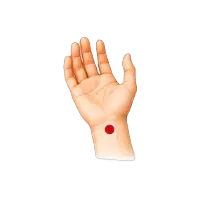
Location
2 cun proximal to the wrist crease, between the tendons of palmaris longus and flexor carpi radialis.
Functions according to tradition
Regulates Heart Qi, opens the chest, calms the mind, descends rebellious Qi, treats Pericardium and heart diseases.
Traditional indications
- Nausea and vomiting
- Angina pectoris
- Palpitations
- Motion sickness
- Anxiety
- Insomnia
- Depression
Indications described by tradition; they do not amount to proven clinical effectiveness for each one.
What its classification means
From here the collateral that links the channel to its interior-exterior partner departs, which is why it is credited with acting on both channels at once.
At this point the channel crosses the Yin Linking Vessel (Yin Wei Mai, 阴维脉), one of the eight extraordinary vessels.
Precautions
No specific contraindications. Needle between the tendons; the median nerve is close—withdraw the needle if an electric sensation occurs.
Points on other channels with similar indications
They share several traditional indications with this point. Comparing them helps understand why one or the other is chosen.
- CV14 Juque (Ren Mai (Conception Vessel)): Anxiety, Insomnia, Nausea and vomiting, Palpitations
- HT7 Shenmen (Heart): Anxiety, Depression, Insomnia, Palpitations
- GV11 Shendao (Du Mai (Governing Vessel)): Anxiety, Insomnia, Palpitations
- BL15 Xinshu (Bladder): Anxiety, Insomnia, Palpitations
- EX-HN22 Anmian (Extraordinary points): Anxiety, Insomnia, Palpitations
- GV20 Baihui (Du Mai (Governing Vessel)): Anxiety, Depression, Insomnia
Point profile
- Code
- PC6
- Pinyin name
- Nèi Guān
- Characters
- 内关
- Translation
- Inner Gate
- Meridian
- Pericardium
- Element
- Fire
- Classification
- Luo-Connecting, Yin Wei Mai
- Topics
- Nausea, Heart, Mental
Health notice. Educational and study content. It describes concepts of Traditional Chinese Medicine and does not replace diagnosis or treatment by a healthcare professional. Needling, medicinal herbs and invasive techniques must be applied by trained professionals. Safety guide.