Tianchuang (SI16)
Tianchuang (SI16), “Celestial Window”, is a point on the Small Intestine meridian. It is point 16 of the 19 on the channel. Benefits the ears and throat and descends rebellious Qi from the head.
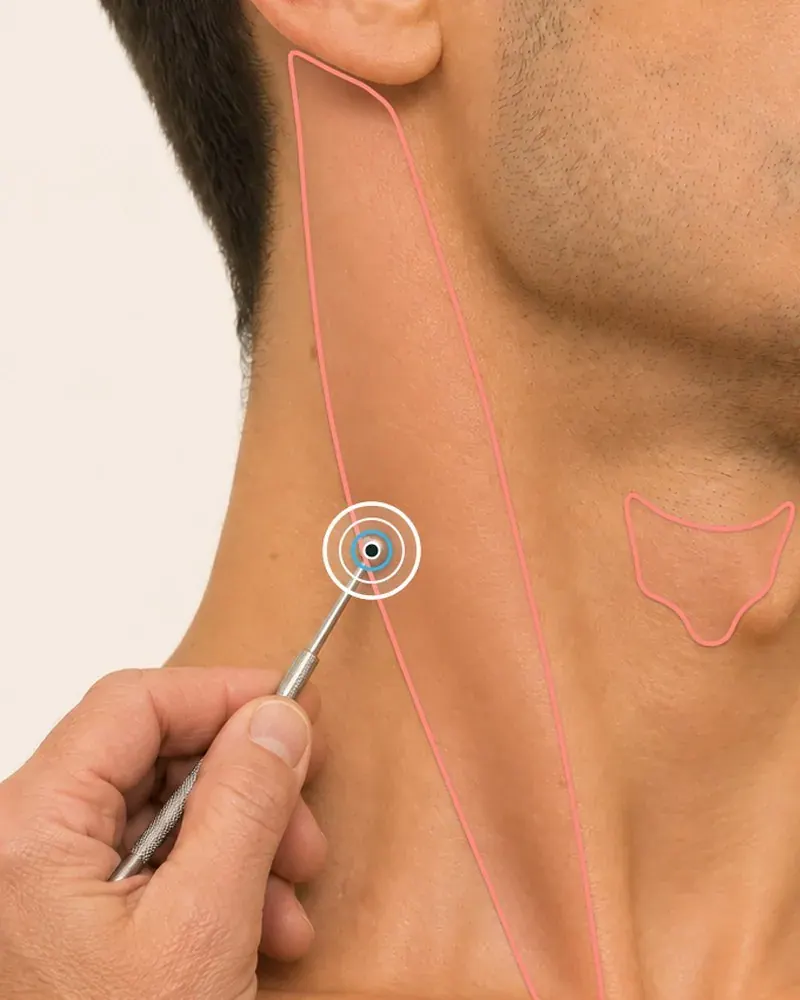
Location
On the neck, posterior to sternocleidomastoid, level with the upper border of the thyroid cartilage.
According to the WHO (2008): In the anterior region of the neck, posterior to the sternocleidomastoid muscle, at the same level as the superior border of the thyroid cartilage. Note 1: the sternocleidomastoid is more clearly defined when the head is turned to the opposite side against resistance. Note 2: SI16 is at the same level as ST9, LI18 and the superior border of the thyroid cartilage; ST9 is anterior to the sternocleidomastoid, SI16 is posterior to it, and LI18 is between its anterior and posterior borders.
How to find it, step by step
Three steps with photos, from an easy landmark to the exact point. Measurements are in cun, the width of the person's own thumb.
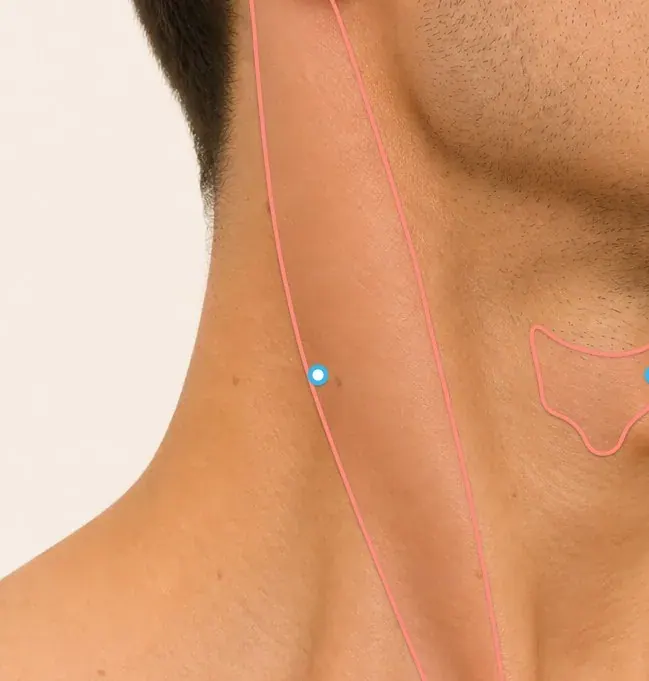 Top of thyroid (Adam's apple)Sternocleidomastoid (back edge)1
Find the Adam's apple
Touch the Adam's apple (thyroid cartilage) and find its upper edge: that is the level of the point.
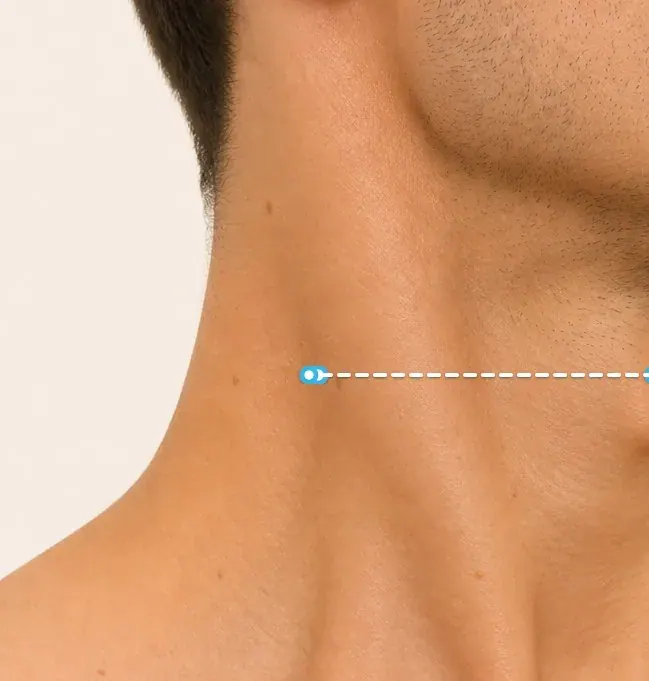 2
Bring out the neck muscle
Turn your head to the other side, pushing against your hand: the sternocleidomastoid stands out, the cord running from behind the ear to the breastbone.
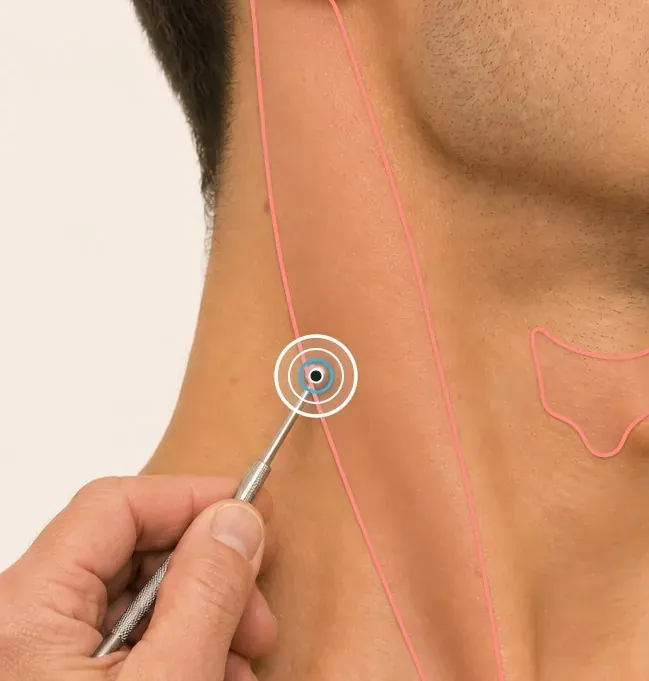 3
Press behind the muscle
Level with the Adam's apple, just behind the back edge of that cord, is Tiānchuāng. Gentle, superficial pressure: the carotid artery runs in front of the muscle.
Functions according to tradition
Benefits the ears and throat and descends rebellious Qi from the head.
Traditional indications
- Deafness
- Tinnitus
- Sore throat
- Neck stiffness
- Loss of voice
Indications described by tradition; they do not amount to proven clinical effectiveness for each one.
What its classification means
Group of points on the neck and shoulders that, according to the classics, regulate the passage of Qi between the head and the body.
Precautions
Shallow needling: avoid the carotid artery, immediately in front.
- Needling depth
- 0.3–0.5 cun (≈ 0.5–1 cm)
- Angle
- Perpendicular, shallow
Needling must always be done by a trained professional. At home, only gentle finger pressure.
Points on other channels with similar indications
They share several traditional indications with this point. Comparing them helps understand why one or the other is chosen.
- GB10 Fubai (Gallbladder): Deafness, Neck stiffness, Tinnitus
- GB11 Touqiaoyin (Gallbladder): Deafness, Neck stiffness, Tinnitus
- TE2 Yemen (San Jiao (Triple Burner)): Deafness, Sore throat, Tinnitus
- TE3 Zhongzhu (San Jiao (Triple Burner)): Deafness, Sore throat, Tinnitus
- ST11 Qishe (Stomach): Neck stiffness, Sore throat
- GB2 Tinghui (Gallbladder): Deafness, Tinnitus
Point profile
- Code
- SI16
- Pinyin name
- Tiān Chuāng
- Characters
- 天窗
- Translation
- Celestial Window
- Meridian
- Small Intestine
- Element
- Fire
- Classification
- Window of Heaven
- Topics
- Throat, Ear, Neck
Health notice. Educational and study content. It describes concepts of Traditional Chinese Medicine and does not replace diagnosis or treatment by a healthcare professional. Needling, medicinal herbs and invasive techniques must be applied by trained professionals. Safety guide.
