Quyuan (SI13)
Quyuan (SI13), “Crooked Wall”, is a point on the Small Intestine meridian. It is point 13 of the 19 on the channel. Frees the channel and relaxes the sinews over the scapula.
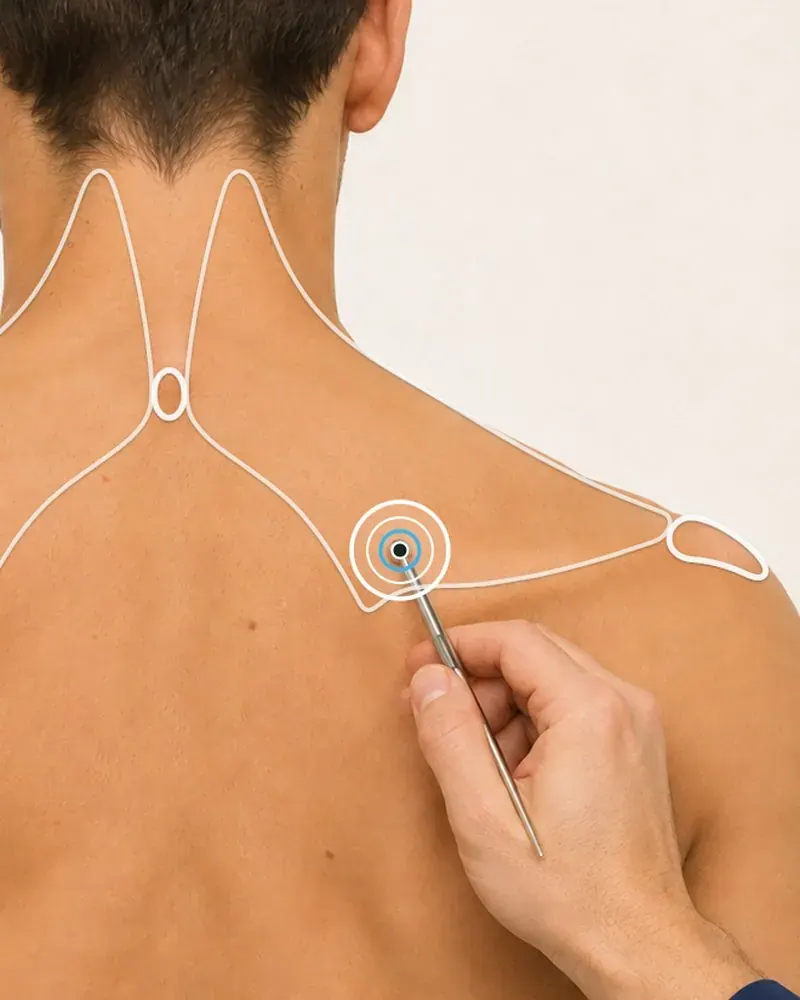
Location
In the depression superior to the medial end of the spine of the scapula.
According to the WHO (2008): In the scapular region, in the depression superior to the medial end of the spine of the scapula. Note: SI13 is located at the midpoint of the line connecting SI10 with the spinous process of the second thoracic vertebra (T2).
How to find it, step by step
Three steps with photos, from an easy landmark to the exact point. Measurements are in cun, the width of the person's own thumb.
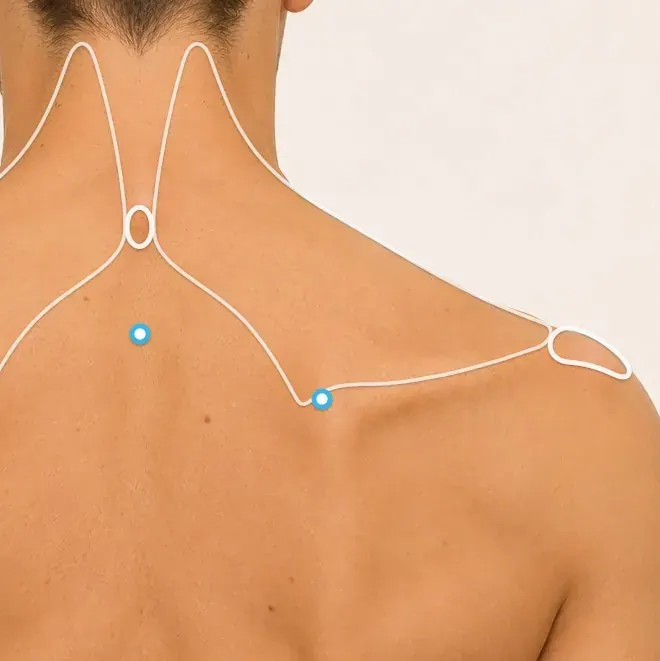 Medial end of spineT21
Find the end of the spine
Follow the spine of the shoulder blade toward the spinal column to its inner end, level with T3.
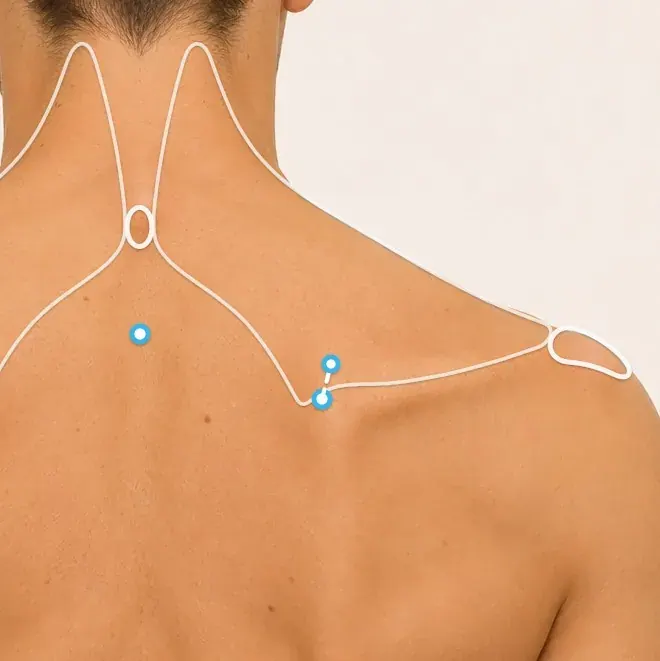 2
Go up to the hollow above
Just above that end, in the fossa, there is a hollow: Qūyuán (roughly halfway between SI10 and the spinous process of T2).
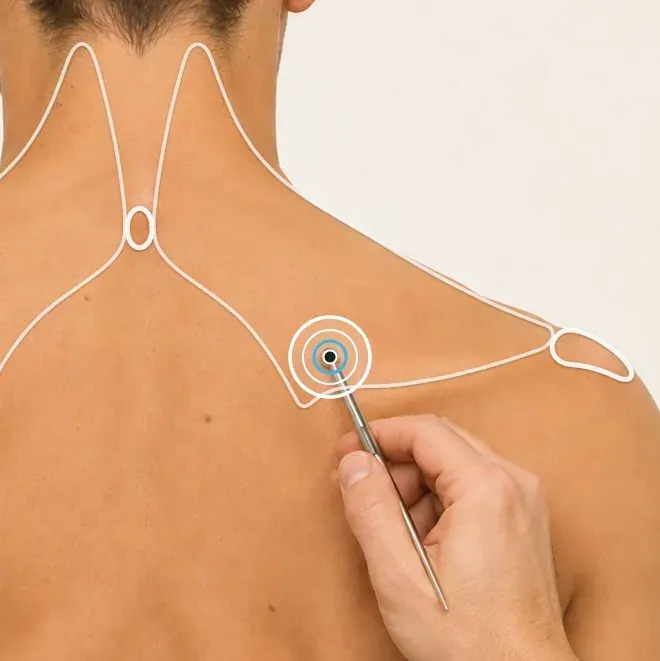 3
Press in the hollow
Oblique and shallow, never toward the chest.
Functions according to tradition
Frees the channel and relaxes the sinews over the scapula.
Traditional indications
- Shoulder and scapular pain
- Contracture
- Neck stiffness
Indications described by tradition; they do not amount to proven clinical effectiveness for each one.
Precautions
Oblique needling over the supraspinous fossa: deep needling can reach the lung.
- Needling depth
- 0.3–0.5 cun
- Angle
- Oblique
Needling must always be done by a trained professional. At home, only gentle finger pressure.
Points on other channels with similar indications
They share several traditional indications with this point. Comparing them helps understand why one or the other is chosen.
- TE15 Tianliao (San Jiao (Triple Burner)): Neck stiffness
- BL41 Fufen (Bladder): Neck stiffness
- BL65 Shugu (Bladder): Neck stiffness
- LI14 Binao (Large Intestine): Neck stiffness
Point profile
- Code
- SI13
- Pinyin name
- Qū Yuán
- Characters
- 曲垣
- Translation
- Crooked Wall
- Meridian
- Small Intestine
- Element
- Fire
- Topics
- Shoulder, Pain, Sinews
Health notice. Educational and study content. It describes concepts of Traditional Chinese Medicine and does not replace diagnosis or treatment by a healthcare professional. Needling, medicinal herbs and invasive techniques must be applied by trained professionals. Safety guide.