External therapies: Gua sha
Sha appears early where it is going to appear. 6 activities, about 12 minutes.
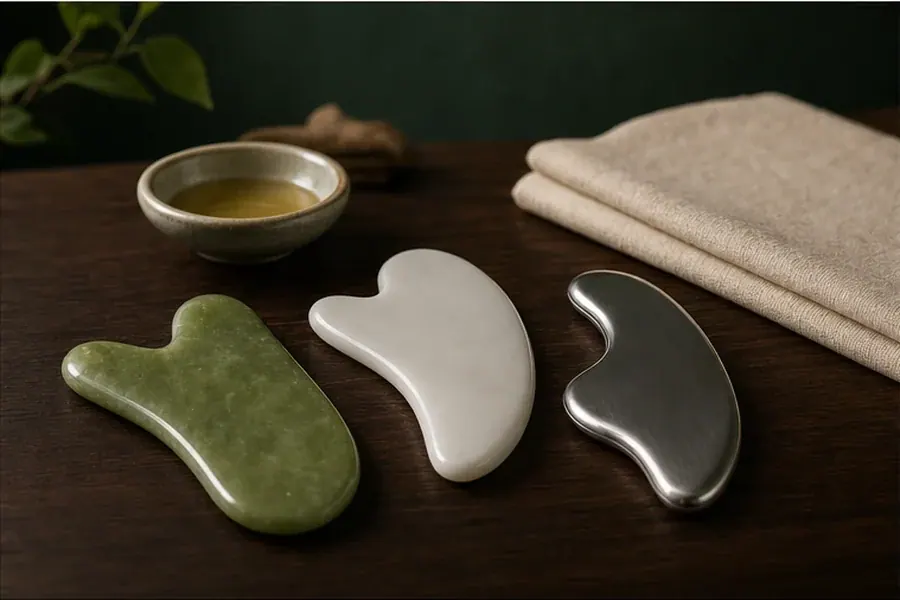
Scraping the sha
刮痧 Guā Shā
Gua sha literally means “scraping the sha”. The word names two things at once: the speckled response on the skin and a whole family of acute presentations described in the classical texts. It began as a household technique, with the edge of a spoon or a coin, and only later entered the professional repertoire.
- Sha, first sense
- The speckled response that appears on the skin
- Sha, second sense
- A family of acute presentations, with its own 1675 treatise
- Household origin
- Spoon or coin, tied to fever and heat exhaustion
- Household versus professional
- Not equivalent in pressure or in selection criteria
What sha physically is
Petechiae: pinpoint micro-extravasations that appear in clusters and that the skin reabsorbs over two to five days, changing color like any bruise. Knowing this is what lets you tell the expected response from an injury.
- Clustered petechiae, no sharp pain
- Expected response; gone in 2-5 days
- Sharp pain, blister, linear abrasion
- Excess or faulty technique: not a goal
- Loss of sensation
- Stop and assess
- Extensive purpura out of proportion
- May indicate capillary fragility or a clotting disorder: refer
Common mistake: Chasing the darkest mark. The aim is enough stimulus with the least possible damage, and those are different things.
After a correct series of strokes, one area has not responded. What do you do?
How does facial gua sha differ from body gua sha?
Put a body gua sha session in order
- Inspect the skin and agree what they will feel
- Lubricate the area
- Start at minimum pressure and assess after the first series
- Go up a step if the skin allows it
- Leave the area as soon as the expected response appears
What matters most about the gua sha tool?

Level complete!
Good work. Ordered from start to finish.
Did you enjoy it? In the app you save your progress, review what you forget and unlock the 723 exercises.
Study content. The exercises describe concepts of Traditional Chinese Medicine; they are not medical advice.