Yin and Yang: The symbol
One single thing seen from two sides. 8 activities, about 11 minutes.
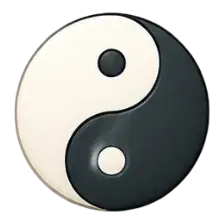
Two faces of the same thing
太極 tài jí
The symbol does not draw two things facing off: it draws one circle divided. Yin and yang are not two substances at war, they are two ways of describing one process. That is why no therapy tries to remove one of them.
- The whole circle
- the complete process
- The wavy line
- the share shifts constantly
- The dot of the opposite colour
- each half holds a seed of the other
Common mistake: Talking about «balancing yin and yang» as if they were two tanks to be levelled at 50 % each.
What yin is and what yang is
They are two opposite qualities Chinese medicine uses to describe anything, the body included. They are not things: they are ways of looking at things.
- Yin
- cold, stillness, below and inside
- Yang
- warmth, movement, above and outside
- Yin in the body
- substance: blood, fluids, reserves
- Yang in the body
- function: warming, moving, defending
Common mistake: Thinking yin is «bad» and yang «good». Both are needed, and illness comes from the one in surplus or the one in short supply.
Each half splits again
Day is yang to night, but morning is the yang of yang and afternoon the yin of yang. The division has no bottom, and that is the tool: it lets you get precise without changing vocabulary.
- Morning
- yang within yang
- Afternoon
- yin within yang
- Early night
- yin within yin
- Before dawn
- yang within yin
Common mistake: Stopping at the first division and being unable to say why a symptom shows at five in the morning and not at midnight.
Zang organs and fu organs
Chinese medicine groups the organs in pairs. In each, the solid one (zang) stores and is the yin side; the hollow one (fu) receives, transforms and empties, and is the yang side.
- Zang
- solid organ: Liver, Heart, Spleen, Lung, Kidney
- Fu
- hollow organ: Gallbladder, Stomach, Intestines, Bladder
- Liver and Gallbladder
- one zang-fu pair
Common mistake: Reading «Liver» as the anatomical organ: here it names a set of functions.
A colleague asks: «is the Liver yin or yang?». What is the best answer?
Inside the body, sort each structure by whether substance or function dominates.
- The warmth that digests food
- The blood running through the vessels
- The push that lifts qi to the head
- The fluids that moisten the joints
- The defence running under the skin
- The essence stored in the Kidney
Match each term with its natural counterpart.
Clinically, what is the dot of the opposite colour inside each half for?

Level complete!
The foundation is firm. Now the details have somewhere to rest.
Did you enjoy it? In the app you save your progress, review what you forget and unlock the 770 exercises.
Study content. The exercises describe concepts of Traditional Chinese Medicine; they are not medical advice.