Kunlun (BL60)
Kunlun (BL60), “Kunlun Mountains”, is a point on the Bladder meridian. It is point 60 of the 67 on the channel. Activates the Bladder meridian along the entire back and spine, relieves pain, expels Wind, relaxes tendons.
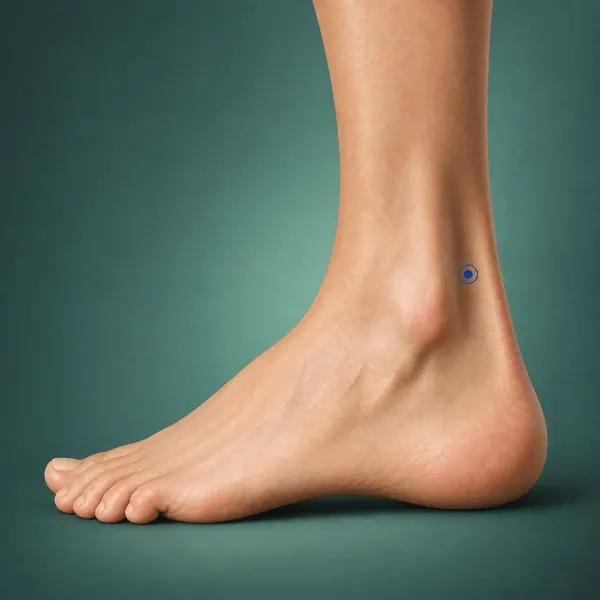
Location
In the depression between the apex of the lateral malleolus and the Achilles tendon.
Functions according to tradition
Activates the Bladder meridian along the entire back and spine, relieves pain, expels Wind, relaxes tendons.
Traditional indications
- Lumbar pain
- Heel pain
- Cervical pain
- Headache
- Difficult labor
- Ankle swelling
- Sciatica
Indications described by tradition; they do not amount to proven clinical effectiveness for each one.
What its classification means
Fourth of the transport points: the Qi “moves” with greater volume. It is traditionally related to cough, dyspnea and changes in the voice.
It belongs to the small group of points that tradition associates with an entire region of the body (Zusanli with the abdomen, Weizhong with the back, Lieque with the head and nape, Hegu with the face and mouth…).
Precautions
CONTRAINDICATED during pregnancy (may induce labor). Avoid the posterior tibial artery.
Points on other channels with similar indications
They share several traditional indications with this point. Comparing them helps understand why one or the other is chosen.
- GB21 Jianjing (Gallbladder): Difficult labor, Headache
- GB10 Fubai (Gallbladder): Headache
- GB12 Wangu (Gallbladder): Headache
- GB40 Qiuxu (Gallbladder): Sciatica
- GV13 Taodao (Du Mai (Governing Vessel)): Headache
- GV18 Qiangjian (Du Mai (Governing Vessel)): Headache
Point profile
- Code
- BL60
- Pinyin name
- Kūn Lún
- Characters
- 昆仑
- Translation
- Kunlun Mountains
- Meridian
- Bladder
- Element
- Water
- Classification
- Jing-River, Command point
- Topics
- Lower Back, Neck, Ankle
Health notice. Educational and study content. It describes concepts of Traditional Chinese Medicine and does not replace diagnosis or treatment by a healthcare professional. Needling, medicinal herbs and invasive techniques must be applied by trained professionals. Safety guide.