Taiyuan (LU9)
Taiyuan (LU9), “Supreme Abyss”, is a point on the Lung meridian. It is point 9 of the 11 on the channel. Yuan-Source of Lung.
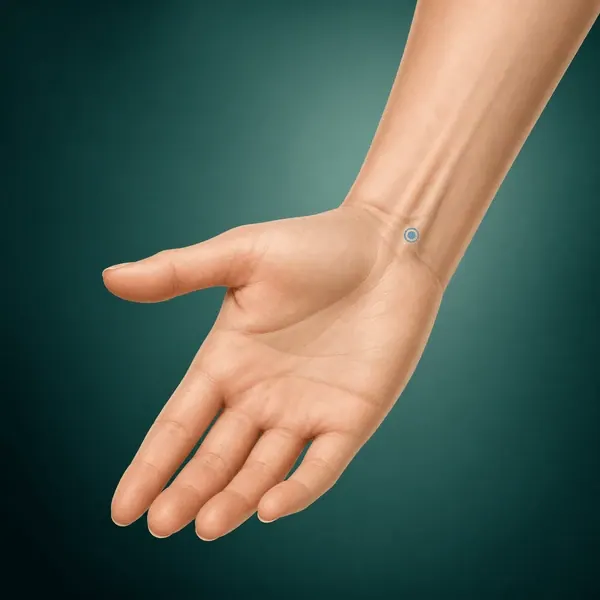
Location
At the transverse wrist crease, in the depression radial to the abductor pollicis longus tendon.
Functions according to tradition
Yuan-Source of Lung. Influential point for blood vessels (Mai). Tonifies Lung Yin, nourishes fluids, descends Lung Qi, benefits the throat.
Traditional indications
- Chronic cough
- Asthma
- Hemoptysis
- Lung weakness
- Palpitations
- Weak voice
- Vascular diseases
Indications described by tradition; they do not amount to proven clinical effectiveness for each one.
What its classification means
Where the original Qi of the organ manifests. Tradition uses it both to examine and to treat the channel's organ.
Third of the transport points: the Qi “flows”. It is associated with heaviness of the body and joint pain; in the yin channels it coincides with the Source point.
One of the eight points that tradition credits with a special influence over a tissue or substance: Qi, Blood, tendons, marrow, vessels, bones, zang organs or fu organs.
Precautions
Located over the radial artery. AVOID needling the radial artery (radial pulse).
Points on other channels with similar indications
They share several traditional indications with this point. Comparing them helps understand why one or the other is chosen.
- BL43 Gaohuangshu (Bladder): Asthma, Chronic cough
- CV17 Shanzhong (Ren Mai (Conception Vessel)): Asthma, Palpitations
- BL13 Feishu (Bladder): Asthma
- BL42 Pohu (Bladder): Asthma
- CV18 Yutang (Ren Mai (Conception Vessel)): Asthma
- CV21 Xuanji (Ren Mai (Conception Vessel)): Asthma
Point profile
- Code
- LU9
- Pinyin name
- Tài Yuān
- Characters
- 太渊
- Translation
- Supreme Abyss
- Meridian
- Lung
- Element
- Metal
- Classification
- Yuan-Source, Shu-Stream, Influential point of vessels
- Topics
- Lung, Breathing, Blood Vessels
Health notice. Educational and study content. It describes concepts of Traditional Chinese Medicine and does not replace diagnosis or treatment by a healthcare professional. Needling, medicinal herbs and invasive techniques must be applied by trained professionals. Safety guide.