Eight Brocades
Eight standing movements combining gentle extension, coordination, attention, and breathing without forcing joint range.
Traditional framework
Traditionally, each “brocade” is associated with cultivating Qi and regulating the San Jiao, organs, sinews, and spine. These associations describe the historical practice framework.
The 8 movements step by step
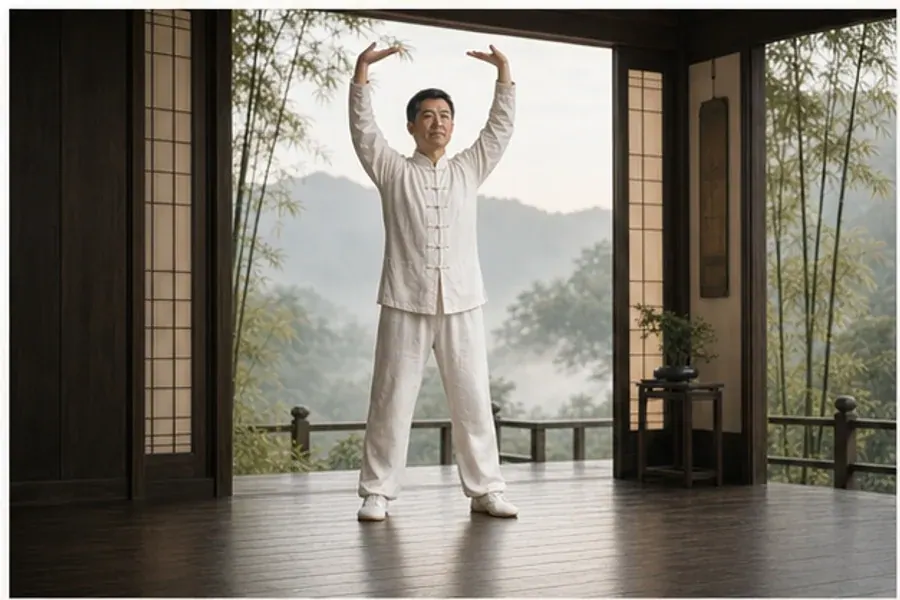
Two Hands Support the Heavens 双手托天理三焦
From a stable stance, loosely interlace the hands and raise them without locking elbows or knees.
- Breathing
- Inhale as the hands rise; exhale as they lower with control.
- Repetitions
- 8
- Duration
- 64 s
Common mistakes
- Locking the elbows at the top: keep a soft curve in the arm.
- Shrugging the shoulders toward the ears while rising; the neck stays long.
- Arching the low back to gain height instead of lengthening from the center.
Draw the Bow Left and Right 左右开弓似射雕
Use a comfortable wider stance and mimic drawing a bow on each side while keeping the trunk upright.
- Breathing
- Inhale to prepare; exhale through the opening.
- Repetitions
- 8
- Duration
- 56 s
Common mistakes
- Letting the knee drop inward as the stance opens.
- Leaning the trunk toward the pulling side instead of keeping it upright.
- Gripping the bow hand at full force; the gesture is firm, not rigid.
Raise One Hand to Regulate the Center 调理脾胃须单举
One palm rises while the other lowers; alternate without leaning the torso.
- Breathing
- Breathe continuously and change sides after the exhalation.
- Repetitions
- 8
- Duration
- 56 s
Common mistakes
- Side-bending the torso toward the descending hand.
- Forgetting the lowering palm: both hands work at the same time.
Look Back 五劳七伤往后瞧
Slowly turn the head and upper trunk within a comfortable range; return to center before changing sides.
- Breathing
- Exhale through the turn; inhale on the return.
- Repetitions
- 6
- Duration
- 42 s
Common mistakes
- Turning only the head and straining the neck instead of letting the upper trunk follow.
- Bouncing at the end of the turn to chase more range.
Sway the Head and Tail 摇头摆尾去心火
From a comfortable wider stance, shift weight softly with a small trunk rotation.
- Breathing
- Exhale into the shift; inhale at center.
- Repetitions
- 6
- Duration
- 48 s
Common mistakes
- Turning it into a fast head circle; the movement comes from the hips.
- Letting the knees travel past the feet during the weight shift.
Hands Descend Toward Legs and Feet 两手攀足固肾腰
Lengthen the spine, hinge from the hips, and let the hands descend only as far as comfortable.
- Breathing
- Exhale while descending; inhale to return gradually.
- Repetitions
- 6
- Duration
- 48 s
Common mistakes
- Rounding the low back to reach lower instead of hinging from the hip.
- Coming up abruptly at the end, which commonly causes dizziness.
Clench the Fists and Open the Gaze 攒拳怒目增气力
Close the fists without maximal gripping and extend one arm at a time while relaxing the jaw and shoulders.
- Breathing
- Exhale with the extension; inhale on return.
- Repetitions
- 8
- Duration
- 48 s
Common mistakes
- Holding the breath through the extension.
- Clenching the jaw and shoulders; steadiness comes from the trunk, not the face.
Rise and Settle Through the Heels 背后七颠百病消
Lift the heels slightly and settle the whole foot with control, using support if needed.
- Breathing
- Inhale while rising; exhale while settling.
- Repetitions
- 7
- Duration
- 42 s
Common mistakes
- Dropping the heels rather than settling them with control.
- Rising so high that balance is lost; a couple of centimetres is enough.
What the evidence says
Baduanjin research mainly studies gentle activity, balance, function, and quality of life. Results do not make each movement a condition-specific treatment.
Safety
Stay within a comfortable range and use nearby support if there is fall risk. Stop with pain, dizziness, unusual breathlessness, sudden weakness, or loss of balance.
Health notice. Educational and study content. It describes concepts of Traditional Chinese Medicine and does not replace diagnosis or treatment by a healthcare professional. Needling, medicinal herbs and invasive techniques must be applied by trained professionals. Safety guide.