Seated Foundations
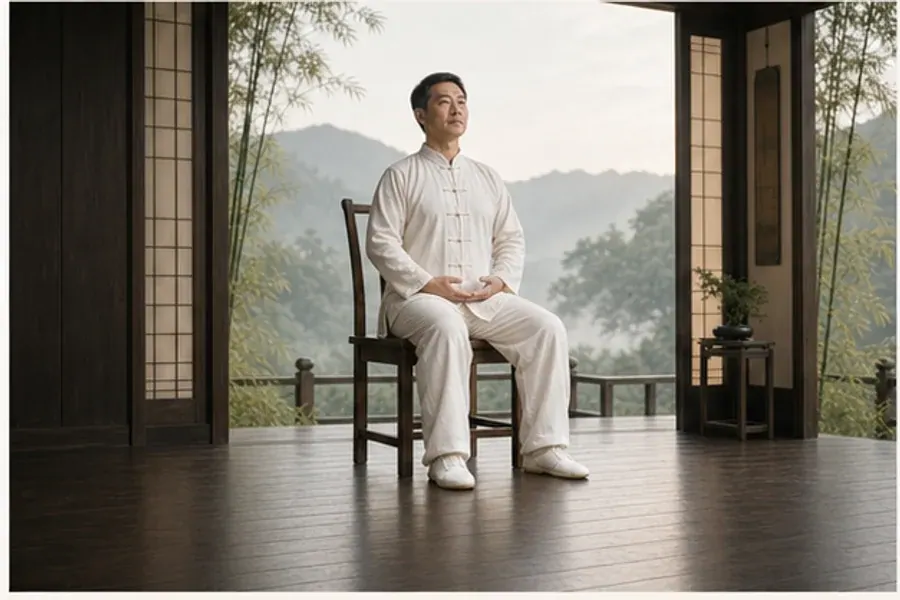
A short routine performed in a stable chair to learn posture, breathing, and coordination without standing balance.
Traditional framework
Seated practice and Daoyin have many historical forms. This is a contemporary educational adaptation, not a reconstruction of one lineage.
The 6 movements step by step
Arrive in the Posture 调身 · Tiáo Shēn
Sit toward the front of a firm chair with feet supported and hands on thighs.
- Breathing
- Observe three breaths without changing them.
- Repetitions
- 5
- Duration
- 50 s
Common mistakes
- Leaning on the backrest; the practice asks you to sit forward.
- Changing the breath when the task is only to observe it.
Open and Release the Shoulders 松肩 · Sōng Jiān
Lift the shoulders slightly, open, and let them settle without large circles.
- Breathing
- Inhale to lift; exhale to release.
- Repetitions
- 6
- Duration
- 42 s
Common mistakes
- Making wide circles instead of lifting and releasing.
- Holding the tension at the top instead of letting the shoulders drop.
Cloud Hands 云手 · Yún Shǒu
Move the hands side to side with a small trunk rotation and stable pelvis.
- Breathing
- Breathe continuously and transition softly.
- Repetitions
- 8
- Duration
- 56 s
Common mistakes
- Turning the pelvis along with the trunk; the base stays stable.
- Tracking the hands with the head until it causes dizziness.
Open and Close 开合 · Kāi Hé
Separate the hands as if expanding a sphere and bring them closer without touching.
- Breathing
- Inhale opening; exhale closing.
- Repetitions
- 8
- Duration
- 64 s
Common mistakes
- Forcing a bigger breath than is comfortable.
- Separating the hands with locked elbows.
Move Feet and Ankles 活踝 · Huó Huái
Alternate lifting toes and heels while keeping both feet controlled.
- Breathing
- Use natural breathing.
- Repetitions
- 8
- Duration
- 48 s
Common mistakes
- Lifting the feet off the floor instead of alternating toes and heel.
- Speeding up until the movement loses control.
Close the Practice 收功 · Shōu Gōng
Rest the hands, gently lengthen the spine, and notice contact through feet and chair.
- Breathing
- Take three quiet breaths.
- Repetitions
- 5
- Duration
- 50 s
Common mistakes
- Standing up immediately at the end.
- Skipping the closing; it is part of the practice, not an extra.
What the evidence says
The adaptation supports accessibility and low-intensity movement. It is not presented as rehabilitation or a substitute for physiotherapy guidance.
Safety
Use a firm chair without wheels, support the feet, and clear the space. If sitting or standing requires help, practice with assistance.
Health notice. Educational and study content. It describes concepts of Traditional Chinese Medicine and does not replace diagnosis or treatment by a healthcare professional. Needling, medicinal herbs and invasive techniques must be applied by trained professionals. Safety guide.