Chinese herbal medicine: herbs, formulas and safety
Chinese herbal medicine is the use of plants, and to a lesser extent minerals and animal products, combined into formulas according to the principles of Traditional Chinese Medicine. It is the most widely used TCM therapy in China; some substances have led to effective drugs, but it also poses real risks of toxicity, contamination and interactions.
Key points
- Chinese herbal medicine rarely uses a single herb: it is based on formulas that combine several ingredients with different functions.
- Its major historical references include Zhang Zhongjing's Shanghan Lun and Li Shizhen's Bencao Gangmu.
- Artemisinin, an antimalarial derived from the qinghao plant, earned Tu Youyou the Nobel Prize in Medicine in 2015.
- Some herbs contain toxic substances, such as aristolochic acid, which causes severe kidney damage and urothelial cancer.
- They can interact with medications, especially anticoagulants, and their quality depends heavily on the manufacturer.
- Natural does not mean harmless: always check with your doctor before taking them.
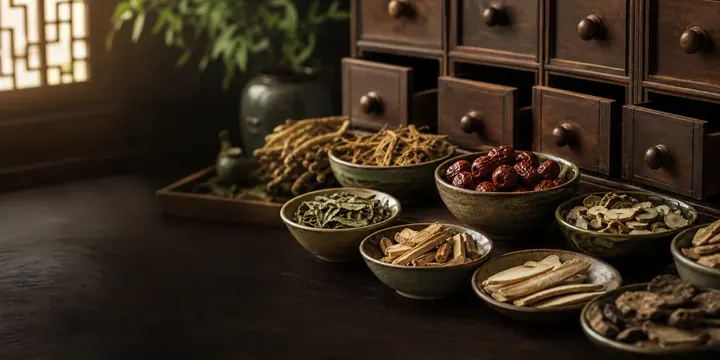
In China, herbal medicine is the backbone of traditional medicine: far more than acupuncture, it is the therapy TCM doctors prescribe most. It is commonly known as zhongyao (中药, zhōng yào), "Chinese medicine", and although most of its ingredients are plants, it also includes minerals and some animal products. On this page we explain how a formula is built, what its reference texts are, what specific risks it carries and what research has been able to demonstrate.
What is Chinese herbal medicine?
Chinese herbal medicine classifies each substance according to traditional properties: its nature or temperature (cold, cool, neutral, warm or hot), its flavor (sour, bitter, sweet, pungent or salty) and the meridians it is directed toward. This system is closely tied to the theory of the five elements and is the same one applied to foods in Chinese dietary therapy.
From the traditional point of view, the aim is not to treat an isolated symptom but to correct a "pattern" of imbalance: excess heat, Qi deficiency, Blood stagnation, and so on. Two people with the same Western diagnosis may receive different formulas if their traditional pattern is different.
Classical reference texts
The Chinese pharmacopeia has accumulated over centuries. Among its most influential works are:
| Work | Author | Significance |
|---|---|---|
| Shanghan Lun (伤寒论) | Zhang Zhongjing | Treatise on febrile diseases; many of its formulas are still used |
| Bencao Gangmu (本草纲目) | Li Shizhen | Great compendium of materia medica from the Ming dynasty |
| Huangdi Neijing (黄帝内经) | Anonymous | Theoretical foundation of all Chinese medicine, more than a book of prescriptions |
If you are interested in the context, you can read our history of Chinese medicine.
How is a formula built?
A single herb is rarely prescribed on its own. The usual approach is a formula (方剂, fāngjì) that combines several ingredients with distinct roles according to a traditional hierarchy:
- Emperor (君, jūn): the main ingredient, aimed at the central problem.
- Minister (臣, chén): reinforces the action of the main ingredient.
- Assistant (佐, zuǒ): treats secondary aspects or moderates toxicity.
- Envoy (使, shǐ): harmonizes the formula or "guides" it to an area.
Forms of preparation
- Traditional decoction: the dried herbs are boiled and the liquid is drunk.
- Granules or powders of concentrated extract, dissolved in water.
- Industrially made pills, tablets and capsules.
- Preparations for external use (liniments, plasters).
Safety and precautions
The idea that natural means harmless is especially dangerous in this field. Chinese herbal medicine has been at the center of some of the best-documented safety problems in traditional medicine.
Toxicity of certain herbs
The best-known case is that of aristolochic acid, found in plants of the genus Aristolochia, which can turn up through confusion or substitution between species with similar Chinese names. In the 1990s, in Belgium, patients at a weight-loss clinic who took a preparation containing these plants developed severe kidney disease, and an increase in urinary tract cancers was later observed. Today this is known as aristolochic acid nephropathy, and the substance is known to be carcinogenic. Another example is ephedra (麻黄, máhuáng): after numerous adverse cardiovascular effects, the US FDA banned dietary supplements containing ephedra alkaloids in 2004.
Quality and contamination
Various analyses have found Chinese herbal products containing heavy metals (lead, mercury, arsenic), pesticides, misidentified ingredients or even undeclared added drugs. Quality depends largely on the manufacturer and on the controls in the country of origin. Some preparations also include products from protected species, which raises an ethical and legal problem as well.
Interactions with medications
Herbs can change how drugs work. Especially relevant is the interaction with anticoagulants such as warfarin: herbs such as danshen (丹参, dānshēn) or dang gui (当归, dāngguī) have been linked to an increased risk of bleeding. There is also risk for people taking immunosuppressants, antiepileptic drugs or cancer treatments.
Practical recommendations
- Always tell your doctor and pharmacist about any herb you take.
- Avoid products of unknown origin, bought online without guarantees or without clear labeling.
- Take extreme care during pregnancy, breastfeeding, childhood and in people with liver or kidney disease.
- Stop the product and seek medical advice if you notice symptoms such as jaundice, dark urine, severe fatigue or bleeding.
You will find more advice on our safety page.
What does the scientific evidence say?
The most brilliant example of the potential of the Chinese pharmacopeia is artemisinin. In the 1970s, a team led by researcher Tu Youyou reviewed ancient texts in search of remedies for fever and focused on the qinghao plant (青蒿, qīnghāo, Artemisia annua). A classical text described its use cold, which helped design an extraction method that preserved the active substance. Artemisinin derivatives are now a mainstay of malaria treatment, and Tu Youyou received the Nobel Prize in Physiology or Medicine in 2015.
However, this achievement was reached by isolating an active compound and subjecting it to the methods of modern pharmacology. For most traditional formulas the situation is different:
- There are many clinical trials, but they are often small, of low methodological quality or hard to reproduce.
- Evaluating complex, individualized formulas of variable composition is difficult.
- For most indications the evidence is limited or inconclusive, and it does not allow us to claim they are effective or to equate them with conventional treatments.
In short, Chinese herbal medicine is an interesting source of pharmacological research, but its clinical use should be accompanied by caution, quality control and communication with your doctor. You can learn more about the context in scientific evidence.
Frequently asked questions
Do Chinese herbs have side effects?
Yes. Like any biologically active substance, Chinese medicinal herbs can cause side effects, ranging from digestive upset or allergies to liver or kidney damage in severe cases. In addition, some products have been found to be contaminated with heavy metals, pesticides or undeclared drugs. That is why it is important to use quality-controlled products and to tell your doctor and pharmacist that you are taking them.
Can I take Chinese herbs if I take anticoagulants?
Only with great caution and after talking to your doctor. Some herbs used in Chinese medicine, such as danshen or dang gui, have been associated with an increased effect of warfarin and a higher risk of bleeding. Others can alter how medications are metabolized. Do not start or stop any herb without telling whoever manages your anticoagulant treatment.
What is a formula in Chinese medicine?
A formula is a combination of several substances, usually between four and fifteen, that are prescribed together. Tradition organizes its components in a hierarchy: a main ingredient, others that reinforce its action, others that correct unwanted effects and others that harmonize the whole. Many classical formulas are centuries old and are still used today, often as granulated extracts.
Does artemisinin prove that Chinese medicine works?
Artemisinin shows that traditional texts can be a valuable source of leads for drug discovery. But its efficacy was established with modern scientific methods: isolation of the active compound, laboratory studies and clinical trials. On its own it does not validate Chinese herbal medicine as a whole or other formulas, each of which requires its own evaluation.
Health notice. This content is educational and describes concepts of Traditional Chinese Medicine together with the available scientific evidence. It does not replace diagnosis or treatment by a healthcare professional. If symptoms are persistent or severe, consult your doctor. Safety guide.