Moxibustion: the heat of mugwort in Chinese medicine
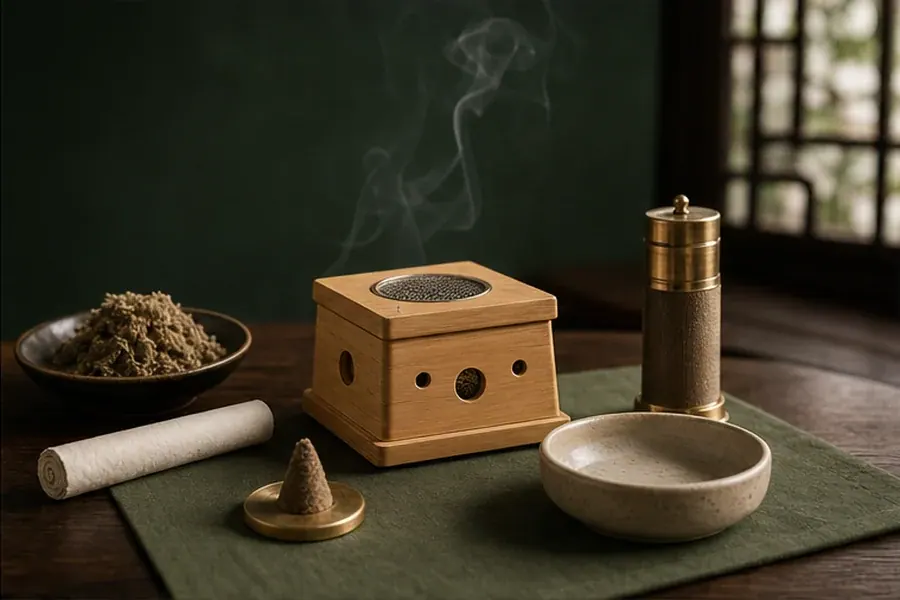
Moxibustion is a traditional Chinese medicine technique that applies heat to acupuncture points by burning moxa, a material made from dried mugwort leaves. Traditionally it is used to warm and tonify; the scientific evidence on its effectiveness is scarce and of limited quality.
Key points
- Moxibustion applies the heat of dried mugwort (moxa) to acupuncture points or areas of the body.
- In the tradition it is considered indicated for cold and deficiency patterns, and it is often used together with acupuncture.
- There are direct and indirect forms; today indirect forms predominate, such as moxa sticks or the warm needle.
- Its most studied use is breech presentation in pregnancy, with limited and inconclusive results.
- The main risk is burns, as well as irritation from the smoke.
Moxibustion is the lesser-known sister of acupuncture, although in Chinese the two share a name: zhenjiu (针灸, zhēn jiǔ) joins the needle (zhen) and moxibustion (jiu). The technique consists of applying heat to points on the body by burning moxa, a material made from dried mugwort leaves. Its more specific Chinese name is aijiu (艾灸, ài jiǔ), "cauterization with mugwort". On this page we tell you how it is applied, what it is traditionally used for, what precautions it requires and what is known about its effectiveness.
What is moxibustion and how is it understood in the tradition?
From the traditional point of view, the heat of moxa penetrates the meridians, warms and "moves" Qi (气, qì) and Blood, and expels cold and dampness. That is why it is reserved mainly for patterns considered to be of cold or deficiency, that is, a predominance of yin or weakness of yang, according to the theory of yin and yang. On the other hand, it is usually advised against in patterns of heat or excess.
The plant used is mugwort, mainly Artemisia argyi, known in Chinese as aiye (艾叶, ài yè). It is left to dry, crushed and sifted to obtain fine fibers: the more refined it is, the more evenly it burns.
Types of moxibustion
There are many ways to apply moxa. The main ones are summarized in this table:
| Type | How it is applied | Notes |
|---|---|---|
| Direct scarring | Moxa cone burned on the skin until a blister forms | Historical; today discouraged in Western practice |
| Direct non-scarring | Small cone removed when intense heat is felt | Requires a lot of experience |
| Indirect with a stick | Lit moxa stick held a few centimeters from the skin | The most common form |
| Indirect with an interposed layer | Cone on a slice of ginger or garlic, or on salt | More diffuse heat |
| Warm needle | Moxa placed on the handle of an acupuncture needle | Combines both techniques |
| Moxa box | Container holding lit moxa over a large area | Common on the abdomen and back |
There are also smokeless alternatives, such as carbonized moxa or electric heat devices, although it is not clear that they are equivalent.
What is a session like?
Moxibustion is usually integrated into an acupuncture session. The practitioner chooses the points, brings the lit stick close or places the cones, and constantly watches the skin's reaction. The sensation sought is a pleasant, deep warmth, never pain. The area usually stays red for a while. Each application lasts from a few minutes to about a quarter of an hour, depending on the technique and the area.
Most common traditional uses
The tradition uses moxibustion in situations such as:
- Joint or muscle pain that worsens with cold.
- Digestive discomfort associated in Chinese theory with "cold" in the stomach or the Spleen.
- Tiredness and weakness interpreted as yang deficiency.
- Breech presentation in the third trimester of pregnancy, by stimulating the point Zhiyin (至阴, zhìyīn, BL67).
It is worth stressing that these indications follow traditional logic and are not equivalent to proven effectiveness.
What does the scientific evidence say?
Moxibustion has been studied much less than acupuncture, and the available research has important problems: small trials, difficulty designing a credible placebo (the patient feels the heat) and large differences in the way it is applied.
- Breech presentation. This is the best-researched indication. Systematic reviews, including those of the Cochrane Collaboration, find limited and heterogeneous results: some studies suggest a possible benefit, but the quality of the evidence does not allow it to be considered effective. It does not replace the usual obstetric options.
- Other uses (pain, digestive disorders, fatigue): the evidence is scarce and of low quality, and does not allow firm conclusions to be drawn.
Overall, moxibustion should be considered a traditional technique without proven effectiveness for most of its applications. For an overview of the state of research, see scientific evidence.
Safety and precautions
The most obvious risk of moxibustion is burns, which can range from redness to blisters and scars, especially with direct techniques or if the moxa is brought too close. Other possible problems are:
- Irritation from the smoke: cough, itchy eyes or worsening in people with asthma or respiratory diseases. A well-ventilated place is recommended.
- Allergic reactions to mugwort in sensitive people.
- Fire risk if the moxa is not put out properly.
Important precautions:
- Avoid it in areas with reduced sensation (diabetic neuropathy, nerve injuries) because the person may not notice they are being burned.
- Do not apply it over wounds, inflamed skin, varicose veins or the face.
- During pregnancy, only use it on the advice of and with monitoring by professionals, keeping your midwife or obstetrician informed.
- Take extra care with children and older people.
You will find general recommendations in our safety guide.
Frequently asked questions
What is moxa?
Moxa is a spongy material obtained from the dried, crushed leaves of mugwort, in particular the species Artemisia argyi. It comes loose, in cones or pressed into the shape of a cigar. As it burns slowly it gives off a gentle, penetrating heat and a characteristic smell, and it is the material used to perform moxibustion.
Can moxibustion be done at home?
Some practitioners teach their patients to apply a moxa stick at a distance over specific points. If it is done, it should be after receiving clear instructions, keeping a safe distance from the skin, in a ventilated place and putting the moxa out properly afterwards. It is not recommended for people with reduced skin sensation, such as diabetics with neuropathy, or for children without supervision.
Does moxibustion help turn a breech baby?
This is its most researched application: the Zhiyin point, on the little toe, is stimulated with moxa. Systematic reviews find limited results and heterogeneous studies, so it cannot be considered a method of proven effectiveness. If you wish to try it, you should discuss it with your midwife or obstetrician, and it must never replace monitoring or the medical options available.
Health notice. This content is educational and describes concepts of Traditional Chinese Medicine together with the available scientific evidence. It does not replace diagnosis or treatment by a healthcare professional. If symptoms are persistent or severe, consult your doctor. Safety guide.