Tuina: the therapeutic massage of Chinese medicine
Tuina is the therapeutic massage of traditional Chinese medicine: it combines pressing, kneading, rubbing and mobilizations on meridians and acupuncture points. It is one of the classical branches of TCM; the evidence suggests it may relieve some musculoskeletal pain in the short term, although the quality of the studies is limited.
Key points
- Tuina literally means pushing and grasping, two of its basic maneuvers.
- It is one of the classical branches of Chinese medicine, along with acupuncture and herbal medicine.
- It works on muscles, joints, meridians and points, and can be more intense than a relaxation massage.
- It is used mainly for back and neck pain and muscle knots; there is a pediatric version.
- The evidence is limited: possible short-term benefits for pain, with low-quality studies.
- It should be avoided or adapted in osteoporosis, fractures, thrombosis or skin problems.
Tuina (推拿, tuī ná) is the therapeutic massage of traditional Chinese medicine. Its name joins two verbs: tui, to push, and na, to grasp or squeeze, which sum up its active, hands-on character well. In China it is taught at traditional medicine universities as a specialty in its own right, on the same level as acupuncture or herbal medicine. On this page we explain what it is based on, what its techniques are, what to expect from a session and what we know about its usefulness and risks.
What is tuina and what is it based on?
Tuina shares its foundations with the rest of Chinese medicine. According to tradition, the maneuvers act on the meridians and acupuncture points to promote the circulation of Qi (气, qì) and Blood, break up stagnation and restore the balance between yin and yang. That is why the practitioner does not just massage the painful area: they may also work on distant points located on the same meridian.
From a Western point of view, tuina resembles other forms of therapeutic massage and manual therapy: it acts on muscles, fascia and joints, can reduce muscle tension and provides a feeling of relief and relaxation.
Main tuina techniques
The classical manuals describe dozens of maneuvers. Some of the most common are:
| Technique | Chinese name | What it involves |
|---|---|---|
| Pushing | 推 (tuī) | Sliding the thumb, palm or elbow with pressure in one direction |
| Grasping | 拿 (ná) | Pinching and lifting the muscle between the thumb and the other fingers |
| Pressing | 按 (àn) | Sustained pressure on a point or area |
| Kneading | 揉 (róu) | Circular movements that move the tissues |
| Rolling | 滚 (gǔn) | Rhythmic rolling of the back of the hand over the muscle |
| Rubbing | 擦 (cā) | Rapid friction that generates heat |
| Mobilizing | 摇 (yáo) | Passive movements of the joints |
Pediatric tuina
There is a version adapted to babies and children, pediatric tuina (小儿推拿, xiǎo'ér tuīná), which uses very gentle maneuvers and specific points, mainly on the hands. Traditionally it is applied to digestive discomfort, colic or sleep problems, always as a complement and never instead of pediatric care.
What is a tuina session like?
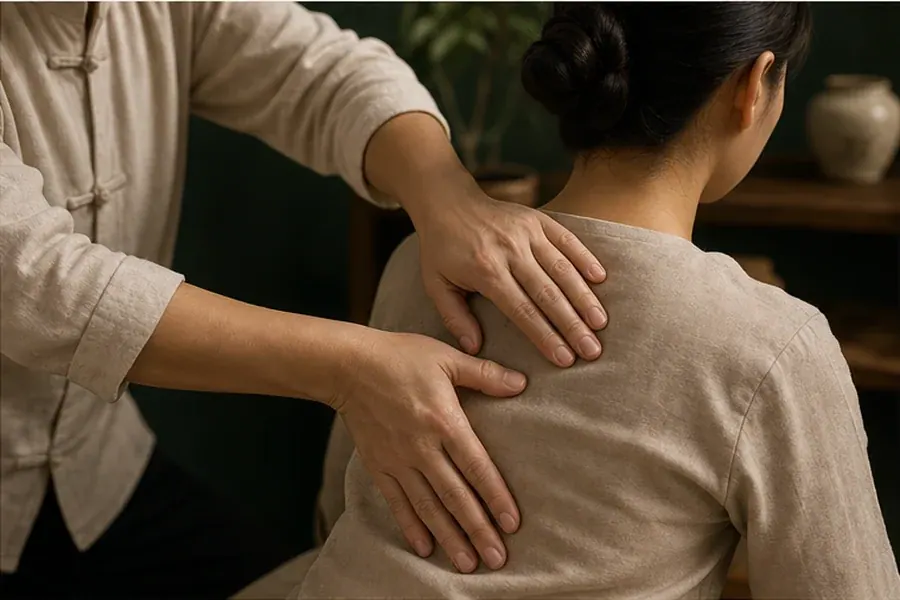
A session usually begins with a short interview and an assessment based on the four diagnostic methods of Chinese medicine. Then, with the person lying down or sitting, and often dressed in comfortable clothing or covered with a cloth, the practitioner applies the maneuvers for about 30 to 60 minutes. It is sometimes combined with cupping, gua sha, moxibustion or herbal liniments.
The intensity can be greater than in a relaxation massage. It is normal to feel some discomfort in tense areas, but not severe pain.
What is it used for?
In practice, tuina is used mainly for:
- Back pain, low back pain and neck pain.
- Muscle knots and stiffness.
- Painful shoulder and joint discomfort.
- Tension headaches.
- Stress and general tension.
The tradition also applies it to digestive problems, insomnia or gynecological disorders, but there is not enough evidence for these uses.
What does the scientific evidence say?
Research on tuina is relatively scarce and comes largely from studies carried out in China, often small and with methodological limitations. In addition, it is very difficult to compare tuina with a placebo, because the patient clearly perceives whether or not they are receiving the massage.
With this in mind:
- Musculoskeletal pain. Some systematic reviews suggest that tuina may relieve low back or neck pain in the short term, similarly to other manual therapies. The quality of the evidence is low to moderate, and it is not clear how long the effects last.
- Other indications. For uses such as insomnia, constipation or childhood problems, the evidence is insufficient to draw conclusions.
In summary, tuina can be considered a reasonable manual therapy option for mild muscular discomfort, but there is no solid evidence that it cures diseases. You will find an overview in scientific evidence.
Safety and precautions
In the hands of a trained professional, tuina is generally a safe technique. The most common adverse effects are discomfort or temporary pain after the session and, occasionally, small bruises. Serious problems are rare, but injuries have been described when vigorous maneuvers or spinal manipulations, especially of the neck, are applied to unsuitable people.
It is best to avoid tuina, or to adapt it and consult your doctor beforehand, in these cases:
- Advanced osteoporosis, recent fractures or bone metastases.
- Venous thrombosis or suspected thrombosis.
- Wounds, burns, infections or skin diseases in the area.
- Taking anticoagulants or having clotting disorders.
- Pregnancy, especially on the abdomen and lower back.
- Pain accompanied by warning symptoms: fever, weight loss, loss of strength, spreading tingling or problems urinating.
New, intense pain or pain that does not improve needs a medical assessment. More advice on our safety page.
Frequently asked questions
How is tuina different from a regular massage?
Tuina is based on the theory of Chinese medicine: the practitioner chooses areas, meridians and points according to a traditional diagnosis, not just according to where it hurts. It uses specific techniques, often more vigorous and localized than a relaxation massage, and includes joint mobilizations. It is usually applied with the person wearing comfortable clothing, although it can also be done directly on the skin with oil.
Does tuina hurt?
It can be intense, especially over tight areas, and it is normal to feel some discomfort. However, it should not cause severe pain or leave bruises. It is a good idea to tell the practitioner what intensity you can tolerate. After the session there may be a slight soreness that goes away in one or two days; if the pain increases or persists, you should seek advice.
Can tuina be used on babies and children?
There is a version called pediatric tuina, with very gentle maneuvers applied mainly to the hands, forearms, abdomen and back. It should only be practiced by a professional with specific training. It must never replace an assessment by a pediatrician, and in the presence of signs such as high fever, listlessness, difficulty breathing or dehydration, the priority is to seek medical care.
Health notice. This content is educational and describes concepts of Traditional Chinese Medicine together with the available scientific evidence. It does not replace diagnosis or treatment by a healthcare professional. If symptoms are persistent or severe, consult your doctor. Safety guide.