Cupping: what it is, how it's applied and what risks it has
Cupping therapy consists of placing cups on the skin and creating a vacuum that draws up the tissues. In traditional Chinese medicine it is used to move Qi and Blood and relieve pain; the scientific evidence is limited and of low quality, although some studies suggest some relief of musculoskeletal pain.
Key points
- Cups create a vacuum on the skin using heat, manual pumping or silicone.
- The circular marks they leave are small leakages of blood under the skin and usually disappear within days.
- In the tradition they are used for muscle pain, muscle knots and colds in their early stage.
- The evidence on their effectiveness is scarce and of low quality; it has not been shown that they remove toxins.
- The main risks are burns with the fire technique, bruising and, in wet cupping, infections.
Cupping is an ancient technique found in many cultures, from Chinese medicine to Arab and European traditions. In China it is known as baguan (拔罐, bá guàn), something like "pulling with the cup", and it consists of placing cups on the skin and creating a vacuum that draws up the tissues. It became popular worldwide when several elite athletes appeared with its characteristic circular marks on their backs. On this page we explain how it works, what the tradition says, what risks it has and what we know about its effectiveness.
What is cupping and how is it explained in Chinese medicine?
From the traditional perspective, the suction of the cup "opens" the surface of the body, moves stagnant Qi (气, qì) and Blood (血, xuè) and helps to expel pathogenic factors such as wind, cold or dampness, which Chinese medicine considers external causes of disease. That is why cups are applied mainly to the back, along the meridians, and to large muscular areas.
From the standpoint of Western physiology, what is observed is a local increase in blood flow, stimulation of skin receptors and the breaking of small capillaries, which produces the marks. The fact that the technique has visible physical effects does not in itself demonstrate a therapeutic effect.
Types of cupping
| Type | How the vacuum is created | Comment |
|---|---|---|
| Fire cupping | The inside of the glass cup is heated with a flame and quickly placed on the skin | Traditional technique; risk of burns |
| Pump cupping | A mechanism or hand pump extracts the air | Allows the intensity to be regulated |
| Silicone cupping | The flexible cup is squeezed before being placed | Widely used in massage |
| Sliding cupping | Oil is applied and the cup is moved across the skin | Combines suction and massage |
| Wet cupping | The skin is punctured before applying suction | Higher risk; requires sterile equipment |
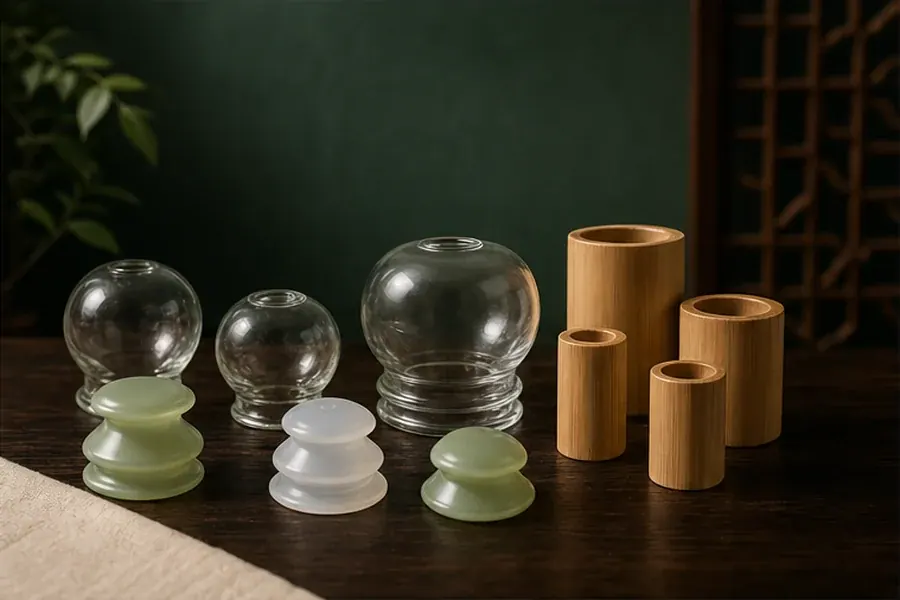
In the past, bamboo or ceramic cups were used; today glass, plastic and silicone predominate.
What is a cupping session like?
The practitioner chooses the area, usually the back, shoulders or thighs, and places one or more cups. They can be left in place for roughly five to fifteen minutes or moved with oil. The sensation is one of tightness and warmth; it should not be intensely painful. When they are removed, the skin is left marked with reddish or purplish circles.
Cupping is often combined with other manual techniques such as tuina, gua sha or acupuncture.
Traditional uses
The tradition turns to cupping mainly for:
- Pain and muscle knots in the back, neck and shoulders.
- Muscle stiffness associated, in Chinese theory, with cold or dampness.
- Early stages of colds, interpreted as an invasion of wind-cold.
- Cough and mild respiratory discomfort, with cups applied to the upper back.
These indications belong to the traditional framework; they should not be confused with proven effectiveness.
What does the scientific evidence say?
Research on cupping has grown in recent years, but it still has important limitations: most studies are small, short-term and at high risk of bias. In addition, it is almost impossible to "blind" the patient, because the suction can be felt and the marks can be seen.
With these caveats:
- Musculoskeletal pain. Some systematic reviews suggest that cupping might relieve neck or low back pain in the short term compared with no treatment, but the quality of the evidence is low and it is not clear that it outperforms other treatments or a well-designed placebo.
- Other indications (cough, acne, shingles, high blood pressure, "detoxification"): the evidence is very scarce or nonexistent.
Overall, cupping can be seen as a technique that some people find pleasant and relaxing for muscle discomfort, but there is no solid evidence that it cures diseases. You will find more context on our scientific evidence page.
Safety and precautions
When applied carefully, dry cupping is usually well tolerated. The most frequent adverse effects are the marks, small bruises, local discomfort and, sometimes, dizziness. The more serious risks include:
- Burns with the fire technique, from the alcohol or the flame.
- Blisters if the cups are left on too long or with too much suction.
- Infections and risk of transmission of bloodborne diseases in wet cupping if sterile, disposable equipment is not used.
Avoid cupping or consult your doctor first if:
- You take anticoagulants or have a clotting disorder.
- You have damaged skin, sunburn, wounds, eczema or varicose veins in the area.
- You are pregnant (especially on the abdomen and lower back).
- You have a serious illness, anemia, high fever or fragile skin, as occurs in many older people.
And remember: persistent or unexplained pain requires a medical assessment. More information in safety.
Frequently asked questions
Why does cupping leave marks?
The suction breaks small capillaries under the skin and blood leaks into the tissues, just as in a bruise. That is why red or purple circles appear, which normally last from a few days to one or two weeks. The tradition interprets their color as a reflection of the state of Qi and Blood, but there is no evidence that the marks indicate toxins or disease.
Does cupping remove toxins?
There is no scientific evidence that cupping removes toxins from the body. This is a common marketing claim, but detoxification of the body is carried out mainly by the liver and kidneys. The marks left by cupping are blood that has leaked under the skin, not extracted toxic substances, so it is wise to be wary of such promises.
What is the difference between dry and wet cupping?
In dry cupping, suction is applied only to intact skin. In wet cupping, small incisions or punctures are made first so that some blood comes out into the cup. Wet cupping carries more risks, such as infections or transmission of bloodborne diseases if sterile equipment is not used, and it should only be performed by trained staff under proper hygienic conditions.
Health notice. This content is educational and describes concepts of Traditional Chinese Medicine together with the available scientific evidence. It does not replace diagnosis or treatment by a healthcare professional. If symptoms are persistent or severe, consult your doctor. Safety guide.